Dukh-i-zhizniki in America
An update of Molokans in America
(Berokoff, 1969). —
IN-PROGRESS — Do not cite text without references.
Enhanced and edited by Andrei Conovaloff,
since 2013. Last update: 17
December 2024. Send comments to <
Administrator @ Molokane. org >
Original:
Molokans in America © 1969 by John K.
Berokoff, 3478
East 5th Street, Los Angeles, California 90063, USA
Privately Printed by Stockton-Doty
Trade Press, Inc. Whittier, Calif., 208 pages.
Contents Updated 14 August 2022
| Chapter
|
Title |
Page number |
Original page count by chapter |
Updated |
|
| Review
of Original Book |
Added |
0 |
17 Dec 2024 |
||
| Foreword |
7 |
|| 2 |
1% |
14 Aug 2018 | |
| Introduction: The Flight to the
Refuge |
9 |
| 1 |
0% |
27 Aug 2021 | |
| Why Did They Wait So Long in Russia? Why Did Most Stay Home? |
Added |
0 |
7 Dec 2024 | ||
| 1 |
The Migration | 11 |
|||||||||| |||||||||| | 21 |
10% | |
| 2 |
The First Years | 32 |
|||||||||| ||||||||| 19 |
9% | 31 Oct 2020 |
| 3 |
Attempts at Farming | 51 |
|||||||||| || 12 |
6% | |
| 4 |
The First World War | 63 |
|||||||||| |||| 14 |
7% | |
| 5 |
Post War Problems | 77 |
|||||||||| |||||||||| |||||
25 |
12% | 28 Feb 2021 |
| 6 |
Appearance of New Leaders | 103 |
|||||| 5 | 2% | 16 Sep 2019 |
| 7 |
The Second World War | 109 |
|||||||||| |||||||| 18 | 9% | 31 Oct 2020 |
| 8 |
Aid to Brethren in Iran | 138 |
|||||||||| 10 | 5% | 1 Jul 2016 |
| 9 |
Conclusion | 148 |
||||||||| 10 |
5% | |
| Addenda — Petitions and Letters | 157 |
|||||||||| ||||||||||
|||||||||| |||||||||| |||||||||| | 51 |
25% | 10 Jul 2017 |
|
| Photos | Added |
0 |
|||
| Maps | Cover |
|| 2 cover end papers | 1% |
Review of Original
Book
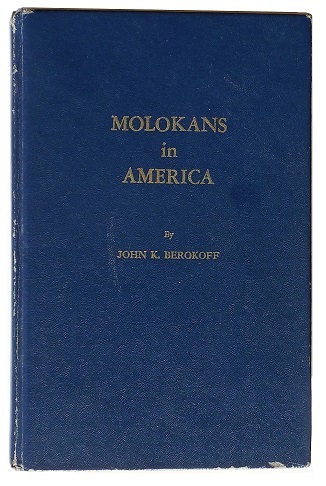 Molokans in America, a book NOT
about Molokans, was the first history book in English by a
Dukh-i-zhiznik
for American Dukh-i-zhizniki.
Published in 1969, it was the last of several books by the late
author and translator John Kereich Berokoff (1898-1972), and his
only book with photos and tables showing unpaid bills by
congregations. After publication, no congregation was
willing to pay their debts.
Molokans in America, a book NOT
about Molokans, was the first history book in English by a
Dukh-i-zhiznik
for American Dukh-i-zhizniki.
Published in 1969, it was the last of several books by the late
author and translator John Kereich Berokoff (1898-1972), and his
only book with photos and tables showing unpaid bills by
congregations. After publication, no congregation was
willing to pay their debts.The book is biased with many errors and omissions which have never been addressed on the scale presented here. This often cited original book can be found in several libraries and online. It's not about Molokans!
My main reasons for extensively correcting the book are:
- The title and labels are very misleading (Did I say it's not about Molokans?),
- Much unbiased history is
needed with citations,
- Lack of visual aids,
context and index, and
- Missing Addenda.
This Review is a preface to a work in-progress that should be periodically checked for updates, time stamped above. Because so much of this history is forgotten, unclear, confused, and polluted with myth and rumor, the certainty of information here will be rated as fact, a correlation, or inference; and what data may be missing. I try to distinguish clearly between comment, conjecture and fact.
In Black Font the reader will find the original text, and in Red Font changes and comments, with hyperlinks to more information on the Internet. Some links may have broken since posting, and are constantly being updated. The current Russian alphabet is used, updating pre-1918 Russian texts. Square brackets '[-]" are used for original footnotes, and added data. Simple HTML code is used for quick download and multi-platform accessibility on desktop and handheld mobile computers and phones.
About the Author
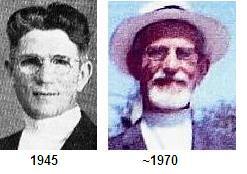 JOHN K. BEROKOFF (1898-1972) was
born 16 February 1898 in the village of Voskresenovka, Erivan
Governorate (also: Yerevan guberniya),
Russia (now Lermontova,
Republic of Armenia). He was the last of 12 children of Kiray
Timofeyitch and Maria (Bolstin) Berokoff.
JOHN K. BEROKOFF (1898-1972) was
born 16 February 1898 in the village of Voskresenovka, Erivan
Governorate (also: Yerevan guberniya),
Russia (now Lermontova,
Republic of Armenia). He was the last of 12 children of Kiray
Timofeyitch and Maria (Bolstin) Berokoff. Their village neighbored Nikitino village (now Fioletovo, Republic of Armenia), the home village of M. G. Rudomyotkin, founder of the Spiritual Christian Maksimist faith, and E. G. Klubnikin (1842-1915) (Klubnikinist faith founder) who had a legendary boyhood vision about a land of refuge, also an apocalyptic theme among some staroobriadsty and some Mennonites.
Family oral history, told to me about 1970 by Joel John Berukoff, reported 3 immigrant Biryukov (Бирюков) brothers landing together at Ellis Island, New York. When they saw long lines (queues) of people waiting, they decided to split into 3 lines, thinking they will save time by finishing together. After processing they compared immigration documents. Each was given a different name in English — Berekoff, Berokoff, Berukoff. There was no standardized transliteration of languages at that time. I cannot verify Joel's story, because a search of the Ellis Island passenger database finds no similar last names spellings.
- https://www.ancestry.com/search/categories/40/?name=_berokoff
- https://www.ancestry.com/search/categories/40/?name=_berukoff
- https://www.ancestry.com/search/categories/40/?name=_berekoff
Less than a block from his house, Spiritual Christians from Russia were attending the packed "Russian Spiritual Christian Church" at 318 Lafayette Street, led by a Russian-speaking Presbyterian minister, Rev. Henry Teichrieb. The building, named the "Stimpson-Lafayette Industrial School," was built and donated by Mrs. Stimpson, then was managed by the Dr. Rev. Dana W. Bartlett, Bethlehem institutions.
Many Jews from Russia and Japanese lived in his "Bethlehem" neighborhood. A block south from his house across First street, was the first east side Hebrew school and synagogue, Congregation Talmud Torah at 114 Rose St (1904-1910), which gradually moved to 247 Breed Street, and by 1923 built the largest Orthodox congregation west of Chicago, which Dr. Young may have attended.
Like his peers, J. K. Berokoff began full-time work about age 16, avoiding junior high school. His first job was in a reed furniture factory, probably downtown with other immigrants, who were taught reed weaving, rattan, furniture building and other sloyd trades in free vocational classes. His next job was collecting rubbish, which was a preferable profession among his peers because little education was needed and they had flexible hours allowing them to attend most all religious meetings (sobranie, holidays, funerals, etc.). ("John K. Berokoff (1971): 'The simpler our faith, the better it tastes,' "a 75 minute 2-part interview on CD with text introduction by James J. Samarin, 2001. Photo on CD courtesy Andrew J. Berokoff.)
When they moved east across the Los Angeles River into the "Flat(s)" (address not known here), his family attended Romanovskoe sobranie (also called: Klubnikin, Podval, and Shubin sobranie), 114 S. Clarence street, between the Subbotnik meeting hall and the north and on the south next to the Klubnikin bakery and store, all just south of First street in "The Flat(s)." His congregation was named after Romanovo village, Kars Oblast, and split into 3 faith tribes by the 1960s. The evolved original (postoyannie) congregation is now at 15052 Clark avenue, Hacienda Heights, with a branch in Oregon. Starii Romanovskii (Old Romanovsky) became "Blue Top", 322 Clela street. His family followed the Novie Romanovskoe (New Romanov) branch to 3553 Beswick street, nicknamed Freeway sobranie because it bordered a freeway (I-5); and in 2010 the meeting hall relocated 10 miles southeast to South Whittier. At least 3 congregations split from "Freeway" — one to South Australia before his death; and after his death, one each to Oregon and Porterville, CA. Berokoff's heritage Romanovka congregation divided the most (5+ times) of any of the American Dukh-i-zhizniki faiths, which today all falsely claim to be the "true Molokan" faith tribes.
In his youth he also attended the Young Peoples Meeting (molodoe sobraniya) which zealously embraced the Dukh-i-zhiznik ritual books, charismatic jumping, prophesy, and opposed both the United Molokan Christian Association (U.M.C.A., since 1926) and the Young Russian Christian Association (Y.R.C.A., since 1941, 2 years after it was founded in 1939). Progressively since their founding, these 3 different organizations have been dividing their founding members and descendants into about 3 distinct social movements which are addressed in the Taxonomy of Dukh-i-zhizniki.
About 1920, age 22, he married Hazel Moses Shubin (1900-1958) and they moved to 335 South State St, east out of the "Flats", but not into the Kara-kala district. His new home was about half a block from Second Street Elementary School, half a block from the 4th street streetcar line, a fourth mile (2 blocks) from the beautiful Hollenbeck Park, and a little more than a half-mile walk to his podval sobranie.downhill on First Street into the Flats.
Berokoff lived close to the core population of Dukh-i-zhizniki and other Spiritual Christian groups on the East-side of Los Angles his entire life, where he had good exposure to most events and issues of his generation. He was critical of the U.M. C. A. During WW2 he attempted to coordinate among conflicting Dukh-i-zhiznik congregations and clans during his controversial volunteer service with social scientist, the Drs. Young, and as a Civilian Public Service (C.P.S.) liaisong WWII. He was more self-educated compared to his peers, probably more fluent in Russian and English, and probably typed. I visited his house once in 1967, and recall a typewriter on this dining table.
His exposure to social science research and historical documentation began in the mid-1920s when he, and probably others, assisted University of Southern California graduate student Pauline Young with her master's (1926) and doctoral theses (1928) resulting in her book The Pilgrims of Russian-town (1932). Dr. Young wrote in her book Acknowledgements (page x): "Mr. John K. Berokoff has read the volume, made many corrections, and offered valued criticism. He has kept in touch with the study for several years." Young's publications about Pryguny and Dukh-i-zhizniki in America stood alone for 37 years until Berokoff's history book in 1969. This exposure undoubtedly launched his volunteer position as an amateur historian and an unofficial spokesman for his misunderstood tribal faith(s).
He began to translate Dukh-i-zhiznik ritual books probably for his own use, and to share with youth not Russian-literate and confused about their heritage, which they only learned from limited biased, and often conflicting, oral tales. It was said that he was concerned about his younger relatives and peers questioning their faith and history, about which he writes in Chapter 7, page 129: "... they were not sufficiently indoctrinated." In 1941 he published his first legacy book, the previously translated 1915 Arizona Maksimist prayer book (molitvennik), with a preface explaining that since we are not returning to Russia this book is needed in English to educate the youth. During Wold War II (WWII), translations were needed to show the government that he represented faiths opposed to war, though 90% of their draft-able members enlisted.
Like many of his relatives and peers, whose parents and ancestors were wagon drivers (drozhky, дрожки) in Russia, not irrigation farmers, he developed his own urban recycling business later in life, buying and re-selling kegs of nails. He had 5 children: Bill, Paul, Peter, Andy and Manya. His literacy probably motivated 2 of his sons to graduate college and pursue a teaching profession, unlike their most zealous peers whose families feared that higher education will turn believers into worldly "heathens" and "rob the Spirit." In the 1950s, he raised his family at 335 South State St, the west edge of Boyle Heights, within easy walking distance of The Flat(s), stores, schools, parks, a library, youth programs, and electric streetcars. In the 1960s, he moved to 3478 East 5th St, the east edge of Boyle Heights. He died May 1972 at age 74, 3 years after publishing this book.
During WWII, he volunteered to mediate with the government and a council organized by 3 peace churches regarding alternative military service, and was appointed secretary of the Los Angeles Dukh-i-zhiznik conscientious objector Advisory Committee. Though the committee members rotated, he steadfastly (postoyannie) conducted nearly all its written business. His Committee report is all of Chapter 7 (18 pages). 20% of his book focused on WWII (18 pages of Chapter 7 + 16 pages in Addenda = 42 of 208 total book pages). (Note 7 Addenda are missing.)
Berokoff's 1966 privately printed history book was first web-published in 1998 by me, after correcting the original for spelling and grammar errors, and enhancing with some clarifications, links, definitions and maps. Someone converted my scanned HTML text to PDF which was posted online by Daniel H. Shubin with no error corrections.
In the past decade, I found fascinating forgotten and censored history by exploring hints and clues provided by Berokoff, like the failures of Cherbak, bride selling, colonizations, and unpaid $17,024 CPS debt. By scrutinizing and fact-checking his text and conducting more thorough research, mostly in newspapers, much new material has been found, some of which has been added here to substantially clarify and improve the original book, and using an accurate title. This project is being updated as time permits, and should evolve into several print and e-books. You can read this draft as it progresses.
Though Klubnikin was the founding presbyter and prophet of Berokoff's Romanovka* congregation and Klubnikinist faith tribe in America, Berokoff concludes in his book, with regret and little explanation, that he did not personally fulfill the refuge prophesy of Klubnikin, to flee from Russia to live in an isolated rural community with co-religionists.
* Why was no congregation in America named Nikitino? The martyred spiritual leader, Maksim G. Rudomyotkin, was so important that his writings are 66% of the pages in Kniga solnste, dukh i zhizn'. compared to 11% for Klubnikin. All Dukhizhizniki use Rudomyotkin's prayerbook. Maybe because so few migrated from Nikitino, and no lead elder (starits) or presbyter came who would have transplanted a Nikitino congregation. This suggests that most of the steadfast (postoyannie) Maksimisty stayed in Russia, where they remain critical of those who left their holy land near Mt. Ararat, anticipating the return of Maksim Gavorilovitch with Jesus Christ.
1. The title and labels are misleading
My main criticism of Berokoff's history is the misnomer title and mislabeling of Spiritual Christian faiths from Russia. Though the book claims to be about "Molokans," Berokoff presents almost no information about the Molokan faith until the last Addenda letter (page 207 of 208 total book pages), or about Molokan congregations in San Francisco and north of Sacramento, California. Only upon repeated questioning (page 203) by professor Piepkorn (an American- Russian scholar), does Berokoff admit that he does not know Molokan elders or rituals. The book title: "Molokans in America" is false, by the author's confession.
In the Addenda letters Berokoff documents the change of religious labels from WWI, through WWII and again in the 1960s. Only once in Addenda XXVII #7 does he confess "The title of our church body in Russian is: Dukhovnaye Christiani Pryguny" (page 203, 5th page from the last). After 1928 his Klubnikinist faith became a dukhovnye khristiane Dukh-i-zhiznik faith, which openly opposes the Molokan, Prygun and Subbotnik faiths, and the Armenian Dukh-i-zhiznik faith.
The major error was that the original book was NOT about Molokane, but somewhat about Dukhovnie khristiane pryguny (Духовные христиане пригуны : Spiritual Christian Jumpers) and historically related faiths (Maksimisty, skakuny, Sionisty, novie Israeli, Klubnikinisty. etc.), whose descendants established the Dukh-i-zhiznik family of faiths on the American west coast, mostly clustered in eastern Los Angeles County, and are properly collectively called Dukh-i-zhiz'-ni-ki (Дух-и-жиз'-ни-ки) after 1928.
Beginning in 1902 the first Spiritual Christians to immigrate from Russia to Los Angeles called themselves the "Brotherhood of Spiritual Christians," which by WWI became the "Brotherhood of Spiritual Christian Jumpers," until their Kniga solntse, dukh i zhizn' was published. They are mixed descendants of Russians, Ukrainians, Armenians, Mordovians, Chuvash, Germans and other nationalities and ethnic groups who emigrated from the Russian Empire.
Again, Berokoff wrote a book about Dukh-i-zhizniki not Molokane, and people from Russia not Russians, which confused all the descendants of these immigrants and continues to confuse nearly everyone, including scholars and journalists, who widely propagated the false label by citing his book (1969) and Young (1932), and cite the citations.
In 1971 he incorrectly lectured to youth: "There is no significant difference between Pryguny and Postoyannie (an insulting label for Molokane) except the manifestation of the Holy Spirit;" while focusing on Rudomyotkin and the Dukh i zhizn' to define his faith. (Samarin CD.) He died the following year, in May 1972, buried at the "Old Cemetery."
Throughout his book, Berokoff consistently perpetuated the confusing misnomer that members of his faith are "Molokans" 451 times, an average of more than twice per page (451/208 = 2.2), while sparsely and inconsistently contradicting that they are "Spiritual Christian Jumpers", "jumping", or "Pryguny" 42 times. He reported the wrong faith 11 times more (451/42 = 10.7) than the correct former faiths!
Frequency Count of Selected Term Clusters in the Book
| Label
cluster* |
Total |
Graph (each
bar = 5) |
| Molokane (Molokans
435, Postoyannie 15, Constant 1 |
451 |
|||||||||| |||||||||| |||||||||| |||||||||| |||||||||| |||||||||| |||||||||| |||||||||| |||||||| |
| Pryguny
11, Jump(ers,ing) 31 |
42 | |||||||| |
| brotherhood |
84 |
|||||||||| |||||| |
| Bible |
64 |
|||||||||| ||| |
| millennium |
25 |
||||| |
| Spirit and Life |
31 |
|||||| |
| M.G. Rudomyotkin** | 25 |
||||| |
| E.F. Klubnikin |
31 |
|||||| |
| Semion Uklein*** |
1 |
** Rudomyotkin was arrested and jailed for proselytizing a non-Orthodox faith to Russian citizens, and declaring himself a Tsar ("King of Spirits").
*** Uklein was charged with spreading the "dairy-eaters" heresy (molokane)
The terms Molokan and Postoyannie appear 15 times (7 times in the body text, 8 in the appendix) before Berokoff is requested by Dr. Piepkorn to define it. After Berokoff incorrectly states it is a "branch of Molokany," he uses the word another 8 times in the last pages of his book trying to refine his erroneous definition.(Addenda XXVII, page 203 of 208 pages). He translated Postoyannie as "Constant" only once (Addenda XXX, last page), and never used Young's term : "Steady." Note that Uklein, the reported founder and organizer of Molokane, is only mentioned once (Appendix page 202), in response to probing by Dr. Peipkorn, compared to 56 times that Dukh-i-zhiznik prophets (Rudomyotkin, Klubnikin) are mentioned, which further proves this book is not about Molokane. In the table above, "Klubnikin" (count 31) is mentioned 6 more times than "Rudomyotkin" (count 25), which suggests that Berokoff is primarily a Klubnikinist.
The original label used by these immigrants — Brotherhood of Spiritual Christians (count 84) — is used about 1/6 as often as the Molokane (count 451) terms (84/491 = .17). This shows how the collective memory of this history changed over time in America.
Emphasis on Dukh i zhizn' topics (book, prophets, prophesies, etc.) is about double the Bible topics (111/64 = 1.7), indicating the relative importance of these books to the author. Though writings of 4 mystical Russian prophets are featured Berokoff's Russian religious text (Kniga solntse, dukh i zhizn'), he only mentioned 2 — Rudomyotkin and Klubnikin (above) — omitting the minor prophets David Yesseyevich and Lukian Petrovich Sokolov.
These are examples of the "illusory truth effect" in which repeated statements are rated as more valid than non-repeated statements. A more comprehensive linguistic analysis is in-progress, now shared with research partners and supporters.
2. Much more unbiased research is needed with citations
My second criticism is that Berokoff did little literature research, was biased, and what few "facts" he cites typically lack sources. His comments are too often vague and general with no quantified data or references. No census counts or estimates are shown. No institutions are discussed in detail or listed except in Chapter 7 where he targets the congregations for failure to pay their C.P.S. camp bills. Shame!
His sources are limited, primarily to Kniga solnste, dukh i zhizn', the Sionskii pesennik (songbook) and his own oral history, particularly his knowledge and records and letters of conscientious objectors during both world wars. He skims through Russian history, briefly mentioning topics to set up his story while avoiding significant events. Few people or congregations discussed are identified by name or location. He never named a Dukh-i-zhiznik elder he quoted besides E.G Klubnikin, who appears to be his major spiritual guide.
My goal is to fill in these vast voids with relevant facts and verifiable citations, a tedious task.
I find it odd that he did not mention any of 7 periodicals published by his American Dukh-i-zhiznik community before 1969, or his 3 published articles and letter to the editor:
- Molokanskoe* Obozrenie (Молоканское Обозрение : The Molokan* Review, 1941-1949), including 2 of his own articles:
- Berokoff, J.K. "In Retrospect" (Молоканское*
Обозрение : The Molokan* Review, August 1945,
pages 8, 35); and
- Berokoff, J.K. "The Movies-Good or Evil?" (Молоканское* Обозрение : The Molokan* Review, August 1947, pages 8, 13);
- The Flats Gazette (dates?)
- Сонце (Soltse : The Sun) — 4 editions, edited and published by Vasili Prokhanov, Los Angeles.
- Newsletters and mailings by the UMCA (The
Molokan*) from the 1950s through about 2018, over 60
years.
- YRCA (The Anchor)
- CO camp newsletters (The Molokan*, 1942+)
- Decentralization: Its Effect On Us, The Molokan*, January 1946. [3-Rivers CPS Camp, CA.];
- Russian Molokan* Directory (1954, 1962), Paul A. Samarin, editor/publisher.
- Berokoff, John K. "Reader
Reaction: Unhappy Molokan." Letter to the editor, King's
Business, December 1956, page 8 —
Complaints about article: "Molokans
from the Flats", October 1956, pages 40-41, and cover
photo. (See my review of this article) [Link
pending]
- Вестник духовных христиан — Молокан : The Herald of Spiritual Christian Molokans (San Francisco, Sheridan CA, 1925+). This official Molokan publication was also not mentioned in Young's The Pilgrims of Russian-town (1932, 1967, or 1998).
- Отчет духовных христиан молокан ..
150-ти летнего юбилея .. указа .. июля 1805 года и
50-летнего юбилея .. в Соед. Штаты Америки, состоявшегося
22-23 и 24-го июля 1955 года в
городе Сан-Франциско, Калифорния. – 199 с. (Report
of Spiritual Christian Molokans .. 150 year anniversary ..
of the decree of .. July 1805 and the 50th Anniversary ..
in the United States, held 22-24 July, 1955 in
San Francisco, California. 199 pages.) — On page 44, Berokoff refers to an
article in this book, but cites neither the title of the
article nor the correct book title.
- "II. Statements as to conditions at the Disciplinary Barracks, Fort Leavenworth, Kansas," Political Prisoners in Federal Military Prisons, National Civil Liberties Bureau, New York. (1918). Pages 10-14 describe "Holy Jumpers" in brutalized solitary confinement.
- Sokoloff, Lillian, A.B. The Russians
in Los Angeles, Studies in Sociology,
Sociological Monograph No. 11, Vol. III, March 1918,
No. 3. Edited by Emory Bogardus, Department of Sociology,
University of Southern California. Published by the Southern
California Sociological Society University of Southern
California at the University of Southern California Press,
Los Angeles, California. — Annotated by Andrei Conovaloff,
2021.
- Speek, P.A. Russian Sectarian Peasants in the West, A Stake in the Land, (1921). Pages 24-33.
- Conybeare, F. C.
Russian
Dissenters, Harvard University Press, (1921).
- Young, Pauline V.
- "Social Heritages of Molokane* in
Los Angeles." (1926) Unpublished Master's thesis,
University of Southern California. (An extensive analysis
and translation of early versions of the book: Kniga solnste, dukh i zhizn').
- "Molokan* Family Organization," (1927) Sociology and Social Research 12: 54-60.
- "The Russian
Molokan* Community in Los Angeles," American
Journal of Sociology, Vol. 35, No. 3 (Nov., 1929),
pp. 393-402.
- "Assimilation Problems of Russian
Molokans* in Los Angeles." (1930) Unpublished Ph.D.
dissertation, University of Southern California.
- Day, George Martin. "The
Russians in Hollywood: A Study in Culture Conflict,"
Ph.D dissertation, University of Southern California (1934).
Compares Dukh-i-zhizniki with Russian Orthodox on pages
89-74.
- Maloff, Peter N. Dukhobortsy, ikh
istoriia, zhizh' bor'ba (1948) — Refers to Molokane
in several places, and has a chapter about Tcherback
(Cherbak, Cherbakov).
- Roher, Norman. "Molokans*
from the Flats: Young Russians — American style, King's
Business, October 1956, pages 40-41.
* Should be Spiritual Christian, or Prygun(y) before 1928, and Dukh-i-zhiznik(i) after 1928.And, he omitted Russian language sources, encyclopedias, history books, etc.
He should have had a copy of The Directory of Civilian Public Service, May 1941 to March 1947, by The National Service Board for Religious Objectors, 1947, or at least mentioned it. Nicknamed "The C.O. bible," this book listed most all men on file who completed C.S.P. Alternative Service, showing address, camps, dates, religion, and occupation.
He ignored and/or omitted the Selective Service Act of 1948, and federal court cases of 8 Dukh-i-zhiznik conscientious objectors (Kalpakoff 1954, Chernekoff, Klubnikin and Volkoff 1955, Dobrenen 1956, Kariakin and Prohoroff 1958; and Samarin 1966).
Though public libraries had 100s of relevant newspaper articles and books, and more oral history was abundant from living immigrants, he only referred to one 1969 Los Angeles Times article (Chapter 1, page 17) about a meteor shower in Mexico, which appeared just before publication of his book. His passing emphasis on a meteor shower suggests its mystical-spiritual importance, which I begin to examine on the same page using astronomical data.
It may be due to his limited elementary education that he did not know how to mine the library, cite references, how to conduct interviews, was hiding his project, was influenced by proofreaders and/or assistants, or the facts were so embarrassing that he chose to censor his own book as he apparently did with The Pilgrims in Russian-town. He apparently did not ask anyone with good literary skills to help him, though several (including many college students and graduates) could have helped with research or proofreading. Notably absent is Paul I. Samarin, who collected information about Molokan history at the Los Angeles Public Library, published it in the phone Directory with references, and lectured about his findings at the U.M.C.A. Wednesday Night gatherings in the 1950s. Perhaps Berokoff was promoting his own independent history of his particular Klubnikinisk Dukh-i-zhiznik faith tribe.
He missed so much relevant history and could have correlated events. For examples:
- The Introduction
is a very short listing of a Klubnikin prophesy with no
discussion. Similar prophesies are well-documented and
analyzed in many Anabaptist
histories.
- Though Berokoff said the Doukhobor historian Peter N. Maloff was a friend (page 202), he omits or did not know about the very significant 3 Doukhobor arms burning protests in 1895, or their incarcerations and exiles witnessed by their neighbor E.G. Klubnikin in Romanovka village, who came to Los Angeles as presviter of his congregation. This is a major omission. (Research in-Progress.)
- The secret sealed final Klubnikin
prophesy is not mentioned, perhaps to keep it a secret.
- Though Lev N. Tolstoy is mentioned only once on page 92, among a
list of 3 Russian writers, there is no hint about his
crucial role in appealing to the government 4 times for
peasant relief and permission to emigrate. One cannot understand the history of
Spiritual Christians in America without knowing the
chronological facts about the 1895 burning of arms by
Doukhobors and Tolstoy's
intervention with the Society of Friends, London. This
is a major omission. (Research in-Progress.)
- Community Doukhobors and Svobodniki (Freedomites) tried to move to the U.S. from Canada several times to join with Spiritual Christians in the U.S., while the most zealous Svobodniki tried to join with Pryguny and related faiths Some succeeded.
- A communal farm colony of Independent
Doukhobors was established in 1924 at the north boundary of
Manteca
CA (100 miles northwest of Kerman, 80 miles east of San
Francisco).
- He unevenly mentioned most
colonization efforts while missing plans for major colonies
in Hawaii and Los Angeles (1905), and with all Spiritual
Christians near Santa Barbara (1902, 1910), Oregon (1923),
and Paraguay (1952).
- He omits the impacts of the closing of the Bethlehem Institutes (1913), and its partial replacement by the Y.W.C.A. International Institute (1914).
- In Chapter 4 — The First World War — Though he
summarized the June 1917 arrest of 34 Pryguny in
Arizona for not registering for the draft, he missed what
happened in November in Los Angeles. 3 Christian
ministers were arrested for holding pacifist meetings
endorsed by 100s of ministers. By December 8, 1917, they
were fined $1,200 each and sentenced to 6 months in prison
merely for speaking against war. By January 1918, the case
was a national human rights scandal reported and examined
for decades.
- Omits women's vote, 19th Amendment (1920).
- Omits the impact of many Spiritual
Christian youth who excelled in sports (Olympian Mickey
Galitzen-Riley) and crime, and college graduates, some
with higher degrees, perhaps because they did not embrace
his Klubnikinist faith, were not his close
relatives, were "worldly", etc.
- Omits the impacts of 1920s
prohibition, labor strikes, 1930s dust bowl, 1906
earthquake, 1950s black lists, and 1930s depression; but
mentions fiscal inflation
and rationing.
- No clear mentioning by name of any
president or policies except when they were petitioned. In Chapter 5, F.D.R. and the
New Deal are inferred.
- No mention of the Internment of Japanese-Americans (1942), Zoot Suit Riots (1943) or the Watts riots (1965).
- Omits impact of 5 freeways built through Boyle Heights since 1946 which displaced about 40,000 people and cutoff neighborhoods and congregations.
- Omits both the 1905 and 1955
celebrations of the 1805 order for freedom of Spiritual
Christian Molokane, though on page 44 he tried to cite the
1955 report of the 150th anniversary.
- Omits 50 people who aided,
impacted and/or reported about his Spiritual Christian Pryguny
and Dukh-i-zhizniki (Atkinson, Beglaroff, Bixbys
(3), Black, Bodyansky, Bomar, Carter, Castle, Clark,
Cushing, de Blumenthals (2), Demens, Dunns (2), Eberle,
Fairchild, Fays (2), Gold, Green, Givago, Huntington,
Kropotkin, Kryshtofovich, Kurbatoff, Leopold, Leshing, Lev,
Lochvitzky, Makee, Oxnam, Pilnyak, Redin,
Sandler, Scott, Sokoloff, Sokolov, Sorokin, Spaulding,
Stimson, Taylor, Teichrieb, Tolstaya, Ukhtomsky, Van Waters,
Wilbur), while briefly mentioning 6 (Bartlett,
Cherbak, Cudney, Maloff, Tolstoy, Young). He either did not
know about or missed 91% (50/55) of these people and
thier history with Spiritual Christians from Russia, and/or
he purposely deleted them from his oral history.
- Omission of the the Selective
Service Act of 1948 and 6 federal court cases of Dukh-i-zhiznik
conscientious objectors in the 1950s indicated a continual
need for the lapsed Dukh-i-zhiznik Selective
Service Advisory Board, Draft Advisory Board, C.O. Advisory
Board. No effort to reestablish a board at the U.M.C.A. occurred until the Vietnam
War in the 1960s.
- Doukhobor mass arrests, punishment,
and exodus (1895) and New Year's earthquake in Tiflis
(1900), with Klubnikin's inspiration to seek land of refuge
(~1900). Klubnikin lived on the main highway and probably
witnessed Kars Doukhobors marching to the Kars prison at the
citadel, and back through his village to Tiflis.
- Tolstoy's petitions and letters with
the migration of 1/3 of all Doukhobors to Canada, changes in
Russia of policy and treatment of non-Orthodox faiths, and
impact on reduced emigration of non-Doukhobor Spiritual
Christians.
- Publishing Животная
книга духобортев (Living book of the Doukhobors,
by Bonch-Bruievich) (Бонч-бруевич, 1909), with publishing by
Spiritual Christians from Russia in America of their own
oral history "living books".
- Rejection of help from Cherbak (1910),
"Russian bride-selling" court hearings (1911-1914) and
closing of Bethlehem Institutions (1913), with groups
fleeing Los Angeles to form rural colonies (Arizona, New
Mexico, Utah, Washington), as mentioned at the end of his
1945 article "In Retrospect."
- Protests of the svobodniki in
Canada (1902-1960s), and killing
of Peter
V. Verigin, the first leader of the Christian
Community of Universal Brotherhood (C.C.U.B., communal
Doukhobors in Canada) (1924),
political activity of the Ku Klux Klan in Los Angles
(1920s), the founding of the U.M.C.A. in Los Angeles (1926),
Young's masters thesis (1926), the publishing of the final
version of Kniga solnste, dukh i zhizn'
(1928) with founding of the Dukh-i-zhiznik family
of faiths.
- Long Beach earthquake (1933) and
highway construction through the Flat(s) and Karakala, with
protests about komitet and
Bol'shoe sobranie (The "Big Church" founded in 1933)
and reorganization of congregations when a new cemetery is
purchased in 1938.
- Failed petitions to return to Kars, Turkey (1939, 1945), with urban lifestyle, prosperity and assimilation (loss of Russian language, successes in sports and education)
- The New Deal, Cold War, Nuclear
Holocaust warnings, Vietnam War, Civil Rights Movement, and
Cuban Missile Crisis with the pokhod to refuge in
Australia (Chapter 9).
3. Lack of visual aids, context and index
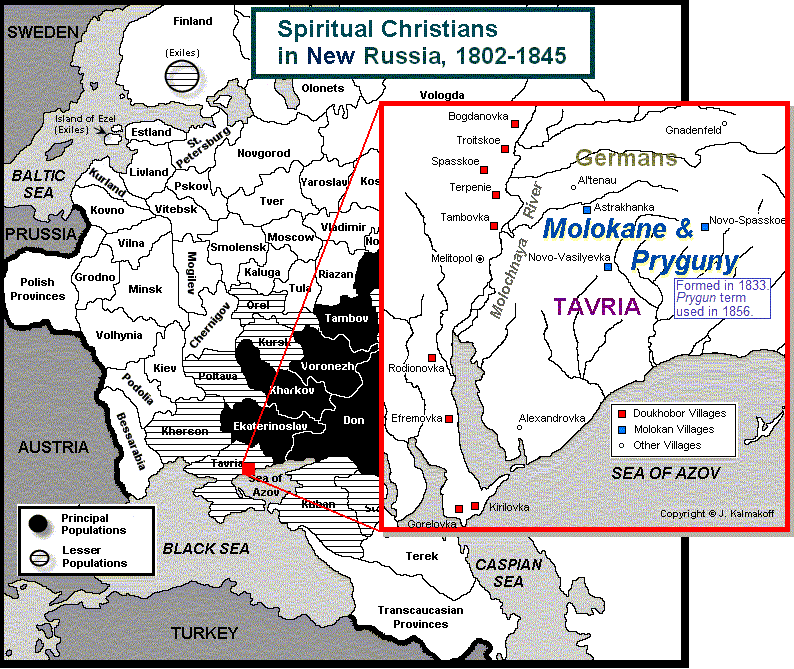
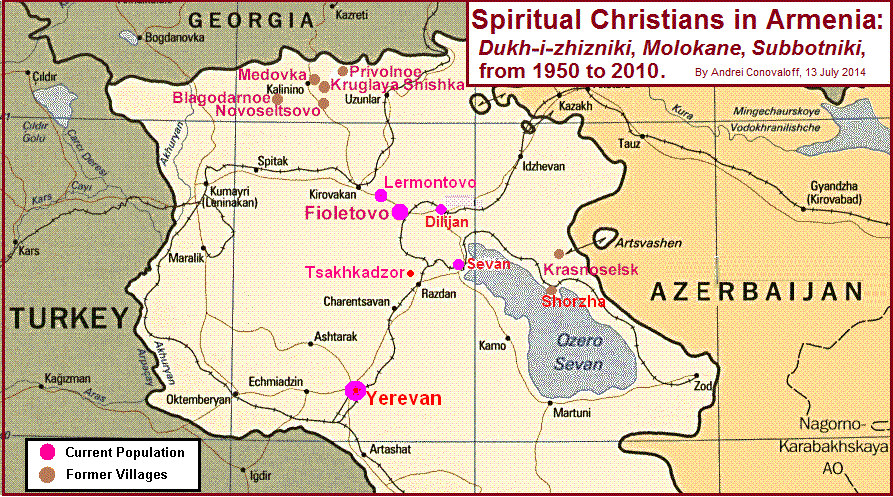
My third wish is for more historic, economic and social context; and more graphic and accurate reader aids (maps, charts, lists, section labels); and, an index. A comprehensive list of why only 1% migrated from Russia greatly expands the Introduction below. The original inside-cover map by Shubin is very crude and some villages have multiple names, not indicated. Simple maps showing the migration paths, neighborhoods, assemblies and colonies would have greatly orientated the reader; and are being inserted as time permits. When I posted this book in 1997, I added rough maps scanned from my mislabeled 1980 Молокан Directory and photos taken in 1939 by Alex Serguiff. I posted them on my mislabeled website (molokane.org). Since then, from my travels and collaboration with Spiritual Christians around the world, many of the emigrant Spiritual Christian villages are now mapped in Google Earth in digital color (in-progress). My new portal website is SpiritualChirstians.org
A major study aide is the 1995 map insert: "Dukh-i-zhiznik Molokan Colonization, Russian Town, The Flats and East Los Angeles" by Kornoff and Mohoff (1995), an insert in A Stroll Through Russiantown (Mohoff and Valoff, 1996); but this map, produced 26 years after Shubin's map, erroneously places 2 of 3 items shown in the Bethlehem district (6, 86) and omits several places forgotten in their oral history.
While a paged index is planned for the published version of this draft, this version is somewhat hyper-linked, with added section headings to aid navigation.
4. Missing Addenda
Some of Berokoff's document collection is shown as Addenda, of which 7 of the 30+1 numbered items are missing with no explanation for omission or non-sequential numbering. The 51-page Addenda comprise 25% of the pages of his 208-page book, indicating how important he felt they were for the community public record, especially since it is printed in relatively large 12-point sans-serif font.
If the Addenda were so important to comprise a fourth of the pages, why are 7 missing (8, 10, 12, 20, 24, 26, 28) and 1 added (6a)? Why are they all sequential odd-numbered pages? Why are there references to 3 misnumbered Addenda on page 125? Were they omitted : (1) due to censure, (2) to save money, fewer pages, (3) due to adding 8 photos, or (3) by blunder, a mistake?
A last minute censure can explain why the 7 Addenda numbers are missing, and one added (6a, VIa). But, why weren't the Addenda numbers re-sequenced? Could it have been to save money, or because photos were added late? I don't think this was an absentminded blunder. Which other reason (1-censure, 2-economy, 3-photos) is most likely?
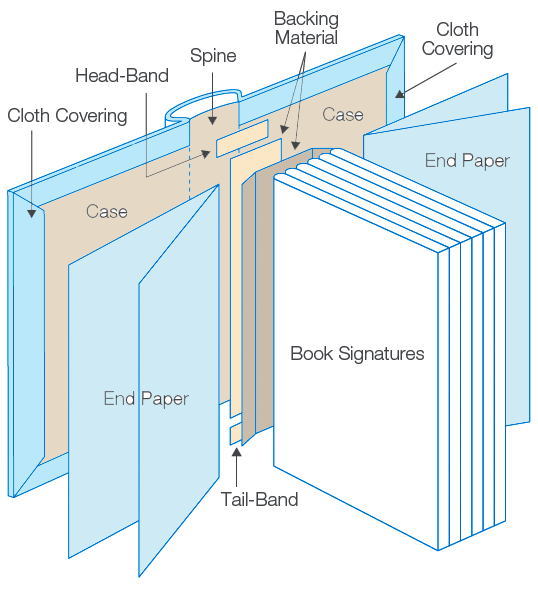
A hint can be found by examining how this book was physically assembled. Books are printed in sections (many pages on large sheets) called signatures, which are folded, collated, sewn and glued together, trimmed, then glued into a cover. A major cost consideration is to not waste blank pages, and print a minimum number of large signatures. Signatures typically have 2n pages (2, 4, 8, 12, 16, 32) mechanically folded from large 2-sided prints. It is most economical to publish books of this size in 32-page signatures — 16 pages on each side, arranged 4x4, folded.
This book was printed in 8 signatures, of which 6 were 32 pages, and the 4th signature was 16 pages with an 8-page signature (#5 in table below) of photos on glossy paper inserted without page numbers, making a 24-page combined (16+8) signature. The photos are stitched in the middle of the book without page numbers. The book has 208 page numbers, with text on the last page, which indicates that no pages were wasted. Numbering began on first signature page 9, not on the text page 1. This indicates that signatures and page counts were scrutinized, and material was added, probably in haste, without updating pages numbers.
Signature Sizes and Pages
| Signature
|
Size (pages) |
Page Numbers |
Chapters
|
| 1 |
32 |
1-32 |
1, 2 |
| 2 |
32 |
33-64 |
2, 3,
4 |
| 3 |
32 |
65-96 |
4, 5 |
| 4 |
16 |
97-112 |
5, 6,
7 |
| 5* |
8 |
none |
photos |
| 6 |
32 |
113-144 |
7, 8 |
| 7 |
32 |
145-179 |
8, Addenda |
| 8 |
32 |
177-208 |
Addenda |
The table shows the signatures with corresponding page numbers and chapters. Because the last printed page is 208 and there are no blank pages at the end, suggests that Addenda were deleted in haste due to economy, to squeeze in as many pages as possible into the last signature. It seems that the Addenda were assembled last and the extra pages were discovered perhaps at the print shop during layout. It appears that Berokoff made a last minute decision whether to print an extra signature of 8 pages at the end, which the publisher would not like, or remove items to fit the last 32-page signature. It was too late and expensive to re-typeset all the Addenda in smaller 10-point font, match the font used in the text, or to renumber them in sequence.
Were the 8 photo-pages added after the book was written, or planned from the beginning? Photos are in the exact middle (between pages 104 and 105), without page or photo numbers. There are no text references to any photo, and some photos are not related to any text. This suggests the photos were added probably during beta-reading and proofreading, perhaps volunteered. The printer may have adjusted his cost estimate to include the photos on an 8-page signature on glossy paper, if the middle (#4) signature was reduced from 32 to 16 pages, and the photos were inserted as a signature. Maybe the printer added it for no extra cost. This would reduce the entire book by 8 pages and explain why 6 Addenda were removed.
More hints appear in the "Contents" list (page 5, no number). After "Addenda .. 157", the section "Petitions .. 177" appears, but not the section "Inquiry of Prof. Arthur Piepkorn ..." (page 192). The label on every odd-numbered page after 157 is titled "Addenda". The section for Petitions does not appear at the top of the odd-numbered pages after page 177. This suggests that Berokoff was arranging these documents in sections (Addenda, Petitions, Inquiry ..) and exceeded his last 32-page signature. Oops! Had all these documents been typed in a smaller font, there probably would have been space to include all, or most, of the missing 7 Addenda. Probably in haste and frustration, he and the printer decided to "just do it, as is" rather than find and correct all errors, to comply with the printer's contracted scheduled print date — the deadline.
It is my opinion that the mystery of 7 missing Addenda appears less likely due to censure, and more likely due to photos squeezing out space for the large-font Addenda. Though the missing items were probably judged not as important as those published, it would be interesting to see what is missing. Does any one have a better explanation, or the actual story?
Biased History book for 60 years
Despite the misleading title and weak biased content, Berokoff's book, which appeared 37 years after Young, stands alone as the only member-produced history of Dukh-i-zhizniki in the Americas since Young's work in the late 1920s and 1930s (thesis, dissertation, books, articles) up to 1991 (when Wren was published), spanning almost 60 years. His book served as a prejudiced rough draft of his version of this history up to 1969. There is no public archive of his papers to definitely locate the 7 missing items in the Addenda, or to add what he omitted. (A single 1971 recording by James John Samarin will be posted here with transcript.)
Among the many significant historical facts and tales Berokoff displays, the most revealing is his 5-page summary financial report showing that their 74 Dukh-i-zhiznik conscientious objectors during WWII (compare to 600+ who enlisted) failed to pay half (46%) of their C.P.S. camp bill (~$17,000), then refused to resolve the matter with a visiting representative of the National Service Board of Conscientious Objectors. The extent and detail which Berokoff reports this breach of contract suggests that exposing the scandalous C.P.S. debt was a major purpose for publishing his book, comprising 20% of the pages, though not mentioned in his Forward. It appears he really intended to blow the whistle about his deadbeat brethren before he died.
Why did he omit the C.P.S. debt in his Introduction? One explanation may be that a characteristic of Dukh-i-zhiznik oration is to lead with a minor neutral topic to get the listeners' attention, delaying one's major point until the end, then changing to the intended topic(s). Berokoff does this oral history bait and switch by burying his C.P.S. debt report in Chapter 7, beginning at page 130. His C.P.S. report is enhanced to show the huge scandalous extent in which Dukh-i-zhizniki financially cheated the 3 major American peace churches that negotiated for and arranged the C.P.S., while remaining steadfast (postoyannie) in refusing to pay their own C.P.S. debt today and hiding behind a false label. 1000s of their archived documents have been collected to complete this story when time permits.
Unfortunately the misleading "Molokan" label and erroneous "facts" have been widely propagated by scholars citing Young and Berokoff. Though both authors identified their subjects as Pryguny, and specifically as Spiritual Christians who use the book Dukh i zhizn', together they obscured those two groups with over 1500 repetitions of the word "Molokan" in print. This label dis-information was so extensive that it appears intentional, perhaps to diffuse attempts by zealots in government from further investigating and/or deporting them. Young and others testified in government hearings and during investigations to defend the most zealous Spiritual Christians (to be added). Her protective propaganda caused Spiritual Christian history and faiths to be scrambled for generations.
After Berokoff was published
Ironically, Berokoff was bullied by a few of the most zealous Dukh-i-zhizniki, including several of his relatives, for publishing his translations: Selections from the Book of Spirit and Life (1966) and history (1969), among other reasons which they cannot articulate, like whistle-blowing about deadbeats, speaking at the U.M.C.A., and corresponding with other faiths (ne nashi). Though most readers greatly appreciated his books, several descendants of J. K. Berokoff still hate him for exposing "their religion" to the world, which they believe to be a sin (apostasy). They did not know that soon after publication in 1928, their Kniga solnste, dukh i zhizn' and religious texts were placed in several libraries, including the National Library of Congress, and never were a secret from the U.S. or Soviet governments.
The next Dukh-i-zhiznik-produced history appeared 32 years later in 1991 (A.F. Wren, True Believers…) using the same misleading faith labels, and no citations. For more than 70 years after Young, only these 2 member-produced books (Berokoff and Wren) existed in a few public libraries along with several scholarly papers, theses and dissertations by "outsiders" (ne nashi). Then many works by Dukh-i-zhizniki appeared (Babashoff, Mohoff, Samarin, Shubin, Slivkoff, Valov, etc.), as their fear of self-publishing somewhat attenuated. Unfortunately, all these recent publications further abused the Molokan label, have many errors and omissions, lacked citations and should be similarly edited as time permits. In short, very little of the material published in the 1900s (20th century) in English was correctly labeled, which affects all citations. What a mess of history.
The U.M.C.A. newsletter (1950s-2000s) was entirely mislabeled and controlled over time by different factions of Dukh-i-zhizniki with opposing agendas. The final 3 decades were mostly controlled by one family of editors who falsely believed: "Whatever Molokanism is, I am in the center of it." (Quote from William Alex Federoff, early 1970s.) The newsletter published sparse information about Dukh-i-zhizniki, censored openness, and silently expired in 2007 after authentic Molokane organized in Russia with official journals. Now western Dukh-i-zhiznik communication is limited to member-only e-mail lists and discussion boards, all mislabeled and functioning as closed secret societies protecting a false identity while trying to debate their various faiths using inaccurate labels. For one example, see the molokan.network.
U.M.C.A. invasion
In the 1940's, Dr. Pauline V. Young was working on a sequel to her 1932 book Pilgrims in Russian-town to report that these Spiritual Christians, whom she earlier assumed would assimilate in Los Angeles within a generation, were being revitalized by their own American-educated youth. She did not realize that while members of the various Spiritual Christian faiths she studied were integrating and assimilating, the Prygun congregations were converting to various Dukh-i-zhiznik faiths which persisted, and generally rejected non-believers in their new faiths unless they were wealthy. Unfortunately her working papers were destroyed in a fire at the International Institute in Los Angeles, and the book was never completed. Dr. Young wanted to document how youth trained at the Young Russian Christian Association (Y.R.C.A.) and the Bible Institute of Los Angeles (B.I.O.L.A.) enhanced the United Dukh-i-zhiznik Molokan Christian Association (U.M.C.A.) with improved management, programs and publications, causing attendance to grow for 20 years. In the mid-1960s, U.M.C.A. Sunday School book purchases, an indicator of attendance, peaked at rank 10 in the country, 3rd in California!
Young died in 1977 before the most zealous Dukh-i-zhizniki who hated the U.M.C.A. took full control of the non-profit corporation and property in the 1980s, converting it into their private school and territory. In contrast to Young's appraisal, Berokoff (page 97) presents the U.M.C.A. teachers (not identified as Y.R.C.A.-ers) as heretics of his Dukh-i-zhiznik faith. Not mentioned is that Berokoff's zealous peers, indoctrinated at the Young Peoples' Meeting (Molodoi sobranie), hated the Y.R.C.A.-ers who bought a building in The Flat(s) to hold their club meetings and socials, had about 25 members educated at B.I.O.L.A. (free tuition before 1959), had a library, and were invited to administer the U.M.C.A., which rapidly grew for 20 years. Partially due to Berokoff's history book and his son Peter, who became a teen boy's U.M.C.A. Sunday School teacher in the mid-1960s, substantial numbers of zealot Dukh-i-zhizniki invaded the U.M.C.A. to evict those whom they perceived to be Americanized heretics of their various Dukh-i-zhiznik faiths.
The 20-year (1962-1982) takeover of the U.M.C.A. by zealous Dukh-i-zhizniki followed by their 1985 Satanic ritual abuse media frenzy caused the Sunday School attendance to plummet more than 95%, greatly reduced regular attendance in all American Dukh-i-zhiznik congregations, and closed their doors to outsiders, including Molokane, for most events. In 2017, though their remodeled Heritage Room store was open for business during the U.M.C.A. Picnic, the back room museum of donated artifacts and books, which some zealots my have considered to be holy relics, was closed. The next year, self-elected zealots decided to purge the Heritage Room of most of the donated books and many of the items, despite a strong protest from elder members. Hundreds of items collected for decades were sold cheap and the remaining was locked from public access. 100 years after immigration from Russia (2004), most of the descendants of these Spiritual Christians, subjects of this book, assimilated, fled or were expelled from Dukh-i-zhiznik faiths by zealots, leaving a total faith-practicing diaspora smaller than the number who immigrated from Russia.
Highgate Road Social Science Research Station (H.R.S.S.R.S.)
In the 1960s, Dr Stephan P. Dunn (anthropologist) and Ethel Dunn (historian), a husband and wife team of social science scholars of the Soviet Union who lived near Berkeley, CA, incorporated their own non-profit organization. They called it their Highgate Road Social Science Research Station (H.R.S.S.R.S.) after their street. Both were educated at Columbia University, New York, then learned Russian and specialized in translating social science articles into English for publication. Dr. Stephan P. Dunn's doctoral adviser was Dr. Margaret Mead. After they became interested in Spiritual Christian history, they were surprised to discover Molokane in San Francisco, from a brother of the Molokan presbyter in Sydney Australia, who happen to live nearby. They were introduced to the congregation, which led to expeditions to Southern and Central California, Oregon, Canada, and a focus on everything about the diaspora groups including networking with J. K. Berokoff.
In the 1970s, historian Ethel Dunn asked Berokoff: "... what a Dukh-i-zhiznik
Berokoff's reply was far too simple. He should have further specified: ".. only in our Los Angeles style and dress, only sung in our Southern Russian dialect as we speak it, by men in long beards who perform our rituals, with jumping and raising both arms exactly as we do and when we do, who are accepted by us as full members of our congregation(s), intermarry with us, and meet with us often." Evidence of his social introversion and exclusion is revealed on page 97 were he says at the end of item 1: ".. such conduct .. should be stopped." The rest of the story reveals what Berokoff omitted when he published his warning.
Though psalm-singing (hymn-singing) in Russian is characteristic of all Spiritual Christians, and in most languages by all Christian, Muslim and Jewish faiths around the world, of which Berokoff had practically no knowledge, his very simple mislabeled definition motivated Ethel Dunn to find a Russian ethno-musicologist. In 1980 she applied for a research grant from the National Endowment for the Humanities (NEH), and proposed to publish a book titled: "The American Molokans as an Ethnic and Religious Group" (RS-*2061-80). She never realized that she focused on non-Molokans.
Unfortunately, the Dunns failed to produce the book by spending most of the money to study singing. (How the money was wasted — in-progress.) With my volunteered help, the H.R.S.S.R.S. only produced the chapter about singing. Berokoff's 1970s definition of "Molokan" was published in O'brien-Rothe, Linda, Ph.D. The Molokan Heritage Collection Vol, IV: The Origin of Molokan Singing, H.R.S.S.R.S., 1989, page 1. Now we know that this book should have been titled: The Spiritual Christian Collection Vol. IV: The Origin of Dukh-i-zhiznik Singing.
In 1973, a master's thesis by W. B. Moore, Molokan Oral Tradition (U.C. Berkeley), with Dunn's guidance, was published which caused a huge oral backlash among zealous Dukh-i-zhizniki, including false reports about Berokoff's widowed daughter-in-law. Lingering hostility and fear erupted when zealots heard that a ne nash researcher (Dr. O'brien-Rothe) had interviewed elder singer Misei Volkoff. The day after Dunn and O'brien-Rothe met Volkoff, zealots raided his house to confiscate his huge tape collection against his will and "protect it" from ne nashi. This delayed O'brien-Rothe's research on singing for a year, until she was given cassettes of 300 songs recorded by Dukh-i-zhizniki in Australia. So her report was mostly about the origins of Dukh-i-zhiznik singing in Australia.
To lessen objection to Dr. Obrien-Rothe's pioneering work, I insisted on having her first draft anonymously proofread by a wide group of elder Dukh-i-zhiznik singers and potential critics who had been slandering the Dunns and Dr. Moore for a decade. It happened that the survey was primarily administered to members of the late Berokoff's congregation (Noviye Romanovskii sobranie, Freeway assembly, Beswick street church), and to singers of other congregations, by elder Jack Peter Ocip. Valov who was quite impressed with the draft. He volunteered to assure that this new research would be scrutinized, for the historic record, and collected all comments on paper. The comments submitted showed a broad multidimensional spectrum of attitudes about outsiders doing research on "their" sacred songs, from full agreement and understanding to absolute disgust by one person, some unable to understand the point, and some initially hostile who changed their minds after reading and discussing with other readers. The results were summarized with responses by the author and included in one version of the book. (To be posted.) The process of open proofreading and a summary report apparently melted most of the zealots' opposition to research and documentation by outsiders.
————
Valov later coauthored and edited books with George Mohoff, while others like Babashoff, Baghdanov and Shubin, published their own books, and a MA thesis by Slivkoff appeared. But when Dr. Breyfogle's was invited to Los Angeles to present his book and research in 2005, the Dukh-i-zhiznik controlled U.M.C.A. board issued a verbal order prohibiting all thesis about their faiths, as if they were an Imperial council of the Tsar Dukhov (King of the Spirits) issuing an ukaz (decree, order) upon academia.
This book in-progress is also open to you as a volunteer beta-reader to comment as it is being edited and composed. Check back often for changes and updates. E-mail : Administrator (at) SpiritualChristians.org.
In many ways, the Dunn's body of work facilitated young social scientists around the world to analyze the previously under-reported non-Doukhobor Spiritual Christians from Russia — Americans (Breyfogle, Clay, Hardwick, 2 Moore's), Australian (Slivkoff), Russians (Inikova, L'vov, Mazo, Nikitina, Panchenko, Petrov, 2 Samarins, Zhuk), Armenian (Grigorian, Mangasaryan), Turkish (Akchayoz). I met most, and have been in contact with all. Unfortunately many believed his false history that these people were "Molokans."
I last spoke with Ethel Dunn about 2002, and suspect she died about 2004, and was cremated to join her late husband. This updated book in-progress can serve as a short sample of the book the Dunns wanted to produce, a project I assisted for most of the 1980s and hope to finish some day, with much more information than imagined 30 years ago, about the folk-Protestant Spiritual Christians from Russia in North America and around the world.
When the 3 labels for these 3 Spiritual Christians faiths — Molokane, Pryguny, and Dukh-i-zhizniki — are untangled and properly used with verified facts, as shown in this text, their individual histories and identities become much clearer.
Foreword [Contents]
PAGE 7 There are numerous reasons why the life of the Dukh-i-zhiznik Molokan people
in America deserves to be recorded in a book but the most
important, perhaps, is the probability that the third and fourth
generation American Spiritual Christian Dukh-i-zhizniki Molokans are
unacquainted with the real reason for their forefathers'
emigration from Russia or how they managed to evolve and survive as clusters of communities a community
for over sixty years up to 1969 in
a large city abundantly supplied with various worldly
temptations.
It is also possible that they do not know why the
United States of America was chosen by
Peter A. Demens as a place of settlement in preference,
say, to Canada or to South America and how it came about that
they chose urban life in Southern
California* instead of remaining on
the Eastern seaboard as millions of other immigrants did.** They
also do not know why their grandparents failed to obey prophesy to return to Russia
(to the east or south), or failed
to form large isolated farming communes.
* Berokoff specifies "Southern California" as the "chosen" land, not Northern California where Molokane settled. Non-Doukhobor Spiritual Christians settled in Southern California, where the new Dukh-i-zhiniki faiths were planted among various tribes of Spiritual Christians from Russia.
** Neither the "Eastern seaboard" nor "South America" were destinations planned by the Brotherhood of Spiritual Christians in Russia. Their initial plan since 1900 was to follow the Verigin-led Doukhobors (1/3 of all Doukhobors) to Central Canada, and settle on blocks of Crown Land in what is now Saskatchewan. See map: Origins of the People, 1901: Manitoba and Saskatchewan, Atlas of Canada, No. 29, Department of the Interior — most of the "Russians" tan-colored area are the Doukhobor Reserves in Saskatchewan, 1899 (Map by Johnathan Kalmakoff, Doukhobor Heritage website). Composite map: Doukhobor Colonies and Prairie Willages - 1905, by John Kalmakov, 2018.
P. A. Demens protested to those who led Doukhobors to Canada, and not to the United States. By 1902 the minority of Svobodniki were denied entry into the U.S. and had begun protesting in nude marches to return to Russia. In 1904, when the next groups of Spiritual Christians were announced in the international news to be leaving Russia, Demens traveled to Canada to divert them to Los Angeles. Some ended up in South America because they did not have money to pay for ship fare, were taken to the Panama Canal Zone and sold for labor to cover their transportation cost.
What was their life in Los Angeles like as a zealous minority that they
clung together in one close knit neighborhood (arguing among themselves) while most Spiritual Christians from Russia along
with other nationalities scattered to become
assimilated in the local population? Insisting, for religious
reasons, on wearing full beards and their peasant clothes in the
face of ridicule while most Spiritual
Christians from Russia along with other nationalities
conformed to local customs; periodically dropping everything to
attend the funeral of a relative, a friend or a respected elder church
dignitary, quitting their jobs twice a year to
observe their daytime* week long Old Testament holidays plus three other
one day religious observances, they yet managed to support their
very large families without admitting to
taking public charity
or assistance from [outside,
ne nash] non-Molokan sources.**
* Probably after WWII, "Big Church" decided to accommodate members who could not take leave from day jobs by holding 2 services a day, or evening services on weekdays, during extended holidays. The most zealous congregations refused to adopted such a flexible holiday schedule, to remain constant (postoyanniye : постоянние) with their rituals (obryady : обряды).
** The oral history that "they did not take charity" is a myth. Perhaps a few zealous families refused "non-kosher" food and education, but the majority appeared to have accepted assistance, especially if offered to kids at school or delivered in secret to their home.

![Delphi234 [CC0], from Wikimedia Commons](https://commons.wikimedia.org/wiki/File:US_annual_unemployment_rate.svg)
To assimilated
descendants of Spiritual Christians Molokans born
and raised since the end of the second World War, this
accomplishment may not seem very impressive because the
continuous prosperity and full employment of the last 25 years (1945-1969) would lead them to believe
that it was always thus, but in fact, during the first ten years
of their PAGE 8 life in
America (1904-1913) the Brotherhood of Spiritual
Christians from Russia was Molokans
were subjected to periods of unemployment when the
bread winner of the family considered himself very fortunate if
he worked an average of four days a week at $1 to $2.00 per day as casual laborer
in a lumber yard. How did they do it?
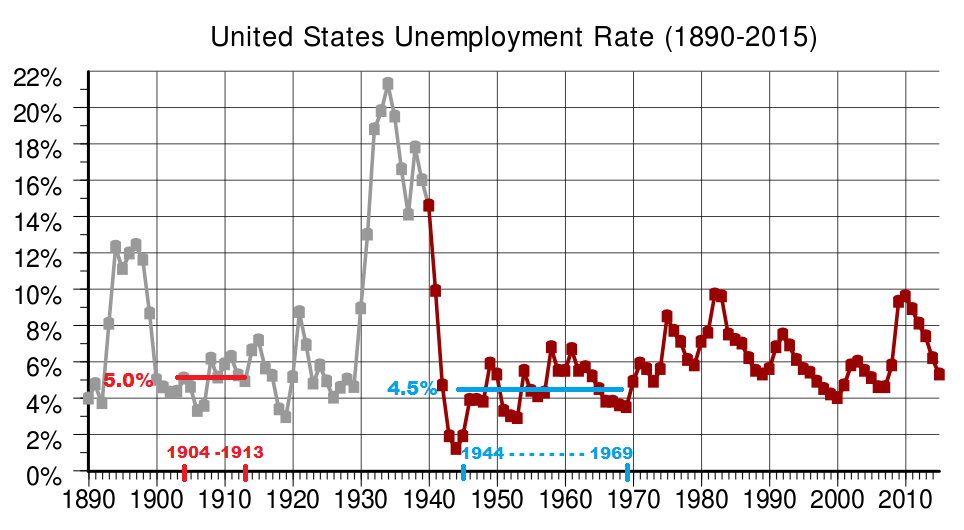
Fact Check: U.S. average unemployment was about 10.5% higher in the first 10 years (1904-1913), compared to the 25 years before 1969 (1945-1969). I suspect that not knowing English was their biggest work impediment.
Credit Captain
P. A. Demens (Dementsov : Деменцов) for guiding
them away from Canada to to Los Angeles, falsely rebranding
them all with the simple label "Molokans," finding rural
land for settlement, and arranging many jobs in a nearby
laundry and lumber yard, and other places. In Los Angeles
Demens owned a wood planing factory, soap factory, and was a
part owner of the commercial laundry. About 50 east in Alta
Loma, he owned a citrus farm and hired Russian labor. The
Bethlehem Institutions, supervised by the Dr. Rev Dana W.
Bartlett, offered job training and placement services; and,
with teacher-journalist Anton Cherbak, hosted the "Russian
University" to teach English, general knowledge and
Americanism for "white
collar" employment and integration.
This book attempts to answer some of these questions. It is a
narrative based on personal observations, on notes, letters and
documents in the writer's possession as well as on information
gathered from many anonymous
persons who are old enough to have personally experienced the
history of the Dukh-i-zhizniki Molokans in
America. It is a story of a people who were and are somewhat unique among all the ethnic
groups in the Los Angeles area, not in San
Francisco.
This narrative is enhanced and corrected
by Andrei Conovaloff (using strikeouts and red font) to add
more details, citations, and data.
Introduction — The Flight to the Refuge* [Contents]
PAGE 9 Prophecies of Prygun
Efeem Gerasovich Klubnikin** (1842-1915)
concerning the coming of World Wars and their after effects,
written in his youthful years in the village of Nikitino Nikitina,
Russia*** in 1855 or thereabouts.
* This phrase is used
11 times in the text — flight to a place of refuge (1)/
fight(s) to the refuge (9)/ flight to a second refuge (1).
Though a major
theme in his book, these terms (flight, refuge) are not
exactly defined by Berokoff who probably expected his readers
to know their meaning, interpreted by his context.
— "Flight",
or journey (Russian: pokhod: поход), is revealed in
examples for destinations from Russia to Canada, diverted to
California and Western states, Mexico, South America, Iran
then California, and Australia from California, and back to
Russia from everywhere. But the prophetic flight back to
Russia has not happened. "Flight" is similar to the Svobodnik
(Freedomite)
term: trek (Russian : трек), journey (by foot, and
back to Russia). Both groups (Dukh-i-zhizniki and Svobodniki)
have spiritual songs about pokhod and trek.
See my edited version of: Moore, Willard B. "Communal
Experiments as Resolution of Spiritual Christian Sectarian
Identity Crisis," University of California, Berkeley.
— "Refuge" (used 34 times)
(Russian: ubezhishche : убежище) appears to be
where Klubnikin and Berokoff settled and were buried — Los
Angeles County. In the final sentence on his last page 155, Berokoff implies
this is the "first refuge," as he encourages "...
emerging younger leadership to ... search for a second
refuge ..." The term "refuge" in context is similar to the
Anabaptist German term bergungsort ("place of refuge/ safe
haven/ salvation" : to escape [from restrictive
legislation], or [obey God's call and come to the] place of
salvation [to be saved]); more than sammlungsort ("place of refuge" : a
meeting place [with God], a tabernacle). Comparable Russian
terms could be: сокрытие (concealment, hiding, escape), and
место сбора (gathering place, venue, sobranie). Anabaptist scholars compiled a document
archive and bibliography about their Central
Asia trek, c a. 1880, and I list
and link to their most relevant material online to show
Dukh-i-zhizniki how their pokhod originated from
Anabaptists who migrated to Russia from Germany in the 1800s,
and was continued and enhanced by oral tradition from writings
published in their 1928 religious text Kniga sontse, dukh
i zhizn', including nearly all of of Klubnikin's
prophesies and drawings.
** For Dukh-i-zhizniki who strive to
retain their ancestral
Southern Russian dialects, Gerasovich must be
pronounced Herasimovich.
*** Nikitino village, Yerevan guberniya, is now named Fioletovo,
Armenia, where in the year 2000 there were about 4 separate Dukh-i-zhiznik
congregations and one Molokan
congregation.
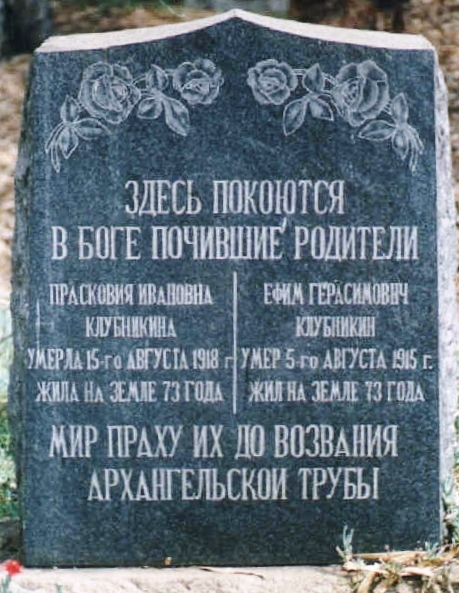
E.G Klubnikin was buried in 195 in East
Los Angeles, California, at the Old
Cemetery (grave-marker right).
The grave marker reads:
| Здесь
Покоются В Боге Почившие Родители |
Here
lie the deceased parents before God |
| Прасковия
Иванова Клубникина умера 15-го Августа 1918 г жила на земле 73 года |
Praskovia
Ivanova Klubnikina died on 15 August 1918 lived on earth for 73 years |
| Ефим
Герасимович Клубникин умер 5-го Августа 1915 г жила на земле 73 года |
Efim
Gerasimovich Klubnikin died on 5 August 1915 lived on earth for 73 years |
| Мир
праху их до возвания Архангельскои трубы |
Peace
be upon them until they return when the archangels trumpets call* |
* This last line probably refers to Klubnikin's own song «Песнь о трубе Архангела» (translated as "Song concerning the trumpet of the Archangel," in Volkoff, John, Book of the Sun, Spirit and Life, Article 25, page 653.) Verse 8 of this song (translated as: "Michael the Archangel shall trumpet among the living and the dead; the world shall shake the living he shall arouse and the dead he shall wake.") appears to be inspired by 1 Thessalonians 4:16, Daniel 12 and/ or Revelations 11:15-19. For some brief online contemporary Christian interpretations see Wikipedia: 1 Thessalonians 4, Daniel's final vision, and Seven trumpets, of which Klubnikin was probably unaware, though he grew up among the Eastern Orthodox and Apostolic Armenians.
Pages 636 and 651, Book of
the Sun, Spirit and Life
(Kniga solntse, dukh
i zhizn' ; Книга солнце, дух и жизнь).
| Story/ Tale/ Article
2. Concerning the removal of peace from the earth. |
ПОВЕСТЬ 2. О взятiи съ земли мира |
| "Kings will go to war with
China. From the time of the war in China, peace will be
taken from the earth. [2] There will be powerful wars in the East.
From the time of the war in the East the wrath of God will
spread throughout the whole earth. |
Пойдут
цари воевать на Китай, с Китайской войны миръ будет
взять с земли. 2. На востоке будет сильная война;
смешается кровь с водою, и с восточной войны разольется
гнев по всей земле, |
| [3] There will be great groaning and crying of peoples, blood will flow everywhere. Great misfortunes and agitation among the peoples; tortures, torment and persecutions. [4] People will fly in all directions; to mountains, caves, forests and to different countries. [5] Separations of father and son, mother and daughter, husband and wife … | 3. Будеть великий плачь и стон народов, кровь нещадно прольется повсеместно, настанеть великое бедствие и волнениe в народах: мучения, скорб, казнь и претмснения. 4. Великое бегство по всем местам: в горы, ущелья, лмса и въ иныя земли. 5. Разлука отца с сыном, матери съ дочерью, мужа съ женою. |
* * * *
| Story/ Tale/ Article 2. Song about the journey | ПОВЕСТЬ 22. Песнь о noxoде. |
| "Let us sing loudly a
song about the flight to a place of refuge. [2] The Lord has
sent His angels with trumpets to all the people; to go, to
go on a journey, to remove themselves from worldly worry.
|
Воспоемъ громкую песнь, о походе въ
место убежища ! 2. Господь послалъ Ангеловъ съ трубою, возвеститъ всему народу; итить, итить в поход,-удалиться от миpcкихъ забот! |
| [3] We shall stand firmly on our
feet, the Lord will give us His help. He is our joy and
our strength. |
3. Станем твердо на ноги, Господь дасть нам помоги. Онъ-радость и крепость наша. |
| [4] A herald is flying from heaven, his command is to prepare us for a journey (pokhod). [5.] Angels are released to torment and to punish harshly everyone throughout the universe". | 4. Вестник с неба летитъ, собираться в
поход велитъ. 5. Решаются Ангелы, на жестокую казнь и
мучение, повсеместно, по всей вселенной. |
Why did they
wait so long in Russia?
Why did 99% stay in Russia?
Why did the non-Dukhobor Spiritual
Christians in the Caucasus (Khlysty, Klubnikinisty, Maksimisty, Molokane, Noviye israeli, Noviye
Molokane, Pryguny, Skakuny,
Skoptsy,
Stary Molokane, Stunditsy, etc.) wait 50 years after
Klubnikin's prophesy to migrate, until after 1900? And, why
did less than 1% of them move to the Americas? What is real,
and what is myth?
Duhk-i-zhzinik oral history in
America repeats variations of a simple narrative, that they
left Russia to avoid war and injustice. The the most zealous
tribes add: to follow one or more prophecies. Here I try to
present the broader context, clustered in chronological order,
of some of the many changing geopolitical, economic,
sociological and religious events that could have caused 1% to
leave while 99% stayed home. Check for updates. Submit your
own missing alleged reasons.
- 103 years before migration
began — Russia —
- As Russia annexed south Ukraine then
the southern Caucasus, non-Orthodox heretics were resettled
there to removed them from infecting the Orthodox
Russians, and to concentrate them for conversion to the
true Orthodox faith. In 1801, Senator Ivan V. Lopukhin led an investigation of the thousands of the
non-Orthodox heretic Dukhobortsy (spirit-wrestlers)
who petitioned for Russians, mostly Spiritual
Christians, were invited and enticed to moved to Novorossiya
(New Russia, now Southern
Ukraine) next to German
immigrants and Dukhobortsy
to concentrate the undesirable citizens and settle
recently conquered southern territory susceptible to
attack from the southern Ottoman
Empire. (After
1905 the remaining Molokane built 15 meeting
houses, which were confiscated during Stalin's
rule in the 1920s. After the 1990s Dissolution
of the Soviet Union, 3 original buildings in 3
villages (marked
in red) were returned to local Molokane for
their meetings. During the 2022
Russian invasion of Ukraine, all Molokane in
the 3 villages were surrounded by Russian soldiers.)
- 85 years before migration
began — Russia —
- In 1818, thousands of Anabaptist
pilgrims from Germany arrived in Odessa,
traveled across Tavricheskaya
guberniya through the Molochna (German
spelling: Molotchna)
region on their way to Palestine for the millennium
prophesied for 1836, but due to continuous
conflicts in Palestine many ended their trek (pokhod)
in the Caucasus where they spiritually refocused on Mount
Ararat (replaced it for Mt. Zion,
Palestine) for their perceived Second
Coming of Christ. Hence, Maksim G. Rudomyokin grew
up with a spiritual focus on Mt. Ararat.
- 70 years before migration
began — Russia — About November 1835, Haley's
Comet may have influenced the zealot sectarian Sokolov
to affirm Apocalyptic prophecies for 1836.
- 60 years before migration
began — USA — In
September 1841, the United States Congress passed the Distributive
Preemption Act which allowed squatters on federal land
to keep their land by buying it for $1.25 per acre, for up
to 160 acres, before their land could be legal sold to
anyone else. Efim G. Klubnikin is born about 1842.
- 50 years before migration
began — Russia — About 1852, according to
oral history, E.G. Klubnikin prophesies began when he is
about age 10. Since 1850 in
the United States of America "...more than 270 million acres
of public land, or nearly 10% of
the total area of the U.S., was given away free
to 1.6 million homesteaders; most of the homesteads were
west of the Mississippi River."
- 47 years
before migration began —
Russia
— In 1857 military schools for boys 12
to 18 plus mandatory 25 years of military service, the cantonist
system, ended after 136 years. After 1839 many Spiritual
Christians were resettled in the Southern Caucasus with
temporary benefits of no military service (10-15 years),
more land, their own villages, freedom of religion and no
taxes.
- 45 years before migration
began — Russia — 1859
Solar Superstorm : September 1–2, the largest recorded
geomagnetic storm occurred; and Aurorae (Northern
Lights) brighter than a full moon were seen around
the world. Before 1861, any serf could gain freedom by
self-declaring to be a heretic Spiritual Christian and get
banished to the warmer Caucasus and get land.(Tarasoff
2002, p.413; Breyfogle 1998) 1861-1866
Emancipation of Russians Serfs which Lev
N. Tolstoy strongly promoted. (40 years later he promoted emigration
for Spiritual Christians.) An earthquake
destroyed much of Shemakh city, capital of Shemakha
Governorate, and the capital was moved the to the port city
of Baku and the territory renamed Baku
Governorate.
- 40 years before migration
began — Russia — John K. Berokoff reported that
about 1865, a mystery woman
in the U.S. had a vision that particular Spiritual
Christians will come to North America and she would give
them land in Southern California. Her vision may be related
to the 1859 Solar Superstorm. On June 9, 1866, an exploding
fireball meteor shower fell eastward at the
Serbia-Ukraine border, about 1230 miles NW from Nikitino
village (Knyahinya
(drawings)
: ~1100
pounds recovered, ~1200 stones) — perhaps similar to
the 2013
Chelyabinsk meteor. It fell
at 5 pm (8 pm in Erevan), traveled about 30
miles in a few seconds, and probably was visible near
the setting
sun as seen from the Caucasus. Or, Berokoff scrambled his
oral history and his timeline was wrong; the mystery woman
could have been a translator for a presentation in Los
Angeles given before his family arrived in 190, about the
many land offers available to relocate the immigrants to
land outside of Los Angeles.
- 30 years before migration
began — Russia — In the 1870s, about 1/3 of the
most dissident of all Protestant Germans in Russia begin to
migrate when their exemptions from military and independent
schooling ended. "From
1873 to 1884 about 8,000 Mennonites migrated to Manitoba,
Canada, and another 13,000 settled in the midwestern
United States." Many who moved to the U.S. got free
transport, free land for churches and schools, some got
wheat seed, and the state of Kansas, U.S.A., and country of
Canada gave them military exception.
- 25 years before immigration
began — Russia — In 1877
the Russo-Turkish War in the Caucasus Theater lasted
less than a year. Kars
and Batum
Oblasts become part of the Russian
Empire. Serfs
were offered land, and temporary exemptions from taxes and
military service, in these newly conquered territories.
- 20 years before immigration
began — Russia — The 1882 May Laws
restricted Jews in Russia for 30+ years. During 1881-1914
over 2 million Jews left Russia, 1.7 million (85%) moved to
the United States. The Hebrew Immigrant
Aid Society formed in 1881 in New York City to provide
meals, transportation, jobs and agricultural colonies, and
temporary housing in 1882; later more Jewish aid societies
formed in the U.S.
- 15 years before immigration
began — Russia —
- Famine
of 1891–1892 and cholera
epidemic, about half-million people died in Central
Russa
- Taxes more than doubled (but were
deferred in Caucasus).
- In New Russia (South Ukraine): Stundists and other non-Orthodox sects were arrested and prosecuted. (The term Stundist, like Molokan, often generally meant a non-Orthodox Russian citizen, folk-protestant — a heretic)
- In his 1978 book: Makcim
Gavrilovich Rudometkin "King of Spirits": Leaser of New
Israel (Molokans) [sic],
William Prohoroff III, page 356, wished that ancestors (who were
not Molokane) had obeyed prophesy earlier and left
the Caucasus between 1890 and 1895 to Canada.
- 10 years before immigration
began — Russia — In 1894, the
Ottoman Empire began mass
killings of Armenians.
80 to 300 thousand were killed in 2 years, many within 100
miles of Kars city, where 1000s of Spiritual Christians from
Russia lived. Demens begins a colony of Russian farmers 40
miles east of Los Angeles.
- 9 years before migration
began — Russia —
- In June 1895, in 3 locations in the Caucasus, about 7000 Dukhoborsty burned guns in 3 simultaneous protests against the military and war. 1/3 of the most dissident participated. By winter about 400 were jailed. The next year about 4000 were evicted from villages resulting in about 2000 deaths from starvation and disease.
- On July 5, 1895, Emperor Nicholas II
signed a decree (ukaz) ordering construction of
Tiflis-Kars Railway which replaced much of the wagon
transportation done by Spiritual
Christians.
- 9 to 5 years before
migration began — Russia —
- From 1895 to 1898 in the Caucasus, 240 Dukhobortsy
were arrested and marched by E.G. Klubnikin's
house to jail in Kars city, then again past his house
to
jail in Tiflis city. The Klubnikin's
village of Romanovka was the only village completely on
this main road with Pryguny, and most of
Melikoy. Spiritual Christians in other villages did not
have a front row seat to the witness the Doukhobor
arrests and marching of prisoners to jail like Klubnikin
did.
- In November 1897, Lev. N. Tolstoy refused the first Nobel Peace Prize nomination, and proposed that destitute Doukhobors should receive it for burning guns in 1895, arrests and suffering.
- Immigration agents in Europe
represented Canada's "new and aggressive immigration
policy" to get "desirable settlers" — " ... a
stalwart peasant in sheepskin coat, born on the soil, whose
forefathers have been farmers for ten generations, with
a stout wife and half-dozen children, ..."
- 5 years before migration
began — Russia —
- In 1899, coordinated by the Society
of Friends (Quakers) in London, the most zealous 1/3 of
all Doukhobors (mostly followers of P.V.
Verigin who is in exile) left the Caucasus beginning
in 1898. About 7,400 relocated to central Canada. By 1930,
8500 arrived. About 67% stayed in Russia.
- Molokane asked for Tolstoy's help to move to Canada and were refused.
- In April 1899, Molokane petitioned
to the British Consulate in Batoum (Batumi,
Kutaisi
Governorate) to emigrate to Canada and get the same
deal as the Doukhobors.
- On July 5, 1899, the Canadian government granted Molokane "to be allowed to settle in Canada on the same terms as the Doukhoborsti." The ruling included military exemption, homestead communal land, own Russian language schools, and religious freedom. (In his 1978 book: Makcim Gavrilovich Rudometkin "King of Spirits": Leaser of New Israel (Molokans) [sic], William Prohoroff III, page 356, wished that his people (who are not Molokane) had obeyed prophesy earlier and left the Caucasus between 1890 and 1895 to Canada.)
- In Russia, many Doukhobors abandoned
much of their property (improved land, buildings,
businesses, animals, tools, etc) to neighboring Molokane
who stayed.
- A railway from Kars to Tiflis (T'blisi) was completed, which improved commerce to the detriment of Spiritual Christian wagon builders and drivers.
- On 31 December 1899 (New Year's
Eve), a "great" earthquake (about 8 on the
Richter
Scale) in South Tiflis governate destroyed 10
villages (6 completely) and killed 800 to 1000 people,
within 50 miles of dozens of Spiritual Christian villages.
The Dukhobor
villages around Paravani Lake were probably
destroyed.
- 4 years before migration
began —
- Russia —
- In 1900, the Transcaucasus Railway
was connected to the rest of the Russian railroad
system. Peasant colonization of Siberia was promoted.
- In early 1900, I.G. Samarin and
P.M. Shubin send or deliver 2 petitions to St.
Petersburg to either free Molokane [Brotherhood
of Spiritual Christians?] from military service or
permit them to leave Russia to Canada (or California).
Search for petition in-progress.
- On 12 June 1900 exile to Siberia
was abolished, reduced by about 85%, and limited to
political and religious offenders. In 1906 exile was
increased.
- In December 1900, L.N. Tolstoy's first open letter to the Tzar
is published internationally, which asks for religious
and economic freedom for Spiritual Christians or let
them emigrate. Molokane and Dukhoborsty are
each mentioned twice. Tolstoy's second letter was on
March 1901. Other tribes like Pryguny and Maksimisty
are not mentioned.
- USA —
- In January 1900, P.A. Demens in Los Angeles offered to help all Spiritual Christians in Russia come to Southern California, to colonize land, or work in his factories or elsewhere. City life for peasants from Russia was opposed by L.N. Tolstoy. Three representatives from dissatisfied svobodnik Doukhobors in Canada visited Demens in Los Angeles, toured the Pacific and plains states for colony land and returned. The west coast Immigration Commissioner protested to Washington D.C. that they are undesirable poor diseased religious monomaniacs.
- In August 1900, Demens arranged work for a small group of Doukhobors to build the coastal line of the Southern Pacific Railroad near Santa Maria, Santa Barbara County, California, for $2/day, and some moved to Los Angeles the next year.
- Canada —
- In August 1900, 3 scouts from the
Caucasus representing Pryguny and Molokane
tour Doukhobor colonies in Canada, inspect many U.S.
states and visit Demens in Los Angeles.
- 3 years before migration began
—
- Russia —
- In January
1901, international news from St. Petersburg,
Russia, reported that "40,000 Molokanen"
in the Caucasus petitioned the Russian government to to
restore their land rent (which has increased 300%
to 400%) or allow them to move to America.
- On February 22, 1901, Lev N. Tolstoy is excommunisted from the Russian Orthodox Church.
- In March 1901, Tolstoy writes his second open letter to the Tzar, a continuation of his first letter (Dec. 1990, above) published in the international press. Molokane are mentioned once, but not Dukhoborsty 1/3 of whom migrated to Canada.
- USA —
- In February-March 1901 in Los Angeles, Rev. Dr. Dana Bartlett, aided by newspapers and women's clubs, launches donation drives to help poor immigrants at the Congregational Church mission complex called the "Bethlehem Institutions".
- Canada —
- In March 1901, "5,000
Doukhobortsi, or Russian Quakers" threaten
to leave Canada due to oppressive laws:
(1) "private ownership of land" rather than communal ownership, signing homestead forms is a sin,
(2) marriage licenses, registration of marriages, births, and deaths; and court control of divorce, only God can recognize these arrangements.
(3) "Doukhobortsis [sic] have issued an appeal to the nations of the world for a haven ... untrammeled by man-made laws".
("Russian Sect Seeks a Haven of Refuge", New York Times, March 13, 1901, page 1)