Not mentioned is that by 1969 Berokoff's
Klubnikin (Podval, Clarence street) congregation had
already divided into 3 congregations, more than any other Dukh-i-zhiznik
congregation in America. After 1969, these congregations
continued to divide. By 2020, I count 5 congregations.
MAP
- Romanovskoy,* original, podval,
Klubnikin's, Shubin's, Clarence street, Flats,
now at 15052 Clark Ave, City of Industry, CA, with separate cemetery,
- Branch in Oregon, with separate
cemetery
- Staro-Romanovskoye, Blue Top, 332 Clela
street, Est Los Angeles, CA
- Novo-Romanovskoye, Freeway, Beswick street, now at 14647 Broadway, Whittier, CA
- Branch in Oregon,
* After the original podval meeting house on Clarence street was damaged by fire in 1975, the congregation met house-to-house, then found an abandoned house-church for rent on Flatbush street, in Norwalk in the construction zone of the 605 Freeway and new 105 Freeway. They rented the building and improved it by removing a hot-tub (jacuzzi) used for baptisms, added plumbing for a women's bathroom and expanded kitchen. Their rent lasted for 4 years (1978 to 1982), until the building was demolished for freeway work. Again, they met house-to-house until a residential property was purchased by _?_ Shubin on Clark avenue, City of Industry, and a new building was constructed from 1985 to 1989. In May 1985, their previous "605" location in Norwalk was investigated by police as a possible crime site which spread fear among most Dukh-i-zhizniki in Southern California. Due to their new street location, the Romanovsoye congregation was nicknamed "Clarkies" or "Clarkys". The new meeting hall was closed to non-members for about a decade as the most zealous adherents obeyed a series of prophesies to unify their members as true and faithful believers. After initiating optional popular daily meetings with intense prayer sessions and jumping in the "Holy Spirit", membership reduced to about half due to deaths and attrition. The Clarkies sponsored a short lived affiliated congregation in Erevan, Armenia, in the 1990s, then opened a branch congregation in in Marquam, central Oregon, which also met daily. About year 2000, American Dukh-i-zhizniki began to shun the Clarkies for being too radical and zealous, and no longer welcomed them as co-religionists. By 2015 they were not allowed to participate in funeral services at the Old Cemetery or New Cemetery, but later allowed to observe, so they formed their own private cemeteries in Southern California and Central Oregon — the "Molokan Sanctuary, about 10 miles west of Murrieta, Riverside county, California; and a section in Twin Oaks Cemetery, Turner, central Oregon, about 10 miles southeast of Salem.
(1)
Prokhladnaia congregation moved to East Los Angeles
where it was typically called "Melikoy", after the
Turkish village name. "Prokhladnaia" was the same
village named by Russia. In
the 1980s this congregation relocated to it moved to
"Costa Glen Avenue", Whittier, and placed a brass plaque on
the building: "The First Prochladonye Molokan Christian Church
of Whittier", on the northwest corner of El Camino Real
(formerly Whittier Blvd) and Cost Glen Ave.
(2) Akhtinskaia was often called Samarin's
and moved to Percy Street, East Los Angele, and in the 1980s
to Pioneer Blvd, Whittier.
(3) Romanov (Old Romanovskaia), the original (postoyannye),
remained in their half-basement building variously called
Romanovsky, podval (basement), Klubnikin's, Shubin's
(after 2 presbyters), and Clarence street added in the 1970s. The building burned
about 1970, and the congregation met house-to-house,
then rented a vacated house converted to a protestant
church in Norwalk adjacent to the 605 freeway being
built, from which it was renamed colloquially. Later it
moved to a house in La Habra on Clark street and was
nicknamed "Clarkies" in ridicule for being the most
socially isolated. In the 1980s the "Clarkies" divided
when younger members moved to Silverton, Oregon, called
"Clarky North".
About the 1950s two congregations
- Old
Romanov, starie Ramonovsky, starie Roman, Blue Top (blue roof shingles),
Sussoyeff 's, and Clela
Street added n the
1970s).
- New Romanov, novie Romanovsky, novie Ramon, Freeway church, Beswick street.
(3) Old Romanovskaia [Romanovsky, podval, Klubnikin's, Shubin's, . Before the building burned about 1970, two congregation split-off;
In
the 1970s, William Federoff, as the new editor of "The
Molokan" (the UMCA newsletter) insisted on abandoning all the
heritage, village, and presbyter names used to identify Dukh-i-zhiznik
congregations in Southern California. He also insisted on
controlling the newsletter with his 2 sons for more than 30
years, into the 2000s and the end its publication. He refused
to allow use of the Internet — one of the incomprehensible
reasons written was "anybody can do that." Son Nick Federoff
bought the domain "molokan.com", and probably "molokans.com"
but never used them.
label to "Gage street church" because he preferred using
street names, or was orientated by street names, rather than
names of people, heritage villages, etc. Federoff ans sons
dominated control of the UMCA newsletter to its end in the
2000s which trained a generation to only use American street
names, not heritage Russian names.
On
10 March 1933,
about 2 weeks after the "Big Church" dedication, a magnitude
6.4 earthquake
occurred in Long Beach which killed 115 people.
Extensive building damage included the Santa Fe "La
Grande" train station west of the LA River, south of
First Street, where Russian Spiritual Christians arrived in
Los Angeles. A new "Union Station" train depot was built May
1939, one kilometer (0.6 mile) north, now a public
transportation hub and historic site.
The fact of the matter is that, due to
in spite of stresses and strains, that
the Spiritual Christian Molokan edifice
(complex system of beliefs) was
subjected to during their adjustment to their life in America,
the structure factions
dominated by zealots with their new holy book, Kniga
solnste, dukh i zhizn' (final version 1928),
transformed into a variety of Dukh-i-zhiznik faiths
which were in constant conflict remained
intact and functioned as a unit in most matters
affecting the brotherhood especially during the two world wars
and the great depression. The cohesive
brotherhood implied here by Berokoff never existed across all
the immigrant groups falsely labeled "Molokan."
This myth was proven again when, late in February of 1946, word reached Los Angeles from a large group of Spiritual Christians from Russia Molokans in Iran (Persia) who were begging for assistance to immigrate to America. It was known previously that they were there but nothing was known of their living conditions or how many there were. It was also known that in early 1930's when the Communist government in the USSR was using all means to force the peasants into collective farms, many Spiritual Christians Molokans fled across the neighboring borders of Iran and Turkey seeking escape from persecution for refusal to join the collective. The Spiritual Christians refugees were mostly of 3 faiths Molokane, Pryguny, Subbotniki, with several Orthodox and Baptist families, who knew nothing about the Kniga solnste, dukh i zhizn'.
In 1938 a tearful plea was received from a group of these refugees, mostly Molokane, who were stranded in Syria after wandering back PAGE 139 and forth between Turkey and Syria begging for a refuge of these governments. At that time a financial response was made to their plea but after the outbreak of the second world war nothing more was heard of this group until 1945 when a young Russian Baptist couple name?, with their children, arrived in Los Angeles from Iran and contacted a Dukh-i-zhiznik Molokan family whose address they brought from the latter's relatives in Iran.
This young couple told of many Spiritual Christians Molokans living in Iran including those who were at one time stranded in Syria but who eventually found refuge in Iran. Their story was convincing because they named families who had close relatives in Los Angeles.
Nothing was done about it at the time, however, because it was not known that they wanted to come to America, in fact it was assumed that they would not because, as it was previously mentioned here, there was still a hope in the hearts of many that our imminent refuge was to he either in Iran or Turkey.
But when this word reached Los Angeles in February, 1946,
everyone was surprised to learn that a large group of our own
flesh and blood was living in Iran for more than a decade and
were now anxiously, in fast desperately trying to emigrate to
the United States.
The message came via a long letter*
from one of their members who claimed that he was writing on
behalf of the whole group living in Teheran, stating also that
there were many other families living in farming villages in
Northern Iran, near the south coast of the Caspian Sea, who are
also desperately anxious to leave Iran. It was a well-written
letter and touched the hearts of all listeners causing an
immediate reaction in the community. A sum of $4100.00 was
quickly collected for their relief and a meeting of elders was
held to discuss the best means of assisting them, while no funds were collected
to pay the CO debt of
$17,023.56.
* If anyone has this "long letter", please send a copy or post it online and send the URL.
PAGE 140 On March 20, 1946 the elders invited the young Russian Baptist [name?] who arrived a year before to give his views on the letter and the best means of assisting them and on the responsibility of the writer of the letter. Upon his suggestion, a letter was dispatched air mail with a small sum of money and with a request that the money was to he distributed to the most needy families, preferably to widows and orphans and at the same time asking for further information on their immediate needs and the most advantageous means of assistance — whether in food, clothing or money.
On May 30th a reply arrived urgently pleading, not for food or clothing but for help in their efforts to immigrate to America, stating that life in Iran was becoming unbearable for several reasons:
- Work was very scarce and whenever a job was available, the population was very fanatical and discriminated against them in favor of a Muslim.
- The economy of the country was corrupt so that nothing could he done without payment of a bribe, hence, if one had not the money to pay the bribe his pleas of any nature were disregarded.
- Life in the farming villages was likewise difficult in that the most fertile lands were in possession of rich landowners who preferred to rent it to the Muslims and the land allotted to the Spiritual Christians Molokans was very poor and in an unhealthy, mosquito infested, malarial region along the south coast of the Caspian Sea where many Spiritual Christians Molokans died after settling there in the first years in Iran.
This letter changed the picture for the American Dukh-i-zhizniki Molokans altogether. It would have been comparatively simple to collect a sizable sum of money for the purchase of food and clothing and shipped to them as it was done in 1921 for the famine PAGE 141 stricken in Russia, but, it was extremely difficult to initiate a mass removal of approximately 500 persons of all ages to the United States at a time when millions of refugees and displaced persons in the liberated portion of Europe were clamoring for admittance to America.
The admittance to the United States was limited by law to a certain quota per year for each European nation, a law that favored the nations of Western Europe against those of Eastern Europe. Since the great majority of displaced persons were from Eastern Europe, a special law was passed to permit entry into the United States of 250,000 of them but this law was not applicable to the Spiritual Christians Molokans in Iran, they had to apply under the quota limits of the old law. By this law the allowable quota for people of Russian origin was very small in ratio to its population. It was so small that the Spiritual Christian Molokan applicants in Iran were told that they would no doubt have to wait at least five years for their turn to enter the United States. Complicating this obstacle was the fact that some applicants were born in the region of Kars which, since the close of the first world war, became Turkish territory, therefore, those Spiritual Christians Molokans born there had to come in under the Turkish quota, which was practically nil. (See Addenda pp. IX, X, XI, XII and XIII)
There were no organizations in America working to aid refugees in Asia similar to the one sponsored by the combined religious bodies of the United States which was very active in the relief and emigration of displaced persons of the European war. Neither was the organization called "The Tolstoy Foundation
PAGE 142 It must he admitted that Spiritual Christians
Fortunately for them, the Spiritual Christians Molokans in America were at that time able to absorb such applicants, having among their members farmers raising cotton or grain which were then scarce commodities and also owners of various factories that could claim a need and scarcity of mechanics of all sorts.
2. Immigration Project Launched
Soon relatives and friends in America were busy preparing the necessary forms and mailing them to Iran for processing by the consulate in Teheran where, after the usual delays due to the regular red tape, visas were finally being granted for entrance to the Promised Land. (Berokoff again confirms Los Angeles is his prophesied "Refuge.")
A slow but steady procession of Spiritual Christian Molokan families were soon arriving in Los Angeles and San Francisco, some by plane all the way, others who hoped to economize on their passage, flew to Italy where they boarded a steamship at the cheapest rates to New York and then by autobus to the Pacific Coast.
The very first family to arrive in Los Angeles, however, came [in 1949?] by a roundabout way that took them overland through Iran cast to Karachi, Pakistan, where they boarded a coast-wise steamer to Bombay (now Mumbai), India where they found passage on a freighter which brought them all the way to Los Angeles, making calls at many ports between India and America, a voyage of approximately three months. But that was the only family to take this difficult route.
As could be imagined, the arrival of the first few families were events of great dramatic interest and considerable emotion. Meeting with relatives one did not ever hope to see PAGE 143 until a year or so ago and then suddenly sitting down to a traditional Spiritual Christian Molokan meal together with them 10,000 miles away from the backward Asiatic nation which was your inhospitable home for 15 years, amid surroundings that seemed like a dream to you, was a scene that only a skilled dramatist could portray.
The stories of their lives that these first arrivals told, differed only in some minor details from those told by later arrivals. No one from Iran ever compiled and published their history.
3. History in Iran
As they sat late into the first night of their arrival, relating the horrors of the wars, revolutions, civil wars and famines they survived; of the persecutions, exiles and executions of their loved ones and finally, of their flight across the high mountain range with their small children towards an unknown fate in neighboring Iran, their listeners, through their tears, could only thank their God for their own preservation from a similar fate.
As each new arrivals told their stories of terror, the impression grew in the minds of their American brethren that these people were exceptionally hardy to survive their adversities and, either courageous beyond belief or foolishly desperate to even attempt the flight across the high range of mountains along which lay the border between the USSR and Iran, knowing as they did that the border was constantly patrolled by soldiers of both nations, guarding against the very thing they were attempting to do.
In fleeing their homes, many were able to evade arrest only by the narrowest margin, only after being forewarned by people who had inside knowledge of the plans for their arrest and exile to concentration camps by the Soviet secret police. In every case they were in such a hurry that they could take nothing with them except the clothing in their backs and as much hard bread as they could carry with them.
PAGE 144 Walking at night and hiding in the mountains to sleep and rest during the day, all who were hold enough to make the attempt succeeded in avoiding detection and capture.
Although all of them were eventually stopped by the Iranian border patrols, they were not betrayed to the Soviets but instead, the patrols delivered them to their superiors whom, in turn delivered them to their district chiefs. Most of the refugees were eventually brought to the city of Mashhad, footsore and hungry, although they were occasionally fed by the more kind-hearted of their captors.
In Mashhad the Iranian officials deliberated on whether to deport them back to the Soviet Union to avoid friction with their powerful neighbor or to transport them in small groups to the interior of Iran and settle them among a fanatical and, at times, inhospitable population.
Fortunately for them, however, divine deliverance came to them in the person of a Spiritual Christian Molokan family that had moved to Iran in less troublesome times several years earlier and who were already well established in the city of Mashhad, who knew the Iranian language and were acquainted with their ways as well as with some of their officials.
This Spiritual Christian Molokan family — the Tihonoff family — were somehow appraised of the predicament of their refugee brethren. They immediately went before the local government officials and begged them not to ship the refugees to the interior but to allow them to settle as a group in some nearby farming area.
The Iranian people, like most people of the Muslim faith, were unsympathetic towards Christians whom they called unclean infidels because of the latter's propensity for the use of pork meat which is unclean to a true Muslim and also because the majority of Orthodox Christians venerate images of saints and display the cross on their houses of worship.
The Tihonoffs knew this antipathy of the Muslims well therefore they set about convincing the officials PAGE 145 these refugees were different from most Christians and very similar to the Muslims in their objection to the use of pork or veneration of images or the cross.
Apparently these explanations satisfied the officials for they relented in their attitude and permitted them to remain together in the vicinity of Mashhad where they secured work in construction of the Abkooh Sugar Factory
After a time the Shah of Iran gave them permission to settle in villages of their own near the south coast of the Caspian Sea in the province of Mazandaran where the majority of them lived until the migration to America while some moved to the capital city of Teheran, working as day laborers or truck drivers.
4. Rahmatabad (Missed by Berokoff)
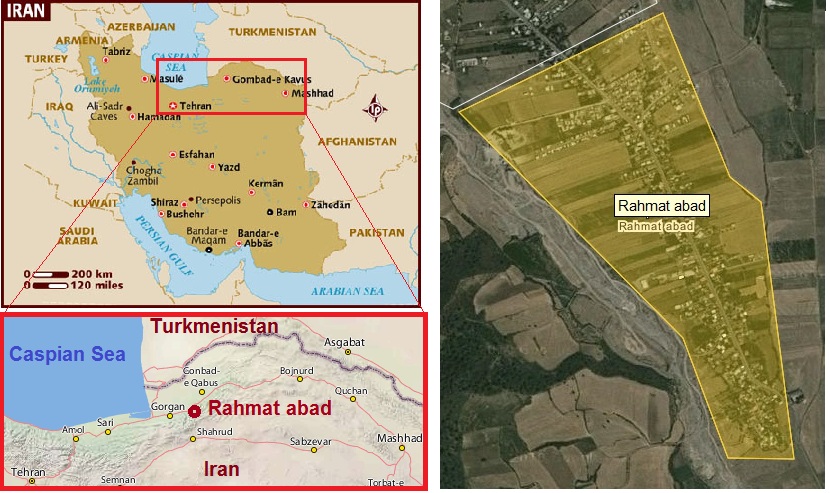
All refugees from the Soviet Union in Iran were offered houses in a row-village called Rahmatabad (Raḩmatābād in Arabic language : Mercy village). Google map location. There over 50 locations in Iran with a similar name. These immigrants compared their village life in Iran as being similar to the Pryguny in Mexico.

Their trials were not over yet, however, for at the outbreak of the war between Germany and the USSR the Soviet armies occupied the northern part of Iran (where the Spiritual Christians Molokan were living) to protect their southern flank from unfriendly armies, bringing terror into the hearts of people who thought that they were free from fears of the midnight knock on the door and its terrible consequences. But here they were again facing that probability. With such a probability they were forced to live for another three years or, until these armies returned to the Soviet Union at the conclusion of the war.
But although the armies were gone, there was no guarantee that they would not be back for a permanent occupation, so that the minds of the refugees were never entirely free of the thoughts of that possibility, therefore, they began to search their collective minds for avenues of escape, fasting and praying for divine guidance in the meanwhile.
5. Immigration Completed, 1951
Possibilities were open to them for emigration to South America and Australia. Indeed, many non-Spiritual Christian Molokan refugees in Iran took advantage of these possibilities and emigrated to these countries, but God, through His servants the prophets,* PAGE 146 told the Spiritual Christian Molokan in Iran to expect help from their American brethren, therefore, they turned their eyes and thoughts away from those continents and concentrated their efforts on the United States. They succeeded so well that, in 1951, five years after making their first contact with Los Angeles, every Spiritual Christian Molokan living in Iran with the exception of several persons who forfeited their right to be called by that name, were in America, praising God for their deliverance and expressing their heart felt gratitude to their relatives and their spiritual brethren for their assistance.
* Berokoff implies the Persuki were guided by the Holy Spirit through their prophets to seek his (Klubnikin's) chosen land of refuge (Los Angeles county), therefore they are members of "New Zion" and worthy in his brotherhood, initially. See below: 8. Persuki ill-treatedAs indeed they should because the brotherhood in Los Angeles and the several farming communities of Arizona and the San Joaquin valley as well as the Molokane Postoyannaye in San Francisco, were never so unanimous or so generous as in the response to their call. It is more than likely that no Spiritual Christian Molokan family in America refrained from participation in their emigration, either by sponsoring a family, (which meant that the sponsor obligated himself for the welfare of the family he was sponsoring for a period of five years), by financial assistance in their transportation or by giving them employment upon their arrival.
As each family arrived they were taken to the various congregations to be greeted in the traditional Spiritual Christian Molokan manner with the holy kiss — prayed for and given a sizable monetary* donation for the start of their new life in America, with every member contributing voluntarily according to his means. In addition, furniture, kitchen equipment and clothing, especially for children, was generously donated.
* Again, no funds were collected to pay the CO debt of $17,023.56.6. 668 Immigrants Divided and Insulted
Practically in no time at all following their arrival, they were absorbed into the Spiritual Christian Molokan communities of America. The majority were of the Pryguny, therefore, these chose to live in Los Angeles, but a considerable number were of the Molokane Postoyannaye and most of these chose to live in San Francisco with their co-religionists there and, it must he said, that they PAGE 147 revitalized that church which was, prior to their arrival, threatened with slow death by anemia.
Berokoff appears to have never attended a Molokan meeting in San Francisco, yet claims the congregation was "threatened with slow death by anemia" without presenting any supporting data, like membership counts. The Persian Pryguny were not "absorbed" in Southern or Central California unless they converted to Dukh-i-zhiznik faiths, and even then most were ill-treated. They were often insulted in Russian as Persuk (singular) and Persuki (plural). Pronounced: Pear-SUK, Pear-SUKI.
The fact that most Spiritual Christians from Russia in Iran were not Dukh-i-zhizniki nor willing to convert, became a problem for many of their hosts in Southern and Central California, and the abused immigrants. The presence of a huge immigrant population of Russian-speakers divided the Dukh-i-zhizniki into those who (1) hated, and those who (2) befriended the Persians. The most zealous and uncivil American-born Dukh-i-zhizniki refused their kids to associated with, and prohibited them from marrying "Persians", belittled as Persuki, and they shunned and/or picked on front-row elders who associated with Persuki.
In 1955 in San Francisco, the 150-year Anniversary of Freedom in Russia (since 1805) was celebrated, and a report published which listed all the immigrants from Iran by name. The list showed 668 people in 176 households. Their Russian surnames were transliterated (Romanized), tallied and listed below.
| Spiritual Christian Immigrants from
Iran Heads of Household Surname Counts |
|||
| Aksyonov Aleksandrov Alkhutov - 3 Babylyov Bakholdin - 2 Bogdanov - 12 Boldyr'ev - 2 Borodin - 5 Chechev Chekunov Deryabin Dolmatov Dopofeev Fedorov - 2 Filipov - 2 Gamzaev Garbenkin - 2 Gorbenkin |
Gribenkin
- 2 Grigor'ev - 2 Gusev - 10 Istagin Ivanov Kantsov - 3 Kashirskiy - 2 Kasimov - 2 Katkov Kocherginov - 3 Konovalov - 15 Korbov Krylov Kudinov Kudryavtsev Kurnosov - 2 Lapin Lazarev - 3 |
Ledyaev
- 3 Leont'ev - 4 Loskutov - 6 Muravlyov - 3 Myasischev Nazarenko Novikov - 2 Orlov - 2 Pavlov - 2 Petrov Potnov - 2 Pyatokov Razvolyaev Rudenko Samodurov - 2 Serkin Shaposhnikov Sherbakov - 2 |
Shubin - 4 Shvetsov Simoav Slivkov - 2 Sokolovskiy Stepanov - 2 Sullemani Sysoev - 8 Tikhonov - 5 Titov Veneev Vinogradov Volkov - 10 Voloshin Voronin Zakharov Zhabin Zhmaev Zol'nikov |
Before he died, John David Novikoff (K.C. Tool Co, South El Monte, CA), who immigrated from Iran, drew a detailed property map of Rahmatabad on which he labeled the owners of all 60 buildings. By the time they emigrated, more than half did not live in the village. They found work in nearby towns, Tehran and along the south Caspian coast. The village had 2 stores owned by Moslems, a school, a brick factory, and 3 meeting halls (sobrania) for Molokane, Pryguny and Subbotniki. This map and a list of all immigrants from Iran is being circulated among Persian elders for editing and proofreading.
Fortunately for all of them, their arrival in the United States, coincided with the most prosperous period in the
Though geographically separated in the US, Persuki remained friends and supportive of each other, especially to defend against insults by Dukh-i-zhizniki. When any Persian family, any faith, had a funeral, wedding or child dedication, many from all faiths attended the service, where ever it was. Kids born in Iran who grew up and married in the US attended Persian family events no matter what faith — Molokan, Dukh-i-zhiznik, Prygun, Subbotnik (Adventist), Baptist and others — which were like reunions. Persian families preferred to match-make their American-born kids with other Persians which helped maintain their sub-group population and offset discrimination by indigenous Dukh-i-zhizniki who believed themselves to be superior. The inter-faith traveling taught them to dress for success and social acceptance by their critics. If they looked like they belonged materially, with the best clothes, fashion, beards, singing, Bible knowledge, speaking Russian, cars, houses, etc.; attended often; joined the UMCAs; did not overtly reject the religious texts or new rituals; and, mingled in groups with the American-born; they gained social stature and were reluctantly tolerated by zealots and bigots who hated them in principle as outsiders.
During the 1960s-1980s the Persians helped popularize the rainbow of solid pastel-colored outfits worn to prayer meetings. Many of the Persian women could sew a new outfit (dress and apron for women, kosovorotka for men) and for little cost have a wardrobe of several matching husband-wife outfits. The multi-colored, bouquet of fashion was so well geographically distributed and displayed by the many Persians in California and Oregon, that anthropologist Ethel Dunn misinterpreted the colored outfits and unity of Persians, who were uniformly friendly to her, as a characteristic for all Spiritual Christians from Russia in America whom she met that she mistakenly confused Molokane and Dukh-i-zhizniki as one "ethnic group" with "insignificant" differences. She saw the same eye-catching fashions and heard similar singing everywhere she traveled while conducting her field research. This distraction helped caused her to miss the significance of major differences among these distinct ethnoreligous groups and the new religious movements of those who used the Kniga solnste, dukh i zhizn'.
7. Compare to Armenian Immigration
Many Dukh-i-zhizniki learned the rubbish business from Armenians in Los Angeles County. Besides the Prygun Armenians who immigrated to Los Angeles (1905-1912) how does the immigration of others compare?
From 1944 to 1952, 4739 Armenians migrated to the US. About 30,000 Soviet Armenians came to the US from 1960 to 1984, and another 60,000 arrived throughout the late 1980s. (Armenian Americans : Second wave of immigration, Wikipedia) Much is credited to one man in San Francisco. In 1951, George Mardikian, who organized the American National Committee to Aid Homeless Armenians (ANCAHA) and already resettled 3200 refugees from Armenia in the US, made arrangements with the International Refugee Organization (IRO) to resettle another 1000, most to Southern and Central California. ("American Seeks Homes In U.S. For Armenians," Chicago Tribune, April 4, 1951, part 2, page 8)
In the 1980s, nearly all Armenians fled Azerbaijan during the Nagorno-Karabakh War (1988-1994), beginning with the 1988 earthquake in Spitak, Armenia. News of the huge migration was on Los Angeles TV and in newspapers for years, but not in the UMCA newsletter. When I learned that Molokane in Nagorno-Karabakh were also bombed and displaced as refugees, I asked several Dukh-i-zhiznik presvitery in California if we will again help our brethren to escape to the U.S. It would be a humanitarian effort and bring a new generation of Russian-speakers into the American flock.
Every elder I asked remained silent and walked away, avoiding the question, refusing to answer. All the Spiritual Christians in the disaster and war zones fled to Russia while a few found homes in adjacent Republics which discriminated against them for being Russians. The silent treatment by diaspora Dukh-i-zhizniki is probably due to several factors:
- lingering disappointments about the "Persians" who did not populate them with many charismatic jumping believers or converts to their Dukh-i-zhiznik faiths;
- the Dukh i zhizn' teaches that all who remained in Russia are non-believers, a lost "Jerusalem" not worthy of membership in their diaspora "New Zion" refuge kingdom in the city;
- there were no important Dukh-i-zhizniki in the Caucasus war zone worthy of saving;
- Dukh-i-zhizniki are forbidden to give charity to non-believers, any other faith, including those remaining in Russia;
- the limited education of the divided Dukh-i-zhiznik elders could never form a united committee (komitet) with skills to manage such an operation; and
- their was no humanitarian diaspora Dukh-i-zhiznik leader like George Mardikian.
Though Dukh-i-zhizniki in Southern California refused to host more immigrants, many are glad they have several nearby stores owned by immigrant Armenians and Russians where they can buy ethnic foods and practice their Russian language with recent immigrants. A change in attitude appeared in the mid-1990s among diaspora Dukh-i-zhizniki who, after the dissolution of the Soviet Union, sought Dukh-i-zhizniki in Armenia, who were more receptive than those in Russia met during the 1992 International Spiritual Christian Molokan Convention trip. Though a few intermarriages in the Former Soviet Union were pursued by American Dukh-i-zhizniki, mostly for brides, those in Australia petitioned their government and received refugee visas for 40 people, but they only used about 20 visas, which greatly disappointed the government official who labored to process all the papers.(I received an email from this official asking why only half were used.) Up to 2015, about 50, mostly young Dukh-i-zhizniki, immigrated from Armenia, many as spouses, half to Australia, half to the US. They (mostly the men) were universally not well tolerated because they sang different songs and had a different holiday. Compliant brides from Armenia were more easily integrated. Those in Australia had to form their own congregation, while those in the US tend to cluster where they are more welcome and can economically survive.
8. Persuki ill-treated
In spiritual matters too, a few reluctantly
8a. Lediaev
About ten years later in 1958, however, the Persian Prygun sobranie led by presviter Ivan Lediaev,
* In contrast, Jack Green was praised by many Dukh-i-zhiznik parents for his 2 decades (1940-1960) of dedicated service providing a free youth counseling, social, recreational, and Christian educational club exclusively for their kids.In March 1959, Ivan Lediaev, the leader of this Prygun congregation
8b. Baghdanov
Also, in the 1960s, Ivan Vas. Baghdanov, led his large extended family away from abuse in Los Angeles to central Oregon where they revitalized a dormant congregation of Pryguny who lived there for decades. In Los Angeles, members of this Gervais congregation met a shipload of Old Ritualists en route to South America, and convinced them to choose Central Oregon. The Baghdanov family ran a furniture factory in Woodburn, at 237 N 1st St, next to the library, where they also employed several Old Ritualist women, and everyone spoke Russian. By 2014 there were 12 Old Orthodoxy churches in and around Woodburn OR. In the 1980s, the Gervais congregation was divided by waves of Dukhizhiniki migrating from California on an interstate pokhod. First a group of 5 families, with some Persians, abandoned the Dukh-i-zhiznik faith to Re-Form as Pryguny; then young Dukh-i-zhizniki from Southern California planted at least 3 breakaway independent congregations, and one separate cemetery.
8c. Sissoyeff
In the 1980s, the assistant presbyter of the "Persian" (Kern avenue) congregation in Los Angeles, Vasili Sissoyeff, called a meeting of all local presvitery to again try to discuss several matters of differences in belief and ritual between Pryguny and Dukh-i-zhizniki, but his effort was rebuffed as heresy, a violation of Maksim Rudomyokin's orders: "All he wants is for us to celebrate Christmas!" (Quote from presbyter A. P. Wren, about a year after the meeting he attended.) Everyone misunderstood Sissoyeff's reason for calling the meeting. Sissoyeff merely wanted them to understand that though they call themselves Spiritual Christian "Jumpers" in print and on state registrations, they in fact are a different faith. Interruptions by shouting zealots prevented him from completing his explanation. The meeting ended in chaos. During my 2nd trip to Russia in 2005, I found the Prygun holiday calendar which proved Sissoyeff was correct, and I personally confirmed this Prygun calendar with him at his home in Montebello about 5 years before he died.
Sissoyeff tried to conduct the last huge meeting of Dukh-i-zhiznik presvitery to occur in America, in vain. All inter-congregational meetings and business had since been delegated to the cemetery board of directors, which will not address any such issues, creating a crippled political system incapable of providing any official response. Occasionally a few presvitery and members will meet informally at events, in homes, and by phone and e-mail, but no collective meeting is likely to ever occur due to increased polarization of factions in several different directions. This behavior illustrates what Berokoff described in the first paragraph of this chapter about "... infraction of ... doctrines ... [and] ... heresies ... ".
8d. More
See: Taxonomy of 3 Spiritual Christian groups: ... Variety of Dukh-i-zhizniki :
By 2000, only a few Persian families remained fully converted to Dukh-i-zhizniki after a trial period of nearly 50 years in which survivors persevered through decades of insults and second-class treatment. To become accepted, they had to perform the "New Ritual" of Maksim G. Rudomyotkin, not question the holy books or prophets, preferably jump in unison, frequently attend other congregations and all the "right" funerals, avoid higher education, etc. Men had to visually conform with full beards, hair parted in middle, successful blue-collar professions, and many kids who married in; and, women must conform, preferably as homemakers.
In the 2000s, the new generation of Dukh-i-zhizniki "elders" (most born after 1950) upped their deceased parents requirements for the tolerated Persians. Ideologically and technically, most zealot Klunikinist Dukh-i-zhiniki had to accept compliant Persians who "followed their Klubnikin prophesy to Los Angeles," though they arrived indirectly 40 years later, about 1950, not by 1910. New rules enacted in 2015 required the Persians to abandon their "Persian" congregation, because it was still in East Los Angles among unclean Mexicans, and join any acceptable Dukh-i-zhiznki congregation of their choice to remain within the Southern California family of affiliated Dukh-i-zhiznik congregations. They had to completely assimilate with descendants of first arrivals or leave.
9. Book about Spiritual Christians in Iran
The only first-hand account of Spiritual Christian life in Iran was published with photos by a Subbotnik:
Light Through the Shadows: The True Life Story of Michael Simonivitch Beitzakhar
Translated and Edited by Daniel V. Kubrock [from Beitzakhar's Russian manuscript]
Washington, DC: Review and Herald Publishing Association, 1953. 184 pages.
<Chapter 7 Contents Chapter 9>
Spiritual
Christian History
Spiritual Christians Around
the World