Dukh-i-zhizniki in AmericaAn update of Molokans in America (Berokoff, 1969). — IN-PROGRESSEnhanced and
edited by Andrei Conovaloff, since 2013. Addenda: 24 items (30-7+1) Note: 7 "Official Documents" are missing (8, 10, 12, 20, 24, 26, 28) and 1 was added (6a).
PAGE 157 Official Documents Relative to the First and Second World Wars.Addenda IPAGE 158ADVERTISEMENT
TO ALL WHOM THIS MAY CONCERN At a meeting attended by 261*
Ivan G. Samarin, Nikolai I. Agaltsoff, Rodion T.
Kulikoff and Vasiley Z. Vedeneff were empowered by the
meeting to sign this notice. The following is the wording of the Resolution: RESOLUTION May 28, 1917
In view of The fact that we, Wherefore, with enthusiasm we herewith witness: that all of us living in Los Angeles, California, and other places, cannot on the strength of these religious views, enter any existing armies, including the conscription of recruits in United States which begins, as the newspapers say, on the 5th of June of this year, provided that that is to affect us also. PAGE 159 We are all Russian tillers of the soil and our aim is to establish ourselves here on farms in preservation of the sacredness of religion.* Though a few of us were able to realize our desires, others were compelled to live for a while in the city by the lack of funds to buy land and farming tools. (The signatures of the heads of families follows.)
Addenda IIPETITION
To His Excellency, The Hon. Woodrow
Wilson, President of the United States of North
America: A petition of the Colony of We have the honor to report to you that we are Russian
farmers,* followers of the
faiths of Spiritual
Christian Jumpers Pryguny and other
faiths, which forbids military service and
carrying of arms. For the sacredness of which, upon
refusing military service, our forefathers were
persecuted by the authorities of the Tsars. Living
through very much bitterness and bearing on their
shoulders heavy burdens, they were subject to tortures,
to mortal corporeal punishment by the rod, the knout,
the cudgel etc. as well as confinement to forts,
prisons, monasteries and mines; they were exiled from
the beautiful parts of inferior Russian to Siberia, to
dark Asiatic Trans-Caucasia and other places, shedding
much of their innocent blood from the iron shackles and
hand-cuffs.**
PAGE 160
Upon the introduction of military service in
Trans-Caucasia, we were compelled to leave our birth
places, our cultivated fields, our homes and households,
coming in the last decade to America, following Dukhoborsty
to a country worthy of peace and liberty, obtaining here
for ourselves and families, a livelihood by the hardest
kinds of labor, not burdening the country. Judging by the general registration of the 5th of June
of this year, it seems as though we unnaturalized
foreigners must also participate in the military
obligations now introduced here.*
But even the inclusion of our names in the military
rolls is prejudicial to our consciences.
By virtue of the above we consider it necessary to
notify you betimes that according to our religious
convictions we cannot enter into the army of the country
entrusted to your government, and to escape the possible
future performance of which as well as prosecution for
refusal, we ask to be exempted from its participation. Herewith we append a resolution adopted by our community on the 28th day of May of this year The number of followers of this religion in America is approximately four thousand souls of both sexes, including children. Delegates Ivan G. Samarin and Philip M. Shubin and M.P. Pivovaroff from Arizona.*
June 2, 1917.
PAGE 161
Addenda IIIOffice of the Provost Marshal General Washington June 19, 1917.
Messrs. I. G. Sarnarin, M. Kolpokoff* & Philip Shubin:[*M. Kolpokoff was the Arizona Prygun Molokan* delegate Mihail P. Pivivovakoff [Pivovaroff].] * Berokoff changed the faith label. Compare to letter above. These differences in faith labels probably indicate that in Los Angeles, I.G. Samarin's people were of a different faith than Berokoff's people. In Arizona, M.P. Pivovaroff's people appear more zealous and different from any groups in Los Angeles. Despite their differences, lead elders of these various faiths attempted to cooperate regarding avoiding military service for their youth. If they migrated to Canada, as originally planned, they would have military exemption. Gentleman: Your personal call at the office this morning and the statements of the petition which you handed me this afternoon leaves me in no doubt that such complications as has arisen in connection with the registration of members of your society is due to a misapprehension of the requirements of the Selective Service law. Registration is not enlistment in the Military Service. It creates in and of itself no obligation to perform any military service. It is the means provided by law whereby liability or non-liability to combatant military service is revealed. In your case, it is the means of bringing to the attention of the authorities your claim of membership in a sect opposed to military service and the bearing of arms. This fact being ascertained as provided by law your exemption from all forms of combatant service would follow I understood at our morning conference that with this
explanation you were willing to register and I gave you
assurance that the facts as stated by you would exempt
you from combatant military service. This letter is sent
at your request in order that it may appear in writing
just what understanding was reached at our conference
this morning. Very truly yours, Crowder, 1859-1932. General Crowder is probably best known as the founder of the Selective Service System. The head Army law enforcement officer explained above that "registration" (item #12) is the American process for declaring one's pacifism. The most zealous Holy Spirit in Arizona did not understand that message in 1917, and 34 young men went to jail in Arizona for not registering. After 1928, American Pryguny began to transform their faith to the Dukh-i-zhiznik faiths by changing rituals, holidays, songs and prayers using the new religious text and ritual book Kniga solnste, dukh i zhizn' (Book of the Sun, Spirit and Life). Practicing Pryguny were extinguished in North America by the mid-1950s. After 1950 in America, practicing Molokan congregations only existed in San Francisco and Sheridan, California. PAGE 162 Addenda IVTo Honorable Henry L. Stimson,Secretary of War, Washington, D.C.:- by The Colony of Spiritual Christian Dukh-i-zhizniki from Russia a religious sect,* of Los Angeles, California, * 23 years after 1917, the faith label changed again attempting to describe all the various faiths with an inclusive 5-word label, which continues for the next 100 years in various permutations, until a Taxonomy dissects this obfuscation. WAR DEPARTMENT
Oct. 15, 1940 Secretary's Office In the month of June, 1917, The [temporarily]
organized Brotherhood of Spiritual
Christian Dukh-i-zhizniki Said petition was signed by representatives of 261 * Actual count was 2 more than 259
because 2 names were added at 36½ and 37½. We consider it necessary to inform you and whom ever it
may concern, that with the increase during the last 23
years, the colony of Spiritual
Christian Dukh-i-zhizniki from Russia PAGE 163
Among our people there are a great many farmers,
most of whom reside at or near Fresno, California, and
other places. Should it be requisite, we will furnish the names of
all the heads of our families. We respectfully submit the above stated facts and pray
that you order that the names of the petitioners herein,
be added to the original petition of the 259 families
heretofore filed in June, 1917, as herein-above stated. Dated at Los Angeles, California, September 21st, 1940. Respectfully submitted, Addenda VNational HeadquartersSELECTIVE SERVICE SYSTEM 21st Street and C Street, N.W. Washington, D.C. October 16, 1940
David Miloserdoff, Walter Shinen, John K. Berokoff. Gentlemen: Receipt of the petition of The Colony of Spiritual Christian Dukh-i-zhizniki
from Russia Pursuant to our conference of this date I shall herein endeavor to briefly summarize the portions of the Selective Training and Service Act of 1940 [passed September 6, 1940] and the regulations issued there-under applicable to conscientious objectors. PAGE 164 It is my understanding that you have no complaint with respect to registration, realizing that all conscientious objectors within the age limits should register. Subsequent to registration, the registration cards will be delivered to the respective local boards of the residences of the registrants. After the national lottery, which determines The assignment of order numbers, questionnaires will be sent by the local boards to the registrants. At first the questionnaires will be sent only to registrants having the lower order numbers. On page 6 of the questionnaire appears a section with respect to conscientious objectors which is designated as "Series X.-- Conscientious Objections to War." Such portion of the questionnaire provides an opportunity for conscientious objectors to make claim for exemption. In addition to making a claim by properly executing Series X of the questionnaire, the conscientious objector should also execute Form 47 in substantiation of his claim. Such form should be obtained from the local board and after execution should be filed with it. The local board will proceed to classify the conscientious objector in the same manner as other registrants. If the conscientious objector is classified into a deferred class, there will be no need to pass upon his claim of conscientious objection. However, if the conscientious objector is not classified into a deferred class, but would, except for his conscientious objection, be classified into Class I, the local board will pass upon such claim. In passing upon such claim, if the local board finds that the claimant is by reason of his religious training and belief conscientiously opposed to combatant service in which he might be ordered to take human life, but is not conscientiously opposed to noncombatant service in which PAGE 165 he could contribute to the health, comfort and preservation of others, the claimant shall be liable for non-combatant service only. However, if the local board finds that the claimant by reason of his religious training and belief is opposed to both combatant and noncombatant service, the claimant shall be liable only for assignment to work of national importance under civilian direction under such rules and regulations as may be later prescribed. If the local board does not make either of such findings and does not allow the claim, the claimant will be classified in Class I and remain liable for combatant service. If the claim has not been allowed, in whole or in part, and if the claimant is dissatisfied with the decision of the local board, he will upon request have an opportunity to appear in person before the local board, at which time he may discuss his classification and point out the class or classes in which he thinks he should have been placed. If after such appearance the local board does not alter its decision and change the classification, the claimant may appeal to the board of appeal. If the question of conscientious objection is the only point involved in the appeal, the board of appeal will transmit to the Department of Justice the records and all other evidence transmitted to it by the local board. The Department of Justice will then make an inquiry and hold a hearing, at which time the claimant will have an opportunity to be heard. Should the Department of Justice be of the opinion that the claim is justified, if will recommend to the board of appeal either that the claimant be assigned to non-combatant service, or that he be assigned to work of national importance under civilian direction. Otherwise, the Department of Justice shall recommend to the board of appeal that the claim be not sustained. Upon receipt of recommendation of the Department of Justice the board PAGE 166 of appeal will determine The question after giving consideration to the recommendation of the Department of Justice. I appreciate your interest in this matter and your desire to cooperate in carrying out and complying with the Act and regulations. I hope that the above summary will satisfactorily serve your purposes. For complete details of the procedure you should refer to the exact language of the Act and regulations, copies of which are enclosed herewith.
Addenda VIApril 17, 1942
Southern District of California 1431 Post Office Bldg. Los Angeles, California Honorable Harry
A. Hollzer Dear Judge Hollzer: Your Honor will recall that on last Monday's calendar,
there appeared the names of three young men charged with
violation of the Selective
Service and Training Act of 1940, in that they had
failed and refused to enter the services of the armed
forces of the United States after having been instructed
to do so by the legally constituted Selective Service
Boards. PAGE 167
In the course of the Probation System
pre-sentence investigation conducted by this office, it
was discovered that these three defendants were members
of the Dukh-i-zhiznik faiths Molokan Church.* It was asserted that the
chief tenet of the faith of that organization was a
strict prohibition against the killing of a human being
and, consequently, the bearing of arms.** My officer felt that a
greater knowledge of the faith(s)
Through the mother of one of the three defendants, a
meeting was arranged in the Federal Building of the
heads of the six Dukh-i-zhiznik Molokan
Congregations.* Before this
was done, my officer informed Mr. Russel
K Lambeau of the United States Attorney's
Office of the proposed exploratory meeting and asked
that an assistant United States attorney be present in
order that no statement from the Probation Officer could
be presented to the Dukh-i-zhizniki Molokans
which would give them an idea that the meeting was
judicial or quasi-judicial, or of any legal bearing on
the cases at issue. Mr. Lambeau assigned Mr. Roland Duni to attend the
meeting, and this was arranged. Also, before the meeting
was opened my officer informed your honor of the meeting
and it's purposes.
Inasmuch as too many persons representing the six congregations churches
of the Dukh-i-zhiznik Molokan
faiths were
present at 10:00 A.M. April 16, 1942, to be accommodated
in any room of the Probation Office, it was arranged
that the meeting be held in the Grand Jury room (#548) in this building. PAGE 168 Probation Officer Calvin A. Meador explained to the group through it's own interpreter (James Haprov, or J.K. Berokoff ?) the reason for asking those present to attend. He stated that he wished to learn the history of the sect; it's tenets; the reason the members of the group came to the United States; and any other facts which might give light to Your Honor and the other judges of this District who may sit in judgment on cases covering the religious scruples of members of the Dukh-i-zhiznik Molokan faiths.*
The information given at this meeting is as follows. In Los Angeles there are six congregations* of the Dukh-i-zhizniki Molokan Church. These congregations churches have no real central authority but are supervised by leaders elected by their entire memberships of churches, and who meet together from time to time to take up matters affecting all of their members. The only reason for having six congregations is to locate them in centers of Dukh-i-zhiznik Molokan population and to avoid having too many persons in one edifice at the services. Actually, they are different faiths, immigrated from different villages, each with their own presbyter, elders, and prefer to remain separate due to differences in faith and rituals, and the most zealous will soon divide. Their ministers are not salaried; in fact, laymen preach many of the services, and often preaching duties are rotated among elders and leaders of the largest congregations. The service in four of the congregations churches is conducted in the Russian language, but in two, part of the time and in one congregation church all the time, services are conducted in English for the younger more Americanized attendants. The Dukh-i-zhiznik faiths Church does no proselytizing, maintains no missionaries, does not have a hierarchy or governing officials. The most zealous Maksimisty are opposed to inter-group meetings and giving information to the government.
During the seventeenth century in central Russia, an
English doctor at St. Petersburg (presumably a Quaker)
became acquainted with certain influential Russians and
interested them in his religious views;* one tenet of which was
against bearing arms. Not only the officials, but their
servants became interested, then convinced, and PAGE
169 commenced
the spread of these doctrines. From this small
beginning, the sects of Dukhobors**
and Molokan*** sprung.
It is said that a delegation of Molokane
Molokans
petitioned Catherine
the Great and that she exempted their members from
military service for 99 years.*
After that time, they were again conscripted into the
army or suffered punishment. In about 1840
Just prior to the year 1900, a group of three Spiritual Christian delegates (2 Prygun, 1 Molokan) Molokans
[page
19] were sent to Canada to investigate
the desirability of emigrating to that country. They
were offered military exemption for 99 years,* but the climate was thought
to be too severe,
and they were told of Southern California in the United
States by P. A.
Demens who offered jobs and colonization aid,
which had no compulsory military service (until 1917), and they
investigated. They returned to Russia and gathered
together groups which emigrated to Los Angeles.
Many arrived in January 1905, some through Canada,
after zealot svobodniki
had been protesting in Canada for 3 years.
Upon arrival in Los Angeles 110 were
diverted to Hawaii in 1906 (which lasted only 5
months), San Francisco (1906), the San Joaquin Valley;
Ensenada, Mexico (1905),
and Mexican points; Utah (1914
Park Valley), New Mexico (1928 Maxwell), Washington,
Oregon (1906 central), as well as two locations in Arizona (1911 west Salt River Valley, 1916
south of Jerome Junction). It is believed that there are now about 10,000 religious observant Spiritual
Christians from Russia Molokans
in the United States, and twice as
more who identify with their cultural heritage (mostly
food) but not with any of the more than a dozen
heritage faiths that came from Russia. At that
time it is also asserted that Argentina offered military
exemption to this sect for 99 years, but they preferred
the United States. During the war in 1917 numerous members of this sect -- 261 Pryguny in Southern California
and 71 (no label) in Arizona who signed petitions as
"the Brotherhood of Spiritual Christians
Jumpers" ) refused to bear arms and likewise to
purchase liberty Bonds; however, in lieu of such
purchases, they made corresponding donations to the
American Red Cross. Those 34 in Arizona
who refused induction in that war were jailed and
6 PAGE 170
Upon the direct question as to whether or not the
Spiritual Christians Molokans
would serve as enlisted
non-combatant stretcher bearers, truck drivers
for the Army, or similar capacities they informed us
that they could not do so, but that they would till the
soil, do fire prevention work, forestation or anything
else for the United States that did not have any
connection with killing or aid to killing. To the contrary, about 90% of the boys
enlisted, many as non-combatants. At the conclusion of the meeting which lasted
approximately one hour, it was the thought of Mr. Duni
and Mr. Meader, that these persons spoke for the entire
Spiritual Christians Molokans sect (religious politically impossible);
that the history for more than two hundred years
attested their sincerity in their belief against bearing
arms and against conflict; that they would do their
patriotic duty in any other manner and that there was no
attempt on the part of their congregations
In the belief that many cases concerning Spiritual Christian Molokan
men will come before the courts in this district,* it is desired to mimeograph a
sufficient number of copies of this document to supply
one in connection with each separate case. This plan was
outlined to the Senior Judge who stated that if we
believed that the group who met with us spoke for the
entire body of Spiritual
Christians Molokans (religious
politically impossible), such program would
have his approval in that it might save duplication of
labor and of time in succeeding cases. We do believe as
outlined above, therefore will take the action to which
I refer.
Trusting that this information will provide a broad
background of information for Your Honor and the other
Honorable Judges of this district, I am
PAGE 171 Addenda VIaApril 4, 1942
Mr. Harold Stone Hull*
544 East Orange Grove Ave. Pasadena, California * Rev. Harold Stone Hull (born 1901 - died?), Fellowship of Reconciliation; 1958 pastor of the Church of Religious Science in San Fernando, and formerly of Pasadena. Dear Mr. Hull; In answer to your communication of March 26 to our Mr. Eropkin, asking for a statement on the Spiritual Christian Molokans history, etc., we herewith submit a brief outline of Spiritual Christianity Molokanismf the origin of and its reasons for emigrating to America, as well as its mode of life here in California. Historical research does not give any definite date or
place of the origin of Spiritual Christianity Molokanism.
Apparently, it followed in the general European
reformation of the 16th, 17th, and 18th centuries. The
Russian Encyclopedia is the authority for the statement
that Spiritual
Christianity Molokanism originated in the
last half of the 18th century, in the central provinces
of Russia, adding that the first official use of the
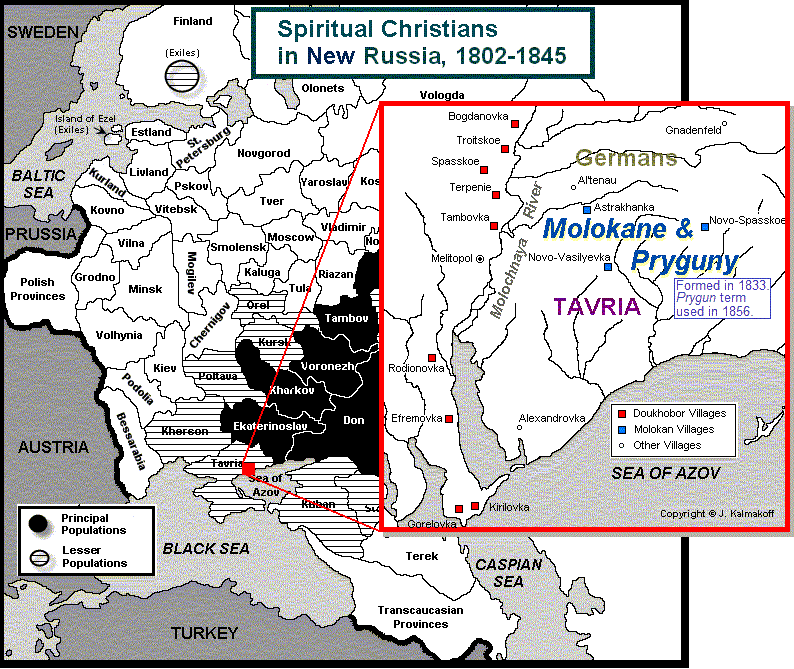
word "Molokan" occurred in 1765. The word Pryguny
appeared about
1856 in New
Russia. Dukh-i-zhizniki
were formalized in 1928 in Los Angeles, but label
formed in 2007. The Spiritual
Christians From Hastings Encyclopedia of Religion and Ethics,* we learn that Spiritual Christianity
Molokanism
was originally a simple Christianity marked by
anti-Ritualistic opposition to the state church.** The Russian
Encyclopedia*** adds that
"the Molokans teach the evasion of those laws which in
their opinion are contrary to the Holy Scripture as for
instance the laws of military service and the taking of
oaths".
Like other dissident sects of that period, the Spiritual Christians Molokans had to endure cruel persecution for their beliefs from PAGE 172 the Russian church and State. They sought to alleviate such cruelties by petitions to the Tsar, but were only partly successful. In the year 1839 they were given permission to settle in the then wild frontier countries, such as Siberia, Azerbaijan, Armenia, Georgia, and Crimea. For being pioneer colonists Together with this permission they were given an exemption from military service for a period of 50 years. [See explanation above.] Our immediate ancestors were offered land and toleration, and voluntarily chose to settle in small villages throughout Trans-Caucasia, where in short space of time, by their industry and thrift they were, able to establish a standard of life far above the surrounding native population. Upon the expiration of the 50 year period the government again forced military service upon our people , unless they again became colonists in Kars oblast or Turkmenistan. Whereupon the elders began to seek other places of refuge. Many different places were suggested and tried, but none proved to be satisfactory. In the year 1898 1900 when the
Dukhobours [Doukhobors]—who
were living in neighboring villages—and who were having
similar difficulties— 1/3 were settled in Canada, our elders
sent a delegation there to determine whether they too
could find the same refuge. Upon the return of the delegation with a favorable report, a determined effort was made to secure from the Russian Government a further exemption from military service. Failing in this, they fried to secure permission to leave the country "en masse". This was also denied them. It was then decided to move to America in small groups. In 1903, three Spiritual Christians (2 Prygun, 1 Molokan) [page 19] Molokans, without families arrived in Canada. The climate there, seemed too severe for them. While there they met some Russian political refugees [Bodyansky, Demens, Khilkov?], who told them that the same freedom from compulsory military service, and the same opportunities to make a living PAGE 173 exist in the United States as in Canada. They further recommended Southern California as an ideal place where Demens offered work in his businesses and colonization aid. The three Spiritual
Christians Molokans
immediately departed for Los Angeles. Following them
came other groups, small and large until 1912, at which
time there were about 4,000 of us in Southern
California. Less than 1% of the Russian
Spiritual Christians in Russia migrated to the U.S. In coming to America we had no intention to live in
cities, but having expended all of our resources in
getting here we were forced to stop in cities to
recuperate. Actually, Demens
personally guided them to Los Angeles, provided train
fare and offered jobs in his businesses (lumber,
laundry). In Los Angeles, they were greeted by the
Bethlehem Institutions which specialized in converting
poor illiterate immigrants into tax-paying citizens.
The city provided mild climate, utilities (water, gas,
electric, sewage), free medical care, free child
daycare, free county burials, free education, free
English and citizenship classes, free job training and
placement, low-cost public transportation, indoor
plumbing, urban entertainment, police and fire
services, much higher wages than rural life; and a
choice of many Protestant faiths and city temptations.
The most zealous faiths established "kingdoms in the
city." Unfortunately, however, the temptation to remain in the
city became stronger as the years went by. Although many
efforts were made to settle the whole group on farms,
none proved successful because most of the colonists were sold
poor land at high prices. However, there are a
number of successful small groups living on farms in
California, Arizona, and Oregon. When the United States entered the last war in 1917 the Pryguny Molokans again bestirred themselves towards securing exemption from compulsory military service. In June of that year they sent a delegation of three men to Washington, D.C. with a petition to President Wilson in which, among other things, it was stated that, "even the inclusion of our names in military rolls was prejudicial to our consciences". In answer to this petition Provost Marshal General Crowder, in a letter dated June 19, 1917, gave them the same status as conscientious objectors as the Friends, Mennonites and other historic peace churches. Notwithstanding this fact, seven members of our faiths were given sentences of 12, 15 and 25 years for draft evasion in the last war. Happily they were released soon after the end of the war. In September of 1940 after the passage of the present selective service act, the Dukh-i-zhizniki Molokans, realizing that the act as it relates to the conscientious objector is so complicated PAGE 174 that the average Dukh-i-zhiznik Molokan boy affected by the act could not secure the full benefit of the law decided to elect an advisory council to assist any Dukh-i-zhiznik Molokan registrant seeking its advice. The present duties of the Advisory Committee is to maintain contact with the National Service Board, to raise funds for the maintenance of assignees in C.P.S. Camps and act in a general advisory capacity to the whole Molokan group on C.O. matters. At the present time there are approximately 10,000 Dukh-i-zhizniki Molokans in the United States. Some of them are farmers many are laborers, the majority are artisans, mechanics and truck drivers. The majority are either native born or naturalized American citizens and many more would apply for naturalization if they were not deferred by their objection to taking an oath and by the knowledge that citizenship would be denied them unless they were willing to take arms to defend the country in time of war. In Los Angeles, there are six branches of the Dukh-i-zhizniki Molokan church. There are also branches in Shaffer, Kerman, and San Francisco, California, as well as Glendale, Arizona and Shedd, Oregon. The tenets and services in all
these branches are identically the same. False. The
services consist of singing of Psalms and songs, reading
of the scriptures, prayer, and exhortations and the manifestations
of the Holy Spirit as recorded in the 2nd chapter of
Acts, called jumping. By the mid-1950s the Prygun services in Los Angeles
and Arizona had been extinguished by the Dukh-i-zhizniki. Prygun congregations
remained in Mexico and San Francisco to the mid-1960s. The sole reason of having six
different branches*
in Los Angeles is that upon arrival in America, each
regional group desired to remain under the pastorate of
the man who was their pastor back in the village at
home. This system continues until the present time,
although there is a marked tendency towards unification
which has PAGE 175 resulted in one
branch "Big Church"
becoming much larger than the others.
In conclusion I would like to
quote from an author who has made a 5 year study of the Pryguny
Pauline V. Young in the "Pilgrims of Russian Town" says, "The Prygun faith Molokanism is both a system of thought and a way of life. The Prygun Molokan is a man of prayer and in His most ordinary acts closely associates sacred with secular attributes. To the Prygun Molokan active in faith, distinction between the two is unknown. Belief and act are inseparable." Trusting that this short resume would be Sufficient, I remain, Yours sincerely, Addenda VIIOffice of the Assistant to the Attorney General Washington (25) April 20, 1944 Mr. John K. Berokoff, Secretary My dear Mr. Berokoff: This acknowledges your letter of April 20, 1944, signed by yourself and ten other ministers and elders of the Brotherhood of Russian Molokan Spiritual Christian Dukh-i-zhizniki Jumpers with reference to the hearings conducted by the Hearing Officers of this Department in conscientious objector cases involving members of your sect. PAGE 176 At the outset, I wish to assure you and your associates that this Department has always recognized the Dukh-i-zhizniki Molokan Church as a "Peace Group" sect, and the tenets of your religion with regard to participation in war are well known to all officials of this Department engaged in the administration of the Selective Training and Service Act of 1940. I desire to point out, however, that membership in the Dukh-i-zhizniki Molokan Church or any other religious denomination does not necessarily qualify a Selective Service registrant for exemption as a conscientious objector. The state of the individual registrant's conscience, rather than his affiliation with any particular denomination, is the question of fact to be determined in deciding whether or not he shall be exempted as a conscientious objector. While the members of the older generation of Dukh-i-zhizniki Molokans may be conceded to adhere strictly to the principles and teachings of their religion, it has been found that many of the younger members professing membership in the Dukh-i-zhiznik faiths Molokan Church have so far deviated from the strict requirements of their religion that they have been found wanting in the "religious training and belief" which would warrant exemption as conscientious objectors. I wish to assure you, however, that this Department is as concerned as the elders and ministers of your church about this particular problem and I feel quite certain that Hearing Officers Williams, Hartke and Files will make every effort to decide Dukh-i-zhiznik Molokan cases coming before them with the utmost consideration and fairness. Of course, each case must be decided upon its individual merits. The matter has been called to the attention of the Hearing Officers involved, and I have no hesitation in PAGE 177 assuring you that you will receive the sympathetic understanding of any one of these Hearing Officers if you desire to make representations to them concerning any particular case which may be referred to either of them in the future. Very truly yours, Missing Addenda VIII Spiritual Christians from Russia MOLOKAN BRETHREN IN IRAN to PRESIDENT HARRY S. TRUMAN and SUPPORTING COVER LETTER from the L0S ANGELES ELDERS Addenda IXTo His Excellency, Harry S. Truman, Sir: Enclosed herewith is a petition of our friends in Iran which we are forwarding to you at their request. We also enclose an English translation of the petition which too, was made at their request. In forwarding this petition we are not unmindful of the fact that the President of this nation is occupied with far more important matters than the affairs of a small group of foreign refugees in far off Iran, but the desperate plight of these brothers in faith compels us to take the presumptuous step of trespassing upon your valuable time. Since the close of the recent war, many of us individually and our whole Dukh-i-zhiznik Molokan Community collectively, have been frequently receiving urgent and pathetic pleas for help from these unfortunate people. Their letters to us are, naturally, written with less restraint than the enclosed petition, hence their description of the life of a small group of Christians amidst a fanatically Mohammedan population is far more graphic and inspirational of pity. We as the more fortunate members of the same religious faith, did not remain unresponsive to their pleas. PAGE 179 On numerous occasions sums of money were collected and forwarded to them for their immediate needs. Indeed, some of us who have relatives among the petitioners have made applications through regular Immigration channels for their admission to the United States, and provided funds for their passage as well, but until now only two families were thus admitted. The suffering and privations of these refugees as narrated to us by the two recently arrived families intensified our concern for them many-fold, that is why we join them in their pleas. Cannot some ways be found to facilitate their admission to this country? If seems that most of these people were born in a part of old Russia (the Province of Kars) which had been acquired by Turkey after the first World War. Consequently, a ruling has been made by either the Consulate at Teheran or by the Immigration authorities in Washington, that they must seek admission not under the Russian quota which is large, but under the Turkish quota which is very small. We respectfully submit that this ruling is unjust and creates an unnecessary obstacle in their path towards admission. Cannot this obstacle be removed by permitting them to file under the Russian quota? As naturalized and native-born citizens of the United States, as residents and tax payers of this country for over forty years, we vouch for the integrity, industry, and collective temperance and character of these petitioners. Furthermore, we can assure you, Mr. President, that they are entirely free from any subversive elements, and if admitted, they will not become a burden upon any private or public institution for their subsistence, but that they will become law-abiding, self-supporting citizens of this great nation. PAGE 180 Respectfully submitted by the undersigned Pastors and Elders of the various Dukh-i-zhiznik and Prygun congregations Molokan churches in California and Arizona: Signed by 6
Dukh-i-zhizniki, a Prygun, but no Molokane.
Addenda X missing Addenda XI
To His Excellency Harry S. Truman, PETITION We are Spiritual Christians — Molokans, Pryguny, Subbotniki, with a few Baptists and Orthodox, numbering approximately 300 souls. By profession we are farmers, cotton raisers, cattle raisers, dairymen, and some mechanics. We have fled the Soviet Union and came to Iran in the early 1920's. The Soviet Government had been pursuing all religious people. As a result of this, many of our brethren PAGE 181 in faith perished from tortures, in prisons and in exiles, many were forcibly separated from their families, wives from their husbands, and infants from their mothers. However, nothing they could do caused us to be afraid. They could not quench in us our faith in the living God, for we were guided by the word of God as it is written in the Epistle of Paul to the Romans, Chap. Eight, Verse 35: "Who shall separate us from the love of Christ? Shall tribulation, or distress, or persecutions, or famine or nakedness, or peril, or sword? Nay, in ail these things we are more than conquerors through him that loved us." Even as the Saviour himself hath said: "Fear not them which kill the body, but are not able to kill the soul." Suffering from harsh and cruel tribunals, many of our brethren fled from city to city and from village to village, until some decided to escape to countries where people still confessed their faith in the Almighty Creator. Over dangerously steep and rocky mountains and cliffs, carrying our beloved children on our backs, not infrequently leaving them behind, frozen to death in the snow, without clothing or any means of subsistence, we finally crossed the border into Iran which is adjacent to the Soviet Union. But alas! our reception here was not hospitable owing to the religious fanaticism of the people. The Government would not permit us emigrants to settle where we could more easily make a living for our families, instead directed us, for the most part, into tropical and malarial regions where many of us died of various tropical diseases. Existing from the very beginning of our emigration under the severest kind of living conditions, having no means of livelihood, neither property nor any land fit for cultivation, we are doomed to perish here. Reading in the newspapers where your Excellency, PAGE 182 as a religious Christian, upon taking the office you prayed God to grant you wisdom to govern the people as he hath granted to Solomon the King of Israel. We could now clearly discern as could all the peoples of the world, that God did invest your mind with that wisdom and love towards humanity so that now all religious people of the world turn their face towards you, Mr. President. This is further attested to by the letters of our Brethren in faith who since 1904, have been living in the United States of America in the cities of Los Angeles, San Francisco, Fresno and other communities of California and Arizona. In view of everything set forth above we, elders and children alike, humbly beg you, Mr. President, on our bended knees, turn your merciful gaze upon us who are weary because we have suffered much, have been persecuted for the Word of God and for the sake of righteousness. Take us under your protection and permit us to enter the confines of the United States of America, where we could be useful to your country and where we could praise and worship our God in peace and happiness. May the words of our lord Jesus Christ be fulfilled by you, for He hath said: "Verily I say unto you, inasmuch as ye have done it unto one of the least of these, my brethren, ye have done if unto me": Matthew 25, Verse XXXX. Our brethren in faith
who live in the United States and who number
approximately 15,000 persons, will vouch for our
dependability and love of labor.
July 21, 1947 PAGE 183 Addenda XII missing Addenda XIIIWashington In reply refer to October l5,1947
Mr. John K. Berokoff, Dukh-i-zhiznik Molokan Advisory Council, 335 South State Street, Los Angeles, California. Sir: I have by reference from the White House your communication of September 14, 1947, and its enclosures, concerning your interest in the visa applications of persons born in the Province of Kars. It may be explained that for quota purposes the law requires that nationality be determined by the country of the alien's birth. Persons born in territory which has been transferred from one country to another, such transfer having been recognized by the United States, shall be considered to have been born in the country to which the territory was transferred. The United States has recognized the transfer of the Province of Kars to Turkey and, consequently, persons born therein are chargeable to the Turkish quota. Very truly yours,
RESOLUTION ADOPTED BY THE Dukh-i-zhiznik MOLOKAN
Addenda XIV
Hon. Carl Vinson, Chairman Washington, D.C. Gentlemen: The undersigned members of the Dukh-i-zhiznik Molokan Spiritual Christian congregations Churches in Los Angeles and vicinity are deeply concerned regarding the Proposed new Selective Service Bill H.R. 7442. Individually and collectively we feel that compulsory military training is not a solution to the present world crisis. We feel that a large military establishment in the age of the atom bomb and other hellish weapons is altogether superfluous. Solutions based on Christian and humane principles should be sought by responsible government officials. We therefore earnestly urge that present plans for compulsory military training be abandoned. PAGE 185 Furthermore as religious objectors to war and military training in any form, we earnestly urge that in the event the proposed new bill is to be considered, provisions for conscientious Objectors as embodied in the Selective Service Act of 1948, (Section 6, J) be restored in its entirety. Very sincerely yours, Addenda XVHon. Andrew May, Chairman Dear Sir: I am enclosing herewith a copy of a resolution passed by delegates of our several churches at their meeting on February 18th of this year. This resolution expresses the unanimous sentiment of our people on this subject. I shall be very happy to send you any additional information on the Dukh-i-zhiznik Molokan people that you may desire.
PAGE 186 Addenda XVIHon. Clifton A. Woodrum Dear Sir: Enclosed is a copy of a resolution passed by delegates of our several churches on February 18th last. The Resolution expresses the unanimous sentiment of our people on the post-war plans for military conscription. I would he very happy to furnish any further information on the Spiritual Christians from Russia Dukh-i-zhiznik Molokan people that your committee may desire.
Addenda XVIIWHEREAS, it has come to our attention that the Congress of the United States of America has before it a proposal to enact a bill to initiate permanent peacetime military training in the United States and, WHEREAS, the United States of America has existed as a nation without peacetime compulsory military service since its beginning and, WHEREAS, this has been a vital factor in attracting to the nation the best of human elements from the four corners of the world, enabling it to grow and prosper beyond the dreams of its most far-sighted founders, and WHEREAS, permanent military training will tend to breed a professional military class which, by its nature, is bound to be undemocratic and in direct contravention to the intents and desires of the founders of the nation and framers of its Constitution, and PAGE 187 WHEREAS, the Brotherhood of the Russian Molokan Spiritual Christian Dukh-i-zhizniki Jumpers, also known as the Dukh-i-zhizniki Molokans, has as one of the principal tenets of its religious faith, objection to military service of any kind, in peacetime or in war, and WHEREAS, The Dukh-i-zhiznik Molokans have, on numerous occasions, made this tenet known to the various governments of the United States of America, notably in a petition to President Woodrow Wilson in June of 1917 and in a similar petition to President Franklin D. Roosevelt in October of 1940, as well as in subsequent communications to Various officials of the Federal Government. Therefore be it RESOLVED, that the Brotherhood of the Russian Molokan Spiritual Christian Dukh-i-zhizniki and Pryguny Jumpers, comprising in its entirety approximately 10,000 persons residing in the states of California, Arizona and Oregon, through the representatives of its several branches in meeting assembled at Los Angeles, Calif., do again make known to whomever it may concern, our unalterable objection to military service and to urge the lawmakers of the nation to refrain from passing any legislation for the establishment of permanent military conscription, which, in the long run, will certainly be detrimental to the nation's welfare, and further be it RESOLVED, that the Brotherhood of the Russian Molokan Spiritual Christian Dukh-i-zhiznik Jumpers, through its representatives, do again inform whomever it may concern that, in the event that legislation is passed establishing permanent compulsory military service in the United States, if is our intention to abide faithfully by the tenets of our religion in respect thereto, and further be it RESOLVED, that copies of this
Resolution, together with copies of the Petitions to
President Wilson and PAGE
188 President
Roosevelt, be forwarded to the Chairman of the House and
Senate Military Affairs Committees, to Senator Sheridan
Downey and Senator Hiram Johnson and to each member of
the California delegation to the House of
Representatives. Dated at Los Angeles, California,
February 18, 1945.
Addenda XVIIISELECT COMMITTEE ON POST-WAR MILITARY POLICY Washington, D.C. My dear Friend: Your communication relative to Universal Military Training has been received and will be filed with the Committee on Post-War Military Policy. The Committee has conducted open public hearings on the broad general policy of Post-War Military Training. A full opportunity has been given for the presentation of the views of those who favor and those who oppose this policy. Your interest in this matter is appreciated. Sincerely yours, Clifton A. Woodrum
Chairman PAGE 189 Addenda XIXHouse of Representatives Washington, D.C. May 9, 1945 Mr. John K. Berokoff, Secretary, Dear Friends: Received your letter of April 23rd and the resolution attached thereto. I am glad to have the information regarding the beliefs of the brotherhood. The question of compulsory military training will come before the Military Affairs Committee soon for decision. I do not know what form of military training will be adopted by Congress. Regardless of the type of training decided on, however, I believe provisions should be contained therein which would grant to conscientious objectors immunity from such military training. I will personally offer such an amendment when the proper time arrives. With the present tenor of public opinion, I believe some type of compulsory military training will be passed and it is my opinion religious groups such as yours, Seventh Day Adventist, the Friends, and other similar groups would do well to concentrate your influence on making sure such a provision of immunity is contained in the measure, rather than expending your influence fighting against the proposal of compulsory military training. I would appreciate your views on the thoughts I have outlined. Most sincerely, CH:rn By the 1960s, the
remaining congregations of diaspora Spiritual
Christian Pryguny were extinguished. PAGE 190 Addenda XX missing Addenda XXICONCERNING EMIGRATION TO AUSTRALIA OCT. 2. 1964 The Dukh-i-zhiznik Molokan
community of Los Angeles as represented by the elders of
the various congregations
churches
deem it advisable at this time to acquaint the American
public with their position relative to the recent
reports that a mass emigration to Australia is
contemplated. It is considered timely and appropriate at
this time to state that the Dukh-i-zhiznik Molokans
of the United States hold no grievances against anything
or anyone pertaining to their life in America. Being a small,
little known Christian folk-Protestant
sects, holding
to convictions considered strange or old-fashioned by
some, such as wearing of beards, observing of Mosaic
dietary laws, conscientious objection to military
service etc. we have at all times been treated with
courtesy, consideration and fairness in our dealings
with local people, local, state and Federal authorities.
The Dukh-i-zhiznik Molokan
people are unanimous in considering America as a holy
refuge from the evils that befell the world since 1914 when WW1
began. It is true that when the Prygun Molokan
leaders of the previous generation led our people to
America from Russia in the first decade of the present
century they did so in response to a revelation received
by a youthful prophet E.G. Klubnikin in
the middle of the previous century. At that time it was
foretold that our sojourn in America would not be a
permanent one. However, the duration of our stay here
was not disclosed. Therefore, we
don't have to leave now. PAGE 191 The
small group of our people who sailed recently to
Australia, did so not because of any economic or
political reasons but to an inner response to a
prophetic revelation that the time of our sojourn here,
as foretold by previous prophets, has ended. It is not
true however, that a mass emigration to Australia or to
any other place, is being contemplated now. The majority
of our people believe that a further confirmation of the
recent revelation is necessary before an emigration of
such magnitude, entailing as it does, privations and
hardships, is or should be attempted. As in Russia 60 years earlier,
the majority 98+% of Spiritual Christians did not
leave. See Introduction: Why did 99% stay in Russia?
Signatures PAGE 192 OF CONCORDIA SEMINARY OF ST. LOUIS, MO. CONCERNING Dukh-i-zhiznik MOLOKAN DOCTRINES AND RELIGIOUS PRACTICES FOR INCLUSION IN HIS PROPOSED REVISION OF A BOOK "THE RELIGIOUS BODIES OF AMERICA" AND REPLIES BY JOHN K. BEROKOFF AS AUTHORIZED BY Dukh-i-zhiznik MOLOKAN ELDERS AT A MEETING ON NOVEMBER 1966 Addenda XXIILutheran - Founded 1839 801 De Mun Aye., St. Louis 5, MO. 5 November 1966 Dear Mr. Berokoff: The Reverend Harold J. Sherk , Mennonite Brethren in Christ, of the National Service Board for Religious Objectors referred me to Mr. John Slevin for information about the Dukh-i-zhiznik Molokan Advisory Council. In reply to my letter he in turn referred me to you. The occasion for my interest is that I have been asked by Concordia Publishing House, St. Louis, to prepare a new and completely revised edition of the late Lutheran scholar Frederick E. Mayer's "The Religious Bodies of America" (4th edition 1956, updated in 1968). I should like to make the new edition of this reference work as complete, as accurate, and as authoritative as possible. For that reason I write to ask you for such information as you can give me on the doctrinal basis, the history, the worship, the distinctive practices, the geographic distribution, and the overall membership of the Dukh-i-zhiznik Molokan Advisory Council. If there are any books, pamphlets, or magazine articles that provide this information, I should be grateful if you would give me the titles and tell me where I can obtain copies and, if you have this information, what they cost. I look forward to early word
from you. For your convenience I enclose an airmail
reply envelope that requires no postage.
PAGE 194] Addenda XXIII
St. Louis, Mo. Dear Mr. Piepkorn: I have your letter of Nov. 5th in which you request information concerning the Dukh-i-zhiznik Molokan Advisory Council. I presume that actually you are seeking information about the Russian Molokan Spiritual Christian Jumpers rather than the Dukh-i-zhiznik Molokan Advisory Council because the Dukh-i-zhiznik Molokan Advisory Council by itself is not a religious entity. It was only an arm of the Russian Molokan Spiritual Christian Jumpers. It was organized by the parent body in 1940 to counsel and assist young Dukh-i-zhiznik Molokans in their problems as conscientious objectors during the Second World War and the Korean War. The Dukh-i-zhiznik Molokan Advisory Council was affiliated during that period with the National Service Board for Religious Objectors but shortly afterwards, due to slow-downs in the draft calls, it ceased to exist. However, we continue to cooperate with that body on an informal basis because, like other members of that organization, we too are known and recognized as a historic peace church, therefore we sympathize with their work and avail ourselves of their service from time to time. I am afraid that I could not supply you with detailed information on our history in this letter. For that data I would refer you to the Encyclopedia Britannica 1913 edition. PAGE 195 See the article on "Molokans." You might also consult F. C. Conybeare's "Russian Dissenters" [page 289] published by the Cambridge Press in 1921. It is also difficult to do
justice in a letter to our doctrine and form of worship.
We have recently published an English translation of
some of the works of our founders. The title is
"Selections from the Book of Spirit and Life."* There you will
find some, although not complete but authoritative
explanations of our doctrines and form of worship. It
could be purchased through the writer at $5.00 per copy
plus postage. But if you would prefer, I could mail you
some excerpts from that book at no cost.
At this time I will limit myself to the following remarks: A non-Dukh-i-zhiznik Molokan visiting our meeting church services would probably say that our form of worship is unsophisticated or even primitive because we try to adhere strictly to the form prescribed by the founders of our denomination who were, for the most part, peasants, artisans and small merchants in Russia. Our church interiors are entirely bare. The only furniture is a table covered by a white table cloth on which are placed an opened Bible, the New Testament, our prayer book and a book of spiritual writings of our founders called "The Book of Spirit and Life". The table is surrounded on four sides by plain benches. Those benches on three sides that are immediately next to the table are occupied by leading elders. Towards one side of the table the first three or four benches are occupied by the male chorus while the opposite side on the first bench sit the prophets. The benches in back of these are occupied by the younger members and children. PAGE 196 The fourth side, facing the end of the table and completing the quadrangle, is occupied by the women with the most respected elderly women sifting on the front benches. Our regular church service begins with everyone sitting, and, while the congregation is assembling, we sing psalms and other passages from the scriptures and from the Book of Spirit and Life. In between the songs our elders read and preach from the scriptures and deliver homilies. After about an hour of this, at a signal from the presbyter, the benches are removed and the prayer service begins. This consists in singing an appropriate song while everyone approaches by turns and places an offering on the table. Following this the presbyter leads in prayers while the congregation is all kneeling. About four prayers are recited when everyone rises. At this time we perform the ceremony of the holy kiss which we call the communion. Everyone beginning with the assistant presbyter, kisses the presbyter and stands alongside of him followed by others who kiss the presbyter and others standing in the line. This is followed by everyone until the whole congregation, old and young, male and female, participates in the holy kiss. This is done while the chorus is singing an appropriate song such as the last five verses of Romans 8, 35: "who shall separate us from the love of Christ?" etc. After this ceremony another prayer is recited with all kneeling following which the chorus sings several joyful spiritual songs. But we consider that the service has not reached its fullness unless there is a manifestation of the Holy Spirit which activates and moves at least some of the members in joyful spiritual jumping. PAGE 197 The service is concluded with another prayer by the presbyter, this time all standing. I believe that this answers
your request for the form of worship and distinctive
practices. In addition to this our men wear beards and
are required to wear a kosovorotka
Our doctrines in brief are similar in many respects with other protestant denominations. We believe in God and His Son Jesus Christ. We believe that He was born of the virgin Mary, that He died for our sins and arose on the third day, ascended to heaven and now sits at the right hand of the Father. We believe that He will return again to judge the quick and the dead and will reign with His chosen ones for a thousand years on earth. We believe in praying and conducting services for the dead and adhere strictly to the Mosaic dietary laws and we believe in the sanctity of the marriage vows. As for the geographical distribution, originally we are from the southern part of Russia. Before the Communist revolution the Spiritual Christians Molokans were very numerous in that area, perhaps over a hundred thousands but no one knew for certain as our ancestors were strict in their belief against taking of census. There are many of our people there even now although the Soviets managed to lessen their number considerably by one means or another. In the United States, to which our fathers brought us in the year 1904-1912, there are now approximately 12 to 15,000 of our denominations. The largest majority are located in the metropolitan area of Los Angeles. About 50 families reside in San Diego county, perhaps 50 families around the San Francisco area are Molokane and a large number of Dukh-i-zhizniki are PAGE 198 in farming communities in The San Joaquin valley. A small group of 30 or 40 families around Salem, Ore. and a similar number near Phoenix, Arizona. In addition to these a small group of our people recently emigrated to Australia and are living there, some in the Perth area and some near Adelaide. We appreciate your efforts in compiling accurate presentation of our denomination. John K. Berokoff Addenda XXIV missing Addenda XXVLutheran - Founded 1839 801 De Mun Ave., St. Louis, Mo. 63105 22 November 1966 Mr. John Berokoff Dear Mr. Berokoff: Thank you very much for your prompt, helpful, and detailed answer to my request for information about the Dukh-i-zhiznik Molokan Advisory Council. I enclose a cheek for $5.50 herewith to cover the cost of one copy of "The Book of Spirit and Life, plus postage. You will, I trust, pardon me if I ask some additional questions, particularly if in my ignorance I ask one or the other question in the wrong way. PAGE 199 In your letter you state that at your services there are on the table an opened Bible, The New Testament, your prayer book, and "The Book of Spirit and Life." I take it that there are four books on the table. Is this correct? Is only the Russian edition of "The Book of Spirit and Life" placed on the table, or may the English edition that you are sending to me be substituted? Is there an English edition of your prayer book available? If so, what is the price? If not, can you give me (in Russian, if you prefer, which I am able to read, although with some difficulty) the full title of your prayer-book, the place where if was published, the publisher or printer, and the year of the current edition? I take it that there are
still members of your faiths church body in the Soviet Union.
Have you received many new members by immigration in
recent years? Have many of your people immigrated back
to the Soviet Union since the November Revolution? (I
ask this question because about ten years ago some 2,500
members of another group of Russian dissenters, the
Doukhobors of Canada, did return, to the Soviet Union.)
Error: 2,500
Canadian Doukhobors did not return to Russia about
1956. Dr. Piepkorn appears to have combined bits of
several news stories and imagined something that never
happened. He may have read that in 1902, about 2,500
marched in protest from their villages north of
Yorkton, though many talked about going back. Here's
what Canadian Doukhobor historians have documented. This leads me to ask another question. Do all the members of your church-body belong to the same group, or are they divided into different movements? (Here again the question is prompted by the fact there are two branches three kinds of Doukhobors in Canada, the Conservative or Orthodox Doukhobors, the Independent Doukhobors, and a group that separated from Doukhobors in 1901 who were later labeled the Sons of Freedom.) From a German source I have information that several groups withdrew from the main body of Molokane in the Soviet Union and persisted at least until 1959 — the "Gemeinsamen" (as my source calls them), the New Molokane (who ultimately joined the Gospel Evangelical Christians, and the Subbotniki. Are any of these groups represented in the United States or Canada? PAGE 200 In your letter you refer to the presbyter. Do you have any persons who exercise oversight over the presbyters, that is, persons who would be comparable to bishops, superintendent, or (as among us Lutherans) district presidents with responsibility for a state or the major part of a state? About how many churches or groups presided over by a presbyter are there in your denomination in The United States and Canada? Do you use Russian exclusively in your services or is English also used? What is the official title of your church-body in Russian? Do you receive many members through conversion from other church-bodies or from a status of no church-membership at all? Do you lose many members to other church-bodies or to unbelief? Over the period since World War II would you say that your church-body has grown or declined in size? What in your opinion are ifs prospects for the future? I am sure that some of my questions are answered in "The Book of Spirit and Life." If they are, please do not put yourself to the trouble of answering them in a letter. Again, if you regard any of these questions as improper, please feel free to disregard them. After I receive "The Book of Spirit and Life" I may have a few more questions, and I hope that you will let me put them to you. I do have one question that
does not pertain to the Russian Molokan Spiritual Christian Dukh-i-zhizniki Jumpers,
but in which you might be able to be some help to me. As
I have indicated, I know about your church-body and
about the Doukhobors. Otherwise I know of no
church-bodies of Russian origin (except, of course, the
three Russian PAGE 201 Orthodox bodies
and the colonies of "German-Russian" Lutherans) in the
United States and Canada. Do you by chance know of any
other bodies of Russian religious dissenters who have
transplanted their church-life to this country or Canada
(such as, possibly, the Staroobryady Popovcy, Staroobryady Bezpopovcy,
Pornorzy, Imjaslacvy, Nozdychency, Liudi Bozii [Luidi Bozhe, Khlysty], the New
Israelites that followed Vasilij Lubkov, Skopcy, the
Osnoynoe zveno Christa, or Jenochovey)?
Addenda XXVI missing Addenda XXVIILos Angeles, Calif
November 29, 1966
Dear Mr. Piepkorn. Herewith are answers to your inquiries concerning the Russian Molokan Spiritual Christian Dukh-i-zhiznik Jumpers. I will answer them in your chronological order. I. It is true that there are
four opened books on the table as I wrote you and only
the Russian version of the Book of Spirit and Life is
allowed on the table as our 3rd
Testament to the Bible. An English translation
of the Prayer Book is included in the "Selections from
the Book of Spirit and Life" a copy of which I am
mailing you under a separate cover. If, however, you
prefer to have the Russian version of the Prayer Book,
it could be purchased from the publisher, Mr. Paul
Samarin, 944 Orme Ave; Los Angeles, Calif. 90023. I do
not know PAGE 202 its present
price but I am sure that it is not over $2.00. It was
last published in 1959. Its title in Russian is
"Molitvenik". The other Services in the Prayer Book, marriages, baptismal and funeral are followed to the letter in all churches in the United States except the Molokane Postoyannaye. 2. There are still many of our people in The Soviet Union although their freedom is curtailed to a great extent. None of them have immigrated to the United States since the revolution, likewise, none of us had returned there since then and very few have the desire to do so. I believe that your
information concerning the 2,500 Doukhobors returning is
incorrect. There had been negotiations to that end but I
am sure no such large group had returned although some
individuals might have done so. You might cheek with a
friend of mine, a well known Doukhobor, Mr. Peter N. Maloff,
Thrums, B.C., Canada. It is surprising that Berokoff
claims Maloff to be "a friend of mine" yet say nothing
about the Doukhobor burning
of arms in 1895 impact of Lev
N. Tolstoy on the migration of Spiritual
Christians from Russia to North America.
3. With the exception of a
small group of 75-100 families in San Francisco who are
Spiritual Christian Molokane of the
Postoyannaye PAGE 203 branch of
Molokany, all of the other
various groups in Arizona, California and Oregon belong
to the Russian Molokan
Spiritual Christian Dukh-i-zhiznik Jumpers.
In all of these some minor doctrinal differences
could be found and
several but no outright divisions. A
member of one congregation could and does freely move
from one congregation as is convenient for him.* As for "The New Molokane"
group in the Soviet Union, we have none here, in fact,
we have never heard of them. Some may have immigrated as
Stundist-Presbyterians to Los Angeles, and quickly
assimilated among the congregation ministered in the
Russian language by Rev. Henry Teichreib. This further
shows that Berokoff had no contact with Molokane, even in
Los Angeles, and limited knowledge of their history.
4. There are no bishops etc. in our denomination. Each individual congregation is entirely independent and is free to select its own presbyter and elders as it deems necessary. Whenever a problem arises that concerns The entire brotherhood, a meeting of presbyters and elders is called upon the initiative of one or another presbyter and an endeavor is made to arrive at a common understanding. Of course it is natural, as in any other group that the word of some elder carries more weight than others. 5. There are at present 15 congregations churches
presided over by a presbyters in California, Arizona and
Oregon. There are none in Canada. By 1966, after the accidental death of
their presviter, the Mexico Prygun
congregation
stopped holding regular meetings. Because Doukhobors
have been confused with Molokane and Molokane
originally intended to migrate to Canada to follow
the Doukhobors, false reports still exist that there
are Molokane in Canada. 6. The Russian language is
used exclusively in all services except in the Sunday
schools and in the young people's meetings. These are
conducted in both languages. Some
congregations allowed limited English during their Paskha
holiday youth hosted service. Most allowed English
memorial speeches during evening funeral wakes when
there was no formal service being conducted. After
Berokoff's book was published, limited English usage
increased in most of the liberal diaspora Dukh-i-zhiznik
congregations. 7. The title of our church
body in Russian is: Dukhovnaye
Christiani Pryguny [Dukhovnye khristiane-pryguny, духовные
христиане-прыгуны]. — Notice the term Molokan
is not included.
8. During our 60 years in the
United States only a very few members were accepted from
other faiths
church
bodies or from non-church individuals. These
were accepted primarily through marriages with other
members. This is mainly PAGE
204 due to
the fact that our services are conducted in Russian
which, as you know, is not the easiest language to learn
, Makismisty are
taught that all other faiths are false, and dominant
diaspora Dukh-i-zhizniki
are often racist and prejudiced. Outsiders who join,
and their adopted families, must endure verbal abuse
and be adaptive to survive among the conservative and
often hostile Dukh-i-zhiznik cultures. 9. I hesitate to express an opinion about our future prospects. The majority of our people believe that the power and authority of the Antichrist is already visible. This belief is based on the book of Revelations as expounded in the Book of Spirit and Life. It is believed that that power will assert itself more and more in the future, therefore, the future of all church bodies, including our own, will depend to a large extent on how well we will be able to stand up against his authority. The present world-wide trend towards indifference to religion has affected us no less than others. The general euphoria created by the extraordinary prosperity has brought about a complacency that is disturbing, and since it is well known that adversity tends to bring a person to God and to the church, it is possible that a sudden reversal in material prosperity might bring about a change in the people's concern for their souls. 10. Do we lose any members to of her denominations? Yes. The Jehovah Witnesses and the Pentecostal groups have made some inroads into our membership but since World War II our membership has grown because of the "population explosion". Most of the growth was due to the revitalization at the U.M.C.A. from 1940 up to the time this book was published, which enhanced Sunday meeting attendance. 11. As for other Russian Dissenters, I know of only one minute group that has recently immigrated to the U.S. from China via Brazil. They are settled in a farming community in Woodburn, Ore. about 35 miles from Portland. They are of the Old Believers or Starovery faith but whether they are of the Popovfsy, Bezpopovfsy or Whatever, I do not know. You might write to a friend of mine who is PAGE 205 their neighbor and who knows them very well, in fact he and others of our faith sponsored their immigration to the U.S. His address is: Efim Podgornoff, Rt. 1, Box 33, Gervais, Ore. The Starovery in Woodburn, Oregon, are of both major branches, but divided into 3 churches in one neighborhood. 12. The latest information
available here is that the New
Israelites who followed Lubkoff to San
Javier,
Uruguay no longer exists as a religious body. To all
appearances they have become assimilated in the local
population. Upon
arrival, Lubkov announced Uruguay is their promised
land, to assimilate and intermarry. Sunday meetings
and holiday services were held into the 2000s though
the hall has been converted to a museum. If I could be of any further assistance do not hesitate to write. John K. Berokoff Addenda XXVIII is missing Addenda XXIXLutheran-Founded 1839 801 De Mun Ave., St. Louis, MO. 63105 27 December 1966 Dear Mr. Berokoff: Two weeks of active duty for training in the Office of the Chief of Chaplains, Department of the Army, at Washington have put me that much behind with my correspondence. Thank you very much for your helpful response to my request for assistance in revising the late Frederick Emanuel Mayer's "The Religious Bodies of America." PAGE 206 The information you have given me is exactly of the kind for which I was looking. Can you (a) summarize briefly for me the differences between the Spiritual Christian Molokane Postoyannaye branch of The Molokany and the main body that you represent Spiritual Christian Dukh-i-zhizniki and (b) give me the name and address of some leader of the Molokan Postoyannaye group in San Francisco? As the actual rewriting
of the book proceeds, I hope that I may turn to you
again for such help as I may need.
Addenda XXXLos Angeles, Calif.
Mr.
Arthur C. Piepkorn, 337 S. State St. January 4, 1966 Concordia Seminary, St. Louis, MO. Dear Mr. Piepkorn. I have your letter of Dec. 27 in which you ask me to summarize the differences between the Molokane Postoyanaye and the Dukh-i-zhiznik Spiritual Jumpers. After 1928, Pryguny in Southern California and Arizona converted to Dukh-i-zhizniki. As you no doubt know from your researches both groups were members of one large body who were commonly called Molokany but who called themselves the Spiritual Christians. In the 1830's there was a great outpouring of the Holy Spirit among them, moving many of them to prophesy, to speak in tongues and to joyful jumping during church services. This manifestation was accepted by many as PAGE 207 divinely inspired but rejected by the majority as having no value in the services. Naturally they soon split up
into two different bodies; those who rejected* the new
manifestation remained
Molokane, called themselves "Postoyannye"**
In separating, both groups
retained the same form of worship, the same prayers and
sang the same psalms and other passages from the
scriptures. However, the Pryguny began to compose and
sing spiritual songs borrowed
from Germans and asdapted from fold songs to
more lively tunes than the psalms which the Molokane
Postoyannaye
rejected as not divinely inspired. Songs Molokane sing, which they may have
borrowed from Pryguny,
are never used in most congregations during the prayer
service, and only rarely used by any congregation that
may use a borrowed song. In America, under the
influence of master singer Misei Volkoff, diaspora Dukh-i-zhizniki developed
"the beat", a faster singing style which stimulates
spiritual jumping. See
Molokan Heritage Collection, Volume VI: The Origins of Dukh-i-zhiznik Molokan
Singing by Dr. O'brien-Rothe. Both groups adhered to the original doctrine to worship no images or ikons or the virgin Mary and the saints neither the symbol of the cross , as do all Russian Spiritual Chrisitans; like Subbotniki, Doukhobors, etc.. Both interpret water baptism spiritually and both observe the Mosaic dietary laws and honor the same founders mentioned on pages 32 and 33 of my translated book, but the American Pryguny added others to this list who were leaders in the Dukh-i-zhiznik separation such as Rudametkin, David Yessayitch and others and formed their new Dukh-i-zhiznik faiths. Both
groups originally observed the same holidays such as
Christmas, Epiphany, Lent, Easter, Pentecost and
Ascension when they
were Molokane and Pryguny. However, in the
1860's, upon the urging of Rudametkin from his prison
confinement, the Maksimisty Pryguny
who followed Maksim
Rudomyotkin gave these up as inventions of the
Ecumenical Councils and substituted in their stead the Passover, the
Pentecost, the day of Trumpets, the day of Atonement and
the Feast of Tabernacles, but we attach a different
significance to these holidays than The Israelites did.
For a
simple detailed explanation, see : Taxonomy of
3 Spiritual Christian Groups.... We Dukh-i-zhizniki commemorate the Lord's last supper on Passover night and feast the following 7 days in honor of His resurrection. We observe the Pentecost in honor of the outpouring of the Holy Spirit, the day of Trumpets in PAGE 208 anticipation of the call to last judgments; the day of Atonement we observe by fasting 24 hours in anticipation of the great judgment day and we feast eight days during the Feast of Tabernacles in honor of the soon-coming Millennium. The Molokane Postoyannaye do not observe any of these except the Pentecost. The Molokane
Postoyannaye
still hold to the old form of worship that I described
to you in my first letter (Nov. 14, 1955,
page 194) but occasionally nowadays they
sing spiritual songs borrowed from other faiths as do the Dukh-i-zhizniki, All Spiritual Christian tribes
borrowed the same songs from neighboring Germans in
New Russia. When the first songbook was first
assembled in Los Angeles in 1915, the leaders assumed
they were a "Brotherhood" and included many songs used
by Molokane,
like "Silent Night". In the 1980s, the Orloff (Dom
Maleetvee) songbook (green) removed most all Molokan songs.
Songbook updates after 1940 probably added no songs
contributed by Molokane.
Similarly, the Prygun songbook published in
Stavropol territory by singer Ilya Samarin about 2000,
removed all the Maksimist songs. At the present time there is considerable commingling
between the two groups here in California. Visitors from
either group are welcomed in either meeting church
services and young people occasionally intermarry
without hindrance. I do not know how it is in the Soviet
Union.
I am not acquainted with any of the leaders in their
group in San Francisco but the name and address of their
presbyter is Mr. Timofey A. Razvaliaeff, 1094 De Haro
St., San Francisco 24. It's amazing that a
Dukh-i-zhiznik who is describing Molokane, states that does not
personally know them, but presents himself as
"Molokan." Would he be credible if he presented
himself as a Doukhobor, or Subbotnik? J.K. Berokoff was a
very sincere man, but he censored many facts and just
could not see the the
big picture of Russian Spiritual Christian
tribes because his focus was too much on the details
of his mis-labeled Dukh-i-zhizniki. I hope that this summary will be helpful to you. Sincerely yours,
The above correspondence between
Dr. Piepkorn and Berokoff and
more is conserved at the Graduate Theological Union
Archives, Berkeley, California, were I copied them (to
be posted). See: Arthur
C. Piepkorn Research Collection for "Profiles in
Belief", the Religious Bodies of the United States
and Canada Collection
number: GTU 89-5-015,
box-folder 10:36: "Russian Molokan Spiritual
Christians San Francisco CA 1967-71". This folder
contains a mixture of infromation about several faiths
of Spiritual Christians from Russia in America.
The title of this book series
since is coded with the Lutheran and theological
term "bodies", which means "independent church
bodies", or "free
churches", not under government control, like
the Russian Orthodox Church. Spiritual Christian History Spiritual Christians Around the World |
||||||||||||||||||||||||||||||||||||||||||||||||||||||||||||||||||||||||||||||||||||||||||||||||||||||||||||||||||||||||||||||||||||||||||