Проблемы этноконфессиональных групп
духоборцев и молокан
Светлана Иникова, РАН
|
Problems with [Spiritual Christian] Dukhobor
and Molokan Ethno-Denominational Groups
Svetlana A. Inikova, Russian Academy of Science
|
[A report on Spiritual Christians in the
Former
Soviet Union up to 1998. Russian copy at molokan.narod.ru/o/inikova01.pdf.
Edits in red text and images by Andrei Conovaloff, last
updated 14 March 2025. Edited text in square brackets for
photocopy visibility.]
Русский : М.Б. Олкотт и
А.В. Малашенко, Фактор етноконфессиональной самобытности
в постсоветском обществе — М., 1998. Стр. 84-104
English: M.B. Olcott and A.V.
Malashenko, ed. Fakto
etnokonfessional'noi samobytnosti v postsovetskom
obshchestvo (Original denominational factors in
post-Soviet society), Carnegie Endowment for International
Peace, Moscow. July 1998. 203 pages. Pages 84-104. ISBN
0-87003-140-6 Edited translation of L. Bliss, re-published
in Russian
Studies in History, vol. 46, no. 3, Winter
2007-8, pp. 78-96.
|
| Появление в России сект
духоборцев и молокан(1) (или духовных
христиан) можно отнести приблизительно к рубежу XVII-XVIII
вв. В основе молоканского и духоборческого учений лежали
идеи западного протестантизма (немецкого анабаптизма,
польского социнианства), а социальной базой сект стало
свободное крестьянство. В их учениях были идеи, подрывавшие
устои государства (непризнание божественного происхождения
верховной власти и земных законов, отказ от насилия вплоть
до отказа от защиты отечества, идея избранности и т. д.),
поэтому они всегда были гонимы — и в царское время, и потом
в советское. В начале XIX в. духоборцы и небольшая часть
молокан с разрешения правительства переселились и компактно
проживали в Таврии (Мелитопольский уезд) изолированно от
русского народа. Большая же часть молокан продолжала жить в
южно-русских и центральных губерниях среди православного
населения. В 1841-1845 гг. духоборцы были выселены в
административном порядке из Таврии в Закавказье. Туда же в
40-е годы началось добровольное массовое переселение молокан
из Тамбовской, Самарской и других губерний России. Они
основывали в Закавказье компактные поселения, главным
образом на территории современных Азербайджана и Армении,
хотя много молокан продолжало оставаться во внутренних
губерниях России. |
The Dukhobor and Molokan (or
Spiritual
Christian)
sects* emerged
in Russia around the end of the 1600s.(1) Their doctrines were founded on the
ideas of Western Protestantism (German Anabaptism,
Polish Socianism),
and
their social base was the free peasantry. Because their
doctrines included ideas that undermined secular authority
(the disavowal of the divine provenance of supreme power and
earthly laws; the repudiation of violence, up to and
including the refusal to defend the motherland; the idea of
elect status, etc.), they were constantly persecuted, both
under the tsars and later, in Soviet times. In the early
nineteenth century, the Dukhobory and a few Molokane
relocated, with government permission, to the Taurida
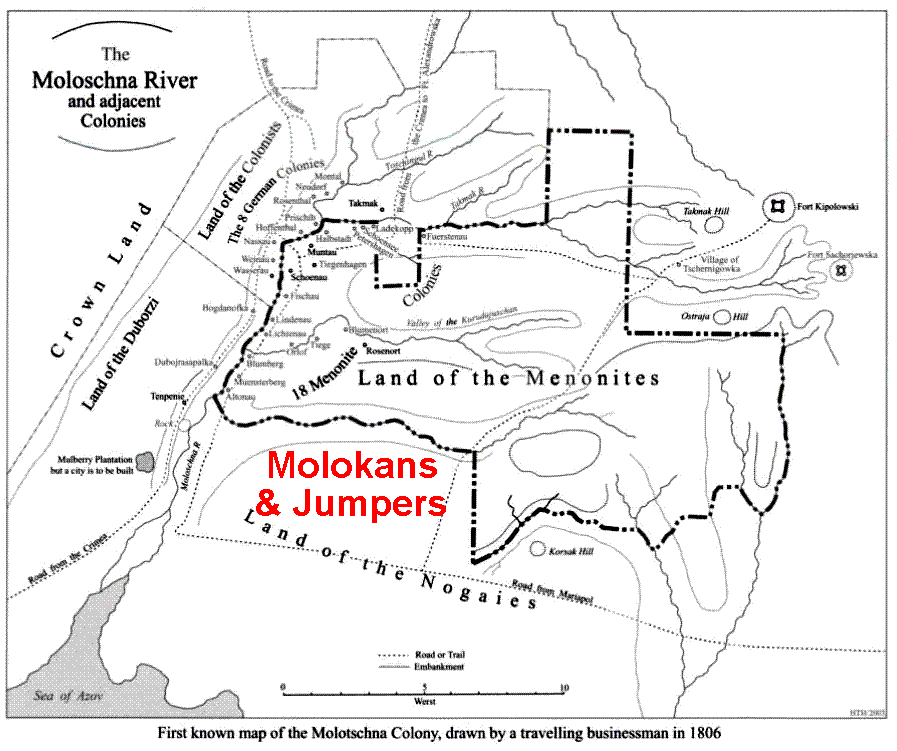
(Melitopol’skii district) [now south
Ukraine], where they lived in close proximity to
one another and in isolation from the Russian people [but friendly with
neighboring Germans, mostly Mennonites.]. But most Molokane continued
to live among the Orthodox in the provinces of southern and
central Russia. [Not so. See map below.]
In 1841–45 most they
were moved out of Taurida by administrative order and
resettled in the Transcaucasus, where Molokane also
voluntarily resettled in large numbers from Tambov and
Samara provinces and elsewhere during the 1840s. They
settled in compact colonies, mostly in what is now
Azerbaijan and Armenia, although many did continue to reside
in Russia’s interior provinces and
Taurida.
* Historically in Russia, "sect" simply meant "Russian" by
nationality but not Orthodox by faith. By law, citizens
(residents) of the Russian Empire who were not Muslims,
Jews, Buddhists or foreigners, were considered "Russian"
(a broad mixture of many nationalities) and must conform
to the state religion, else they are "heretics," criminals
who were often punished.
In the 1800s German immigrants in Russia were free to be
Lutheran, Catholic, Mennonite, Baptist, but not
neighboring Russian citizens who were not Muslim, Buddhist
or Jewish.
During the Soviet Union, most religion was outlawed,
except among the elderly.
For more detail see: N. A. Berdiaev. "Spiritual
Christianity and Sectarianism in Russia", (PDF),
Translator: Fr. S. Janos. "Dukhovnoe khristianstvo i
sectanstvo v Rossii," Russkaia Mysl’. November 1916. #252
____. “Tipy religioznoi mysli v Rossii”, Berdiaev
Collection (Tom III), pages 441-462. YMCA Press Paris,
1989.
The Russian terms for Dukhobor, Molokan and
Dukh-i-zhiznik as used here refer to broad
categories of surviving Spiritual Christian faiths, each
with major sub-divisions.
|
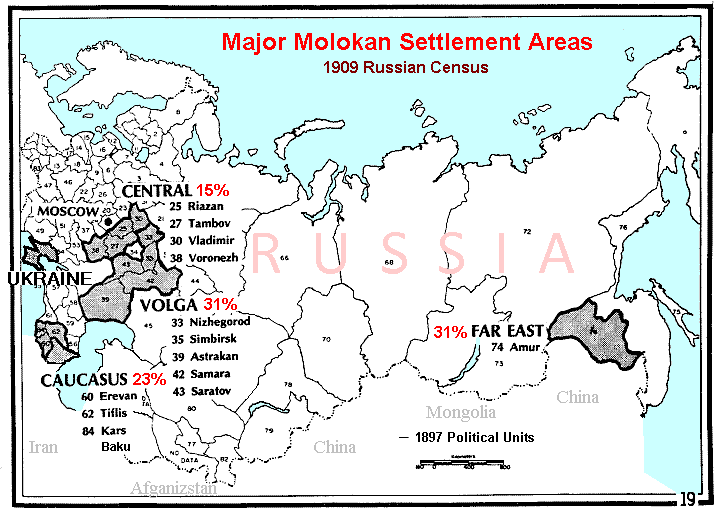
Map updated
from: The 1980 Молокан Directory, by A.J.
Conovaloff, (Clovis
CA) 1980, page 19. Data from History of Religious
Sectarianism in Russia (1860s - 1917),
by A.I. Klibanov, translated by Ethel Dunn,
1982, page 182; and original Russian: История
религиозного сектантства в России (60-е годы
XIX век-1917), page 147.
Most Spiritual Christian faiths (sects) are
not shown on this simplified. map. Most
Molokane (77%) never resided in the
Caucasus. "Siberia and the Far East" is mentioned
only once below, yet the Far East Molokane
(31%) were the most numerous and prosperous. (A.I. Klibanov, History of Religious
Sectarianism in Russia (1800s-1917),
translated by Ethel Dunn and Stephan P. Dunn,
1980.) Klibanov summarized 1909 census data, which
was displayed in Conovaloff, A.J.1980 Molokan
Directory, page 19, shown reorganized in
the map above. Not shown are the many Molokan
villages along river valleys in Siberia
between the Volga and Far East, and thousands who
remained in the south Ukraine.
Scholars concur that Russian censuses vastly
under-counted non-Orthodox Russians, who often
told officials they were Orthodox to avoid
arrest, or hid. Estimates for the actual total
census count of non-Doukhobor Spiritual Christians
could be be 2x,
3x, up to half a million or more. Though
the range of error remains debated, the
proportional distribution (%) among regions are
more likely to be representative, assuming that
under-reporting was proportionately consistent
across the Empire. From these estimates, it's
clear that less than 1% (~3000) of all non-Doukhobor
Spiritual Christians migrated to America in
the early 1900s, while about 35% (~8,800) of all Dukhobortsy
moved to Canada by 1930. (Researching
Your Russian Doukhobor Roots: A presentation by
Jonathan J. Kalmakoff, slide 30.) |
|
Поскольку в XVIII и XIX вв.
слово «православные» воспринималось как синоним слова
«русские», духоборцы и молокане, разорвавшие с православной
церковью, осознавали себя не русскими(2),
а особыми народами Божьими. Конфессиональные особенности
этих сект наложили сильный отпечаток на их культуру,
которая, несмотря на свою русскую основу, приобрела
существенные отличия от культуры их этноса. Осознание своей
культурной и религиозной особенности, богоизбранности,
общего исторического прошлого и позитивная
этноконфессиональная идентичность (высокая, если не сказать
завышенная, оценка «своего народа») в сочетании с негативным
восприятием культуры и религии русского народа и
соседей-кавказцев — все это являлось сущностью того
механизма, благодаря которому они консолидировались и смогли
на протяжении длительного времени существовать и сохранять
свою уникальную культуру.
|
Since in the 1700 and 1800s
the word “Orthodox” was taken to be synonymous with
“Russian,” the [Spiritual Christians]
Dukhobors and Molokans, having broken with
the Orthodox Church,
acknowledged themselves as non-Russians [sectarians, heretics, dissenters],
believing instead that they were God’s own special peoples.(2) The denominational idiosyncrasies of
the sects had a powerful impact on their culture, which,
despite its Russian foundations, came to differ
substantially from that of their ethnic origins. Their
awareness of cultural and religious distinction, their
status as God’s elect, their shared history, and their
positive ethno- denominational identity (their elevated, not
to say overstated, assessment of their “own people”),
combined with a negative perception of the culture and
religion of the Russian people and of their Caucasian
neighbors, formed the essential mechanism that knit them
together and enabled them to exist and maintain their unique
culture over the long term. |
Этот механизм начал
давать сбои еще на рубеже XIX в. В первые десятилетия
советской власти, которая провозгласила атеизм
государственной идеологией и использовала в борьбе с
религией все имевшиеся в ее распоряжении средства, процесс
его разрушения пошел значительно быстрее. С падением
религиозности и разрушением культурной обособленности
постепенно утрачивалась основа для консолидации. К середине
80-х годов представителей каждой их этих двух сект, и
верующих, и уже далеких от религии, объединяло самосознание,
в основе которого лежала не столько религиозная, сколько
культурно-историческая идея. Общины(3)
кавказских духоборцев и молокан объединяли еще и общность
территории и фактор иноэтничного окружения.
|
That mechanism began to fail
at the end of the 1800s. In the early decades of Soviet
power, which proclaimed atheism
the official ideology and employed all means at its
disposal to combat religion, the destruction of that
mechanism accelerated significantly. With the decline of
religious commitment and the dismantling of their cultural
insularity, the foundation of the sects’ cohesion was
gradually lost. Until the mid- 1980s, however, members of
both sects — both the faithful and those who held themselves
aloof from religion — were united by a self-awareness based
on an idea that was less religious than it was
culturo-historical.* The [isolated Spiritual Christian] Dukhobor
and Molokan communities in the Caucasus were also
united by a shared territory, surrounded by people of other
ethnicities .(3)
[*Zealous Dukh-i-zhizniki
insist they are united only by religion, their holy
books and current prophesy, because everything
"culturo-historical" is from man not God.]
|
| Все духоборцы и молокане,
прошедшие советскую школу, знали, что по национальности они
русские, тем не менее они гордились причастностью к своим
группам. Эта в целом позитивная этноконфессиональная
идентичность все же создавала некоторую дистанцированность
от русского народа. Вместе с тем позитивная идентичность
давала надежду, что в условиях либерализации политического
режима возможно возрождение этих русских сект. |
Although all [Spiritual Christians] Dukhobors
and Molokans who graduated from Soviet schools
knew that they were Russian nationals, they still took pride
in their group membership. That ethno- denominational
identification, although largely positive, distanced them
somewhat from the Russian people. Yet their positive self-
identification gave reason to hope that a liberalization of
the political regime might serve to revive [the Spiritual Christians] these
two Russian sects.
|
В конце 80-х лидерам
духоборческого и молоканского движений казалось, что
достаточно не на бумаге, а на деле дать людям свободу
совести, прекратить мелочный контроль со стороны
государства, и у них хватит собственных сил, желания и
энтузиазма возродить традиции, высокую нравственность,
привлечь тех, Проблемы этноконфессиональных групп духоборцев
и молокан кто, считая себя молоканами или духоборцами по
происхождению, отошел от религии и не принимал никакого
участия в духовной жизни общин.
|
In the late 1980s the leaders
of the two movements were convinced that if only freedom of
conscience were to be granted not on paper but in fact, and
if micromanagement by the state were to be halted, the [Spiritual Christians'] Dukhobors’
and Molokans’ own strengths, desire, and
enthusiasm would suffice to revive their traditions and
their high moral standards and to draw in those who
considered themselves [Spiritual
Christians] Dukhobors or Molokans
by origin but had abandoned religion and took no part in the
community’s spiritual life. |
| Этот подъем в среде
духоборцев и молокан совпал с развитием националистических
движений в Закавказье. Антирусская истерия, начавшаяся в
средствах массовой информации республик, расселение по
национальным квартирам стимулировало у кавказских молокан и
особенно у духоборцев быстрый рост этнического самосознания.
В сложных условиях межнациональных конфликтов им надо было
определиться, кто они. Начало 90-х годов характеризовалось
поиском новых идентичностей и массовыми переселениями
кавказских духоборцев и молокан на «историческую родину» в
Россию. Вместе с тем лидеры этих групп понимали, что
рассеивание переселенцев по стране среди русского населения
приведет к их быстрой ассимиляции, утрате наследия предков и
к еще большему ослаблению этих конфессий в целом, так как
наиболее крепкие общины были как раз в Закавказье. Массовое
переселение из Закавказья в Россию как бы подстегнуло,
ускорило процесс институализации этих сект, создание местных
и центральных представительных и руководящих органов,
призванных представлять их интересы на всех государственных
уровнях. |
This enthusiasm among [leaders of Spiritual Christians] Dukhobors
and Molokans coincided with the development of
the nationalist movement in the Transcaucasus. The
anti-Russian hysteria that began in the republics’ [Georgia, Armenia, and Azerbaijan]
media and the ensuing national compartmentalization
stimulated a rapid growth of ethnic self-awareness among the
Molokans, and more particularly the Dukhobors, in the
Caucasus. At a complex time of conflict between nations,
they had to decide who they were. The early 1990s were
characterized by a search for new identities and by mass
migrations of [Spiritual Christians]
Dukhobors and Molokans of the Caucasus to
their “historical motherland” of Russia. Yet their leaders
realized that the dispersion of the settlers among the
Russian population countrywide would lead to their rapid
assimilation and the loss of the legacy left to them by
their forebears. It would serve to further weaken the
denominations as a whole, since the strongest of their
communities happened to have been in the Transcaucasus [segregated from
surrounding nationalities]. Furthermore, the mass
resettlement from the Transcaucasus to Russia impelled and
accelerated, as it were, the institutionalization of the
sects — the creation of representative and managerial
bodies, local and central, whose purpose was to represent
their interests at all official levels. |
Сейчас, почти десять лет
спустя, хорошо видны проблемы, которые надо было решить
духоборцам и молоканам, и то, в какой степени это удалось
сделать.
|
Now that almost a decade has
passed, we can clearly see the problems that the [Spiritual Christians] Dukhobors
and Molokans were set to resolve and the extent
to which they succeeded in doing so. |
| Чтобы возродить эти
религиозные группы, надо было остановить прямо-таки
катастрофическое падение их численности и омолодить состав,
поднять уровень конфессионального самосознания и
религиозности, надо было создать центральные органы и
выдвинуть лидеров, способных выработать программу и пути ее
реализации. |
To revive these
religious groups, it was necessary to stop the downright
catastrophic decline in their numbers and
rejuvenate composition,
raise the level of confessional identity
and religiosity,
and establish
a central authority and
nominate leaders who can
develop a program and ways to
implement it.
|
Сокращение числа верующих в
молоканских и духоборческих общинах началось еще в 30-е годы
и шло в нарастающем темпе. Для многих общин этот процесс
заканчивался самоликвидацией. Например, на Украине в
Мелитопольском уезде еще в 20-е годы в селе Астраханка было
семь молоканских общин и столько же молитвенных домов, в
селе Нововасильевка — пять общин и молитвенных домов. В
начале 90-х годов в этих селах было по одной общине. Такая
картина наблюдалась повсеместно. К началу 90-х годов в
большинстве молоканских общин даже в сельской местности было
по 15—60 человек, но было много и таких общин, которые
состояли всего из нескольких верующих.
. |
The numbers of the faithful [Spiritual Christians] in
Molokan and Dukhobor communities began to fall in
the 1930s, went rapidly downhill from there, and, in many
communities, culminated in self-dissolution. In the 1920s,
for instance, in Melitopol’skii
district, [south]
Ukraine [formerly
Tavria oblast, now in Zaparozhe oblast], the
village of Astrakhanka contained 7 Molokan congregations and
as many prayer houses, and the village of Novovasil’evka
had 5 congregations each with a prayer homes. [Novo-Spasskoe
had 3 congregations and churches. There were 15
congregations, each with a large building, plus a 2-story
Molokan religious educational and business center in
Astrakhanka. All buildings were still standing in 1992.
Only 3 are in use now for Molokan religious meetings.]
But in the early 1990s each village had only one Molokan
congregation*,
and that scenario was repeated everywhere. By then, most
Molokan communities, even in the countryside, had 15 to 60
members, but many consisted of only a handful of the
faithful.
[*After perestroika,
these Molokane wanted to repossess all 15 of
their religious buildings which were taken during Soviet
Collectivization. But the 2-story Molokan center
became the Astrakhanka civic center and police station,
some of the larger buildings were unsafe to occupy, and
others were used for storage, barns or community halls. They had to petition just
to get one per village. Since 2 generations grew up during
communism, few youth were taught religious rituals.]
|
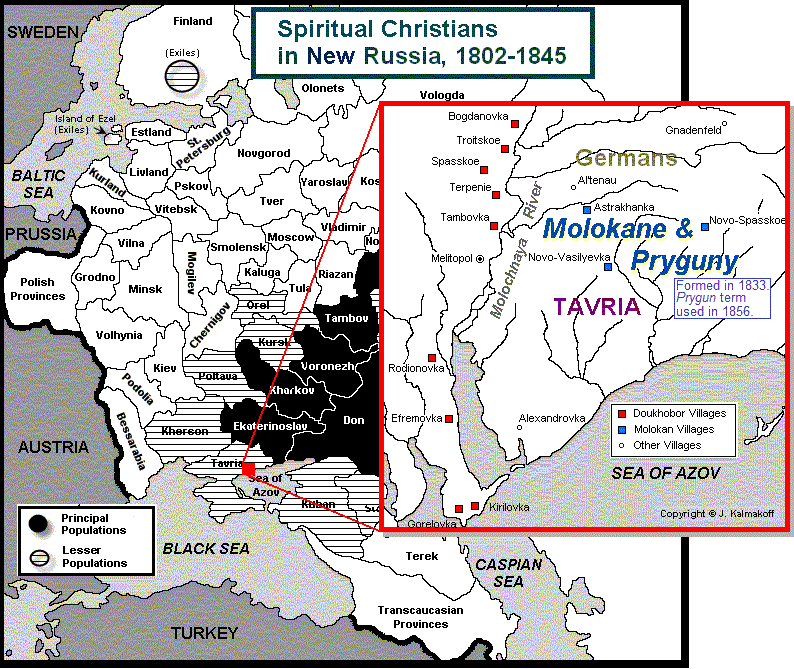
The map above is
adapted from 2 maps created and copyrighted by Jonathan
Kalmakoff: "Doukhobors
in Russia, 1802"
and "Molochnaya
Doukhobor Settlement, 1802-1845". Kalmakoff states: "In Tavria
(present-day Zaporozhye province, Ukraine), the Doukhobors
settled along the [west side of the] Molochnaya River in
Melitopol district. The area was known as Molochnye Vody
(“Milky Waters”). There on the fertile steppe, they
planted grain fields and fruit orchards and established
nine villages as well as flour mills, textile mills, a
stud farm and extensive livestock herds. Their
landholdings totaled 131,417 acres [205 square
miles]." Molokans were given land on the east side
of the river taken from the local Nogai tribes,
just south of the very large German Molochna Colony, shown in
map below. For much more about the interaction among
non-Orthodox faiths in this territory see Russians'
Secret by Hoover and Petrov 1999; and Russia's
Lost
Reformation: Peasants, Millennialism, and Radical Sects
in Southern Russia and Ukraine, 1830-1917 by Zhuk
2004; and Heretics
and Colonizers: Forging Russia's Empire in the South
Caucasus by Breyfogle 2005 and his PhD thesis.
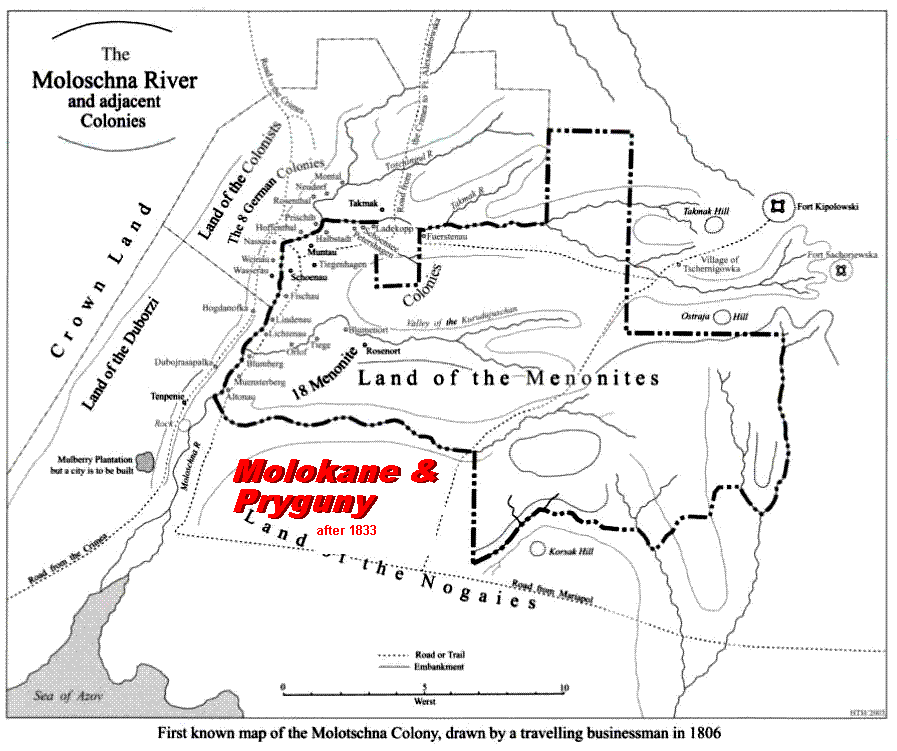
|
| Этот же процесс шел и среди
духоборцев. В самой многолюдной и крепкой духоборческой
общине села Гореловка в Грузии на моления собиралось по 20
человек и только в праздники их число увеличивалось до 50.
Это было связано с атеистическим воспитанием, с развитием
средств массовой информации и со стандартизацией культуры, с
оттоком молодежи в города и, конечно, с политикой
государства в отношении религиозных объединений, особенно
сект. В результате была нарушена преемственность поколений.
Численное сокращение религиозных общин и их старение вело к
тому, что регенерация духоборческой и молоканской культур не
могла происходить в полном объеме и на прежнем уровне. Их
культура утрачивала свою специфику |
The same process was under
way among the Dukhobors. Some twenty people gathered for
prayer in the largest and strongest Dukhobor community in
the village of Gorelovka, Republic of Georgia,
a number that only on holidays rose as high as 50. This was
brought about by official atheist indoctrination, by the
development of the mass media and cultural standardization,
by the outflow of young people to urban areas, and, of
course, by official policy on religious associations,
especially sects. As a result, the line of generational
continuity has been broken. The end result of the shrinking
and graying of religious communities was that the [Spiritual Christian] Dukhobor
and Molokan cultures could never be regenerated
fully or returned to their previous levels. Their respective
cultures had lost specificity. |
| Многие молоканские общины
из-за малочисленности прекращали регистрироваться и теряли
свой юридический статус, хотя он и немного значил в те годы.
Регистрацию обычно рассматривали как возможность сохранить
за общиной молитвенный дом. Собрания нелегально
существовавших общин проходили в частных домах, но
официально их уже как бы не существовало. К 1990 г. по всей
стране было зарегистрировано всего лишь менее полусотни
молоканских общин. Общины кавказских молокан, проживавшие в
сельской местности, вообще не считали нужным
регистрироваться, так как в селе они всегда могли найти дом
для собраний. Иногда колхоз выделял им помещение, а местная
администрация не обращала на это внимания, ограничивая
атеистическую работу рамками школы. |
Many Molokan communities
became too small to retain their registration and thus
forfeited their juridical status, which itself meant little
then except that it granted a community permission to
maintain its own prayer house, so that communities without
legal standing would have to meet in private homes. Those
communities no longer officially existed. By 1990 fewer than
50 Molokan communities were registered throughout the
country. [Dukh-i-zhiznik]
Molokan communities in the rural Caucasus
saw no need to register at all, since they could always find
a place to meet somewhere in the village. Sometimes the
collective farm would allocate premises for meetings,
restricting the teaching of atheism to the schools.
[In 2007, over 150 Spiritual Christian congregations were
meeting for Sunday services in the FSU, 60 in Stavropol'
territory. Most were on private property unrestricted by
the local authorities as long as they did not register as
a "church." Many Prygun congregations joined the
Union of
Congregations of Spiritual Christian Molokans (a
registered "church"), but Dukh-i-zhizniki did
not.]
|
Духоборцы никогда не
регистрировали свои религиозные объединения, и в 1988 г. на
запрос в Совет по делам религий о проживающих в Советском
Союзе духоборцах был получен ответ, что все они выехали в
Канаду в конце XIX в.
|
The Dukhobors never
registered; and in 1988 the Council on Religious Affairs,
having inquired how many Dukhobors were living in the Soviet
Union, was told that they had all emigrated to Canada in the
late nineteenth century. [About a 40% of all Doukhobors migrated to Canada by
1930.]
|
| Такое положение с
регистрацией вполне удовлетворяло и местные власти, так как
не портило картину религиозной ситуации, и самих сектантов,
поскольку им не надо было ни перед кем отчитываться, да и
деятельность их сводилась к молитвенным собраниям и
поддержанию в порядке культовых мест. Никакой общественной,
а тем более миссионерской деятельности они не вели, так как
это было просто невозможно. |
The registration situation
was entirely satisfactory — both to the local authorities,
since it did not mar the picture of the religious status
quo, and to the sectarians themselves, because it meant they
did not have to account to anyone, especially since their
activities amounted only to attendance at prayer meetings
and the upkeep of their places of worship. They were not
active socially and certainly did not proselytize, because
they could not even if they had wanted to.
[There seems to be no restrictions for Orthodox joining
Molokans. In 1992 in Tselinskii
raion, Rostov Oblast, many Orthodox women
joined the largest Molokan congregation, and the
head singer was a sister of the local Orthodox priest.]
|
| Чтобы начать деятельность по
возрождению молоканства и духоборчества, надо было прежде
всего создать руководящие органы. Духоборцы и молокане в
СССР не имели центральных организаций. Еще до революции
после некоторой либерализации законов в 1904-1905 гг.
молокане неоднократно пытались объединиться и создать
организационные структуры, созывали съезды, но реального
объединения разобщенных молоканских общин Закавказья, Южной
и Центральной России, не говоря уже о Сибири и Дальнем
Востоке, не произошло. |
As a first step in reviving [Spiritual Christianity] Molokanism
and Dukhoborism, managerial bodies would have to
be created, because neither group had any central
organizations in the USSR. Even before the Revolution, when
the laws were somewhat liberalized in 1904 and 1905, the
Molokans attempted on several occasions to unify, to fashion
organizational structures, to convene congresses, but there
was never any real unification of the scattered Molokan
communities in the Transcaucasus and southern and central
Russia, not to mention those in Siberia and the Far East.
[About 1905 Molokane built 2-story educational
centers in Tiblisi (Georgia), Baku (Azerbaijan) and
Astrakhanka (Ukraine), and in San Francisco (USA) in 1929.
In Los Angeles (USA) in 1926, an integrated organization
of mixed Spiritual Christians formed the UMCA — United
Molokan Christian Association, now controlled by Dukh-i-zhizniki.
Today only the divided organizations in the USA exist.]
|
| Духоборцы до конца XIX в.
подчинялись своим духовным вождям, возведенным в ранг
«христов» (или «богородице») и решению съездов
представителей всех сел, расположенных в Закавказье и
Карсской области. Неоднократные расколы и переселения в
конце XIX в. — начале XX в. сильно подорвали единство секты
и ослабили ее. Репрессии, начавшиеся в конце 20-х и
продолжавшиеся до конца 30-х годов, вырвали из рядов
духоборцев самых убежденных и авторитетных людей, и всякие
попытки организоваться были подавлены в зародыше. |
Up to the end of the 1800s,
the Dukhobors had subordinated themselves to their spiritual
leadership, whom they elevated to the rank of “Christs” (or
[if female], “Mothers of God”)
and to the decisions taken by congresses of representatives
from all the villages in the Transcaucasus and Kars oblast.
Recurrent schisms and resettlements in the late 1800s and
the early 1900s severely undermined the sect’s unity and
weakened it; the repressions that began in the late 1920s
and continued until the end of the 1930s wrested away the
most committed and authoritative Dukhobors; and any attempts
to organize were nipped in the bud. |
|
[In 1990, Aleksandrov
joined the Committee for Relations with Religious
Organizations (CRRO) in Moscow, filed to register the Molokan
faith, got a grant to hold an organizational meeting,
reserved a banquet hall, announced the meeting on Radio
Moscow broadcasted to nearly all households in the
country, not knowing if any practicing Molokane were
listening. He was astonished by the response.] |
| В течение 90-х годов в целях
объединения духоборцы и молокане провели ряд съездов. Для
подготовки первого молоканского съезда И. Александров в 1990
г. начал издавать возрожденный журнал «Духовный христианин»,
в котором печатались подготовительные материалы. Весной 1991
г. в разных регионах страны начали создаваться союзы общин
или комитеты духовных христиан-молокан данного региона во
главе со старшим пресвитером или председателем. Оргкомитет
по подготовке съезда в апреле того же года начал выпускать
информационный листок «Весть», с помощью которого собирался
информировать общины о ходе подготовки съезда. Незадолго до
съезда была создана благотворительная ассоциация «Община»,
декларированной целью которой было «возрождение
молоканства». Инициатором ее создания, как и созыва съезда,
стал И. Александров, сыгравший большую положительную и столь
же отрицательную роль в молоканском движении. |
The [Spiritual
Christians] Dukhobors and Molokans
held a number of congresses in the 1990s, with a view to
unification. In 1990, to prepare for the first Molokan
Congress, Ivan Aleksandrov revived the periodical Dukhovnyi khristianin
and used it to publish preparatory
materials. In the spring of 1991 in various regions of the
country, local community unions or committees of Spiritual
Christian Molokane, headed by the senior presbyter
or president, were being set up. In April of that year, an
organizing committee began issuing a fact sheet titled Vest’, which was
intended to inform the communities of progress made in
planning the congress. Not long before the congress was
convened, the Obshchina [Community]
charitable association was set up with the declared goal of
“reviving Molokanism.” This was done at the initiative of
Aleksandrov, who had set up the congress. He was a major
player in the Molokan movement, although he ultimately did
it about as much harm as good.
|
|
[Aleksandrov's leadership
was attacked mainly because he led a minority who
envisioned a central office in Moscow, where most business
in Russia is centrally managed. Also, he was not raised in the faith, his Azeri
wife and 2 boys did not participate, and the founding
Moscow organization did not manage records well.
The most vocal opponent was refugee V.V.
Schetinkin, an upstart presbyter from Khimili,
Azerbaijan, who lobbied for a southern center in his
village of Kochubeevskoe, Stavropol, near thousands of
other refugees, also from North rural Azerbaijan.
Also in 1990, an
American Dukh-i-zhiznik presbyter, Vasili Sissoyev
in Montebello, California, was frustrated that he could
not get a visa to Russia. His wife suggested he
complain to Yeltsin. His letter was redirected to the
CRRO, and placed in the Molokan box. Aleksandrov
requested his visa which was approved. Sissoyev, attended and video
taped much of the 1991 Convention, which was shown to many
in the U.S.A.
In 1992, about 30 diaspora non-Doukhobor Spiritual
Christians attended the 2nd Annual Congress held in
Astrakhanka,
Zaporizhzhia
Oblast, (Астраханка, Zaporizhia Oblast) Ukraine. No
diaspora returned in numbers until the 2005 when about 10
Molokane from the San
Francisco congregation attended the 200th Anniversary.
Since 1992, Dukh-i-zhiznik have
not formally affiliated with Molokane.]
|
| Первый
съезд духовных христиан состоялся в Москве в июне
1991 г. На съезд приехали представители более 60
общин, а членами созданного Союза общин духовных
христиан-молокан СССР стали более 40 общин.
Некоторые вступали единолично. Знаменательно, что
Союз был открыт для всех течений молоканства. Он
должен был возродить молоканство и связать
разрозненные общины всех направлений. Однако на деле
членами его стали только постоянные молокане. На
съезде был принят Устав, а в старшие пресвитеры
рукоположен И. Александров. |
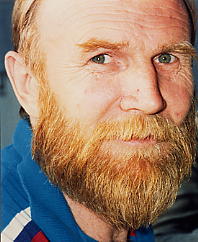
Ivan G. Aleksandrov, 1992
И. Г. Александров
|
The first
Congress of Spiritual Christians [Molokane] took
place in Moscow in June 1991. It was attended by
representatives from more than sixty communities,
and over forty communities came together to form the
new Union of Communities of Spiritual Christian
Molokans of the USSR [UCSCM]. Some people also
joined the union as individuals. Although it is
indicative that the union was open to all the
various [non-Doukhobor
Spiritual Christian] Molokan
groups, its intent being to revive [Biblical Spiritual Christianity]
Molokanism and link the
disconnected communities, whatever their persuasion,
in fact only Constant Molokans
joined. The congress adopted a charter and ordained
Aleksandrov as senior presbyter. [By 2014, no Dukh-i-zhiznik
congregations joined.] |
|
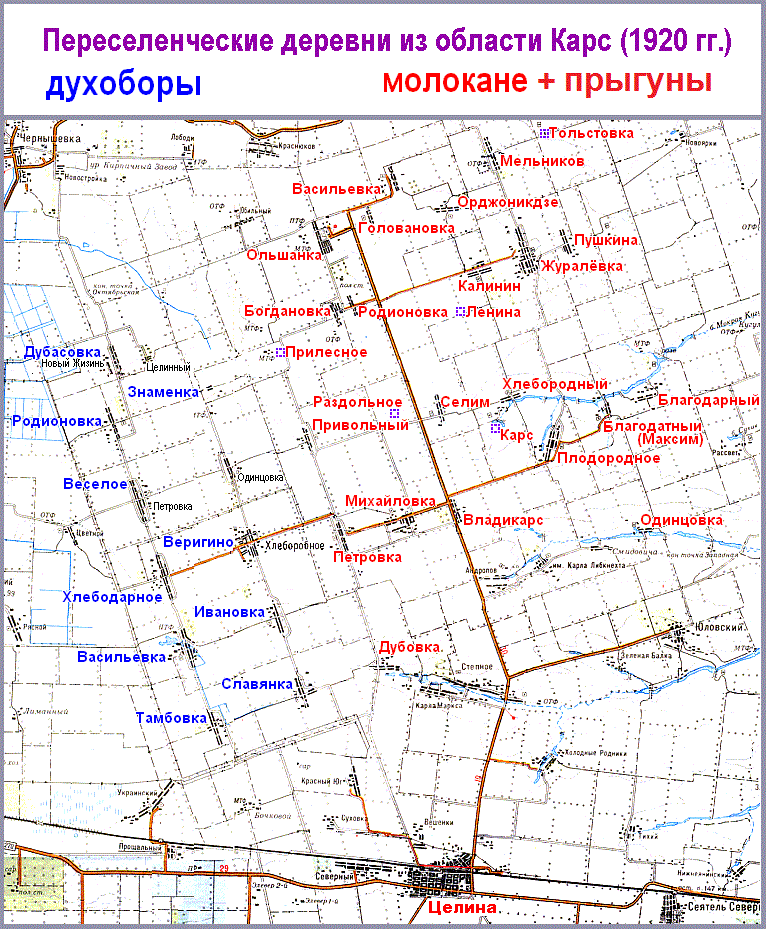
[Многие
духовные христиане были переселены из
Карса, Турции, в Ростовской
области в 1926 году,
и поделили
между двумя колхозов.] |
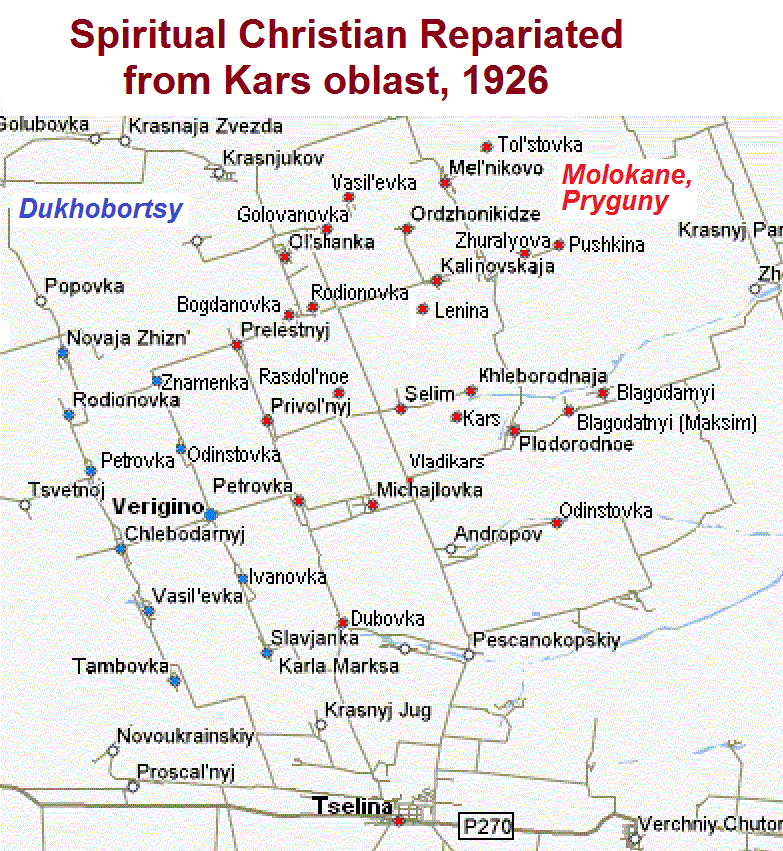
[Many Spiritual Christians were
relocated from Kars, Turkey, to east Rostov province in
1926, and divided among two collective farms. In 1992 only
1 Prygun congregation existed in Tselinskii
raion. After 2000, at least 3 Dukh-i-zhiznik congregations
resettled nearby from Amenia, 2 to the north and one to
the south of the mapped area.]
|
Следом за молоканским съездом
с разрывом в две недели в Целинском районе Ростовской
области состоялся Всесоюзный съезд духоборцев. Накануне его
созыва в Целинском районе, где проживают духоборцы,
переселившиеся туда еще в 1921-1923 гг., уже было
зарегистрировано «Религиозное объединение духовных борцов
Христа в СССР». Инициатором регистрации и одним из главных
инициаторов созыва съезда стал Ю. Крыжановский, человек,
далекий от какой-либо веры, преследовавший личные корыстные
интересы и в дальнейшем принесший духоборческому движению
много неприятностей и разочарований.
|
Only two weeks after the
Molokan Congress ended, an All-Union Congress of Dukhobors
opened in Tselinskii
raion, Rostov oblast, which was inhabited by Dukhobors
who had resettled there in 1921–23. Immediately before the
meeting, the Religious Alliance of Spiritual Warriors [(Wrestlers, Fighters)] of Christ
in the USSR was registered, at the initiative of Iurii
Kryzhanovskii, who had also been instrumental in arranging
the [Dukhobor] Congress. Kryzhanovskii, a
person far from devout in any faith, was pursuing his own
selfish interests and was later to cause a great deal of
unpleasantness and disappointment for the Dukhobor movement.
|
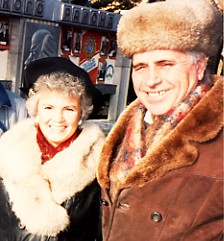
Iurii Kryzhanovskii and wife, 1992
Ю. Крыжановский
|
[Kryzhanovskii and wife in October 1992, while
visiting the administrator of Chern' district, Tula
province. He is a retired army general, with Communist
Party ties and negotiating skills, unlike that of the
worker class Doukhobors whom he adopted to govern. He was
one of thousands of former high ranking ex-Soviets struggling to
professionally reposition themselves to maintain economic status
during the chaos of perestroika.
Because his ancestry was Doukhobor, he chose to appoint
himself leader of the Doukhobors though he did not adhere
to the Doukhobor faith. Many Canadian Doukhobors consider
him to be an opportunist who exploited their Russian
brethren.] |
| В свидетельстве о регистрации
Ю. Крыжановский определил вероисповедную принадлежность
духоборцев следующим образом: «Православная христианская
этническая группа раскольников». Однако поскольку
религиозное объединение было уже зарегистрировано, с тем
духоборцы и пришли к всесоюзному съезду. Он вылился в
большое собрание наподобие партийных; делегатов на съезде
было немного. Обсудили современные методы повышения
продуктивности земли и развитие малых предприятий по
переработке сельхозпродукции, затем решали организационные
вопросы. Никакие сугубо духоборческие, а тем более духовные
проблемы не поднимались. Положительным было то, что съезд
дал толчок поиску путей объединения духоборцев, и на нем был
избран Совет духоборцев СССР из 15 человек. Он должен был
руководить между съездами, а для организации переселения и
связи с государственными структурами был избран исполком.
Съезд обратился ко всем духоборцам страны с призывом «более
активно возрождать традиции, нравы, обычаи, обряды
духоборцев». Всем духоборцам съезд рекомендовал
«использовать все возможности для возрождения и создания
духоборческих общин и других форм, наиболее подходящих для
совместной работы и безбедной, зажиточной жизни». |
On the registration
certificate, Kryzhanovskii defined the Dukhobors’ religious
affiliation as an “Orthodox Christian ethnic group of
schismatics.”* The Dukhobors
arrived at the all-union congress under that designation,
the registration being by then a done deal. But the congress
resembled nothing so much as a glorified party meeting,
since few delegates attended and the first matters up for
discussion included modern methods of increasing land
productivity and the development of small enterprises to
process agricultural output. Only after that were
organizational issues tackled. No expressly Dukhobor, or
even spiritual, problems came up. The congress’s only
positive result was that it set in motion a search for ways
of uniting the Dukhobors and elected a 15-member Dukhobor
Council, whose mission was to provide leadership between
congresses, and an executive committee to organize
re-settlements and establish liaisons with state structures.
The congress appealed to all the country’s Dukhobors with a
call to “be more active in reviving the traditions, mores,
customs, and rituals of the Dukhobors” and advised all
Dukhobors “to employ every opportunity to revive and create
Dukhobor communities and other forms most fitting to
cooperative work and a life of comfort and affluence.”
[* This is a definition of Old
Believers, Old
Ritualists, not Spiritual Christians.]
|
| Для того, чтобы отмежеваться
от Ю. Крыжановского и создать крепкую, поддерживаемую всеми
духоборцами организацию, летом 1992 г. в селе Архангельское
Чернского района Тульской области, куда в 1989-1991 гг.
переселилась часть кавказских духоборцев, был созван второй чрезвычайный
съезд. Он оказался более многолюдным и представительным, чем
первый. На нем был принят устав и решено перерегистрировать
духоборческую организацию под новым названием — «Объединение
духоборцев России», так как после распада Советского Союза
прежнее название уже не отражало действительной ситуации. В
уставе было оговорено, что в Объединение на равных могут
входить духоборческие общины из СНГ. |
To dissociate from
Kryzhanovskii and form a strong organization that would have
the support of all Dukhobors, a second, extraordinary
congress met in the summer of 1992 in the village of Arkhangel’skoe,
Chernskii raion, Tula oblast,
where Dukhobors from the Caucasus had resettled in 1989–91.* This congress was
better attended and more representative than the first. It
adopted a charter and resolved to re-register the Dukhobor
organization under a new title — Alliance of Dukhobors of
Russia — since the old name no longer reflected the
situation that obtained after the collapse of the Soviet
Union. The charter stipulated that all Dukhobor communities
in the Commonwealth
of Independent States (CIS) could join as equals.
|
|
[* These
Doukhobors would resettle only if given their own land,
with their own farm administrator. The Chern' district
administrator who flew to Georgia to recruit Russian
farmers divided his largest collective farm [kolkhoz],
and
gave
about half to the Doukhobors who called it the "L.N.
Tolstoy Settlers Dukhobor Collective Farm/Community." This
was a significant reversal of history, because nearby,
across a creek to the west (19 km., 12 mi. walking), the
old estate
of Sergei Lev. Tolsoy was being restored as a
museum. Doukhobor
serfs lived there 200 years ago. L.N. Tolstoy lobbied for
their freedom, paid for about a fourth of their migration,
and his son Sergei accompanied the first boat of
Doukhobors to Canada with other aides. Now many descendants have
returned to their rural Russian homeland.] |
| Центральные органы
молоканского и духоборческого объединений сразу же взялись
за решение переселенческого вопроса. Уже в ноябре 1991 г.
совет Союза общин ДХМ постановил создать Комитет содействия
переселенцам-молоканам. Этот комитет искал земли для
переселения общин из СНГ, чтобы сохранить их и тем самым
возродить молоканскую культуру на новом месте. Союз общин
ДХМ обращался в высшие инстанции вплоть до президента с
просьбой о помощи переселенцам. Совет Союза составлял
необходимую документацию, сметы, проект будущего поселения.
Он добился выделения для переселенцев земель в Чернском
районе Тульской области. |
The central organs of the [Spiritual Christian] Dukhobor
and Molokan unions promptly took up the
resettlement issue. As early as November 1991 the UCSCM had
resolved to set up a Committee to Assist Molokan Settlers [Komitet sodeistviia
pereselentsam-molokanam], which searched for land
to be settled by communities from the CIS, so as to preserve
them and to regenerate the Molokan culture in a new
location. The UCSCM appealed all the way up to the
president [Yeltsin] to elicit
help for the settlers.* Its
council had compiled a small package of documentation
containing estimates and the plan for a future settlement,
and it was eventually allocated lands for resettlement in
Chernskii raion, Tula oblast.
[* In 1990, Aleksandrov joined the Committee for Relations
with Religious Organizations in Moscow, filed to register
the Molokan faith, got a grant to hold an organizational
meeting, reserved a banquet hall, announced meeting on
public radio (Channel 1) to nearly all households in the
country, and was astonished by the turnout.] |
Созданный на первом
духоборческом съезде исполком по переселению со своей
миссией не справился. Была сделана попытка создать внутри
совета специальный комитет по переселению, но он тоже
оказался неработоспособным, и его функции взял на себя совет
Объединения духоборцев России, который выступал в качестве
юридического лица от имени переселенцев.
|
The executive committee for
resettlement formed at the first Dukhobor Congress was,
however, never equal to its mission. A special committee on
resettlement that was established within the executive
committee also proved ineffectual, and its functions were
assumed by the ADR Council, as the legal entity representing
the settlers. |
| Деятельность центральных
органов и реализация программ по возрождению молоканства и
духоборчества были невозможны без материальных средств. И.
Александров с самого начала объединительного молоканского
движения выдвигал вопрос о создании предприятий, средства от
которых пошли бы на помощь переселенцам из Закавказья, на
финансирование журнала, содержание редакции и на необходимые
организационные расходы Союза общин ДХМ. Ассоциация «Община»
как раз и должна была объединить руководителей молоканских
колхозов и кооперативов, но она оказалась мертворожденной. В
проекте устава будущего Союза общин ДХМ говорилось, что Союз
не только будет способствовать развитию «чувств самосознания
в правовом и общественном отношении» и т. п., но и берет на
себя посредничество между земледельцами, куплю и продажу
машин и оборудования, земли, семян, скота и других
необходимых товаров, предоставление кредитов. Средства Союза
должны были складываться из членских взносов и добровольных
пожертвований. Но уже на стадии его обсуждения были
серьезные нарекания с мест, что это устав не духовных, а
«плотских христиан-молокан». В Устав,
принятый на съезде, пункт об обязательных членских взносах
включен не был, но все же остались положения об
экономической деятельности Союза общин ДХМ
(внешнеэкономическая деятельность, производство и реализация
сельхозпродукции, открытие магазинов и лавочек и т.д.). |
Without material resources,
the central bodies could not act, and the programs to revive
[Spiritual Christianity] Dukhoborism
and Molokanism could not be implemented. From the
beginning of the movement for Molokan movement, Aleksandrov
had urged the setup of commercial enterprises to generate
funds that would help those resettling from the
Transcaucasus, finance a periodical, compensate its
editorial board, and defray the UCSCM’s necessary
organizational expenditures. (The Obshchina association
was actually supposed to have united the leaders of Molokan
collective farms and cooperatives, but it had been
stillborn.) The draft charter for the future UCSCM had
stated that the union would not only facilitate the
development “of legal and social self-awareness” and so on
but would also broker agreements among farmers; arrange the
purchase and sale of machinery and equipment, land, seed,
livestock, and other necessities; and extend credit. The
UCSCM’s financial resources were to come from membership
dues and voluntary donations, but while its charter was
still in the discussion stage, there were serious complaints
from the localities that it catered not to Spiritual
Christian Molokans but to “carnal Christian Molokans.”* So a paragraph on mandatory
membership dues was omitted from the Charter adopted at the
congress, but provisions regarding the economic activity of
the UCSCM (foreign trade, the production and sale of
agricultural products, the opening of stores and stalls,
etc.) remained.
[* Molokans in name only, not faith.
Canadian Doukhobors use the term: "Doukhobors in name
only" to indicate descendants who no longer attend
meetings, inter-married, and have abandoned the Doukhobor
faith, principles, lifestyle or movement — assimilated.]
|
| Вопрос об обязательных сборах
не утратил актуальности до сего дня. На страницах журнала
«Слово веры» последние годы развернулась широкая полемика по
этому вопросу. Для молоканских пресвитеров и активистов
движения оказалось важнее остаться вне каких-либо подозрений
в корысти и избежать возможных упреков в том, что они служат
«ради обогащения или даже ради легкой добычи хлеба
насущного»(4), чем создать
экономическую базу для дальнейшей работы Союза общин ДХМ. |
The issue of mandatory fees
is being debated to this day; in recent years, the magazine
Slovo very has
carried an extensive and heated exchange on the subject.
Molokan presbyters and movement activists have found it more
important to remain free of any suspicion of greed and to
avoid possible accusations of serving “for the sake of
enrichment and even for an easy way to procure their daily
bread” than to create an economic base that the UCSCM could
use going forward.(4) |
| Духоборцы и молокане в силу
своих религиозных установок не знали, что такое десятина в
пользу их церкви, оплата труда пресвитера или кого-то из
старцев, певчих. Добровольные пожертвования всегда делались
так, чтобы никто не видел, кто сколько жертвует.
Материальное, земное вторгалось в духовную жизнь, но одни не
хотели считаться с требованиями времени, а другие не знали,
как совместить то и другое. Это противоречие между традицией
и назревшей необходимостью так и не удалось преодолеть. |
The religious tenets of the [Spiritual Christians] Dukhobors
and Molokans did not include tithing to the [congregation] church
or compensating the presbyter, elders, or singers for their
work. Voluntary donations were always made in secret [under a towel on the alter
table], each giving what he or she could afford.
Material reality was now invading the life of the spirit,
but some did not want to accommodate the demands of the time
and others did not know how to merge the two. The
contradiction between tradition and looming [financial] necessity has never
been successfully overcome. |
| К сожалению, в начале 90-х
молокане передоверили свои материальные проблемы И.
Александрову, а ростовские духоборцы — Ю. Крыжановскому. На
бумаге за подписью последнего вырастали несуществующие
«Генеральное строящееся предприятие» и «Комитет по
переселению духоборцев в Ростовскую область». Начались аферы
со средствами, выделенными Комитету опять же в лице Ю.
Крыжановского. Нарекания в нарушении финансовой дисциплины
были со стороны молокан и в адрес И. Александрова.
Безусловно, подобные факты дискредитировала саму идею
экономической деятельности молоканских и духоборческих
организаций. |
In the early 1990s,
unfortunately, the Molokans had entrusted their material
problems to Ivan Aleksandrov, and the Rostov Dukhobors had
delegated theirs to Iurii Kryzhanovskii. A General
Construction Enterprise and a Committee to Resettle
Dukhobors in Rostov oblast, neither of which actually
existed, sprang up on paper, above Kryzhanovskii’s
signature. Shady deals were put together using funds
allocated to the committee, again as represented by
Kryzhanovskii. The Molokans began accusing Aleksandrov of
financial irregularities. Facts such as these unquestionably
discredited the very idea of the economic activities being
conducted by the [Spiritual
Christian] Molokan and Dukhobor
organizations. |
| Острый недостаток средств
значительно затруднил и продолжает затруднять
организационную работу. Рассчитывать на систематическое
поступление пожертвований не приходится, так как подавляющее
большинство верующих — пенсионеры, т. е. люди
несостоятельные, зачастую просто нищие. Американские и
австралийские молокане и канадские духоборцы периодически
помогали своим российским единоверцам, но эти субсидии,
зачастую предоставляемые в виде гуманитарной помощи вещами и
продуктами, не решали проблему. Правда, американские и
австралийские молокане выделяли средства на организацию
съездов, на издание журналов, строительство молитвенного
дома в Ставропольском крае, но сами они не богаты, и эта
помощь не идет ни в какое сравнение с солидными вливаниями,
которые делают зарубежные адвентистская или баптистская
церкви своим единоверцам. |
Organizational efforts were,
and continue to be, significantly complicated by an acute
shortage of funds. The sects could not rely on a systematic
receipt of donations, since the overwhelming majority of the
faithful consisted of senior citizens who had limited means
and were often simply impoverished. American and Australian
Molokans* and
Canadian Dukhobors have periodically sent help to their
Russian coreligionists, but such subsidies, which often take
the form of humanitarian aid (food and nonfood items), have
not resolved the problem. The American and Australian [non-Doukhobor Spiritual Christians]
Molokans have
allocated funds for congresses*, the publication of periodicals, and the
construction of a prayer house[s]
in Stavropol krai, but they themselves are not rich, and
their assistance pales in comparison with the considerable
infusions of cash sent by foreign Adventist or Baptist
churches to their own coreligionists.
[* Initially diaspora non-Doukhobor Spiritual Christians
joined in fund-raising and collection of
humanitarian aid, but by 1995 the more numerous diaspora Dukh-i-zhizniki
primarily donated to 3 Dukh-i-zhiznik
congregations in Stavropol' province, rather randomly
selected as pet projects by different presbyters in
California, to the dismay of neighboring Dukh-i-zhiznik congregations
who got no aid. An anomaly is a lone Prygun congregation
in Levokumskoe, Stavropol' province, which was funded to
build the "largest meeting hall in Russia" by American
businessman William M. Shubin, Fresno, who naively thought
most Dukh-i-zhizniki would
flock to the largest assembly hall, without considering
location, denomination and transportation.]
|
Деятельность молоканских и
духоборческих в прошлом колхозов, ныне получивших статус
«общин» и «товариществ», не является экономической
деятельностью религиозных организаций. Если они что-то и
выделяют религиозным общинам или центральным организациям,
то это не обязательный взнос, а добровольная помощь, причем
чаще всего направленная на поддержку культурных инициатив.
Например, небольшие средства время от времени выделял в
распоряжение Совета духоборцев переселенческий духоборческий
колхоз — община им. Л. Н. Толстого в Тульской области. На
эти деньги была выпущена пластинка с записью духоборческих
псалмов и народных песен, издано несколько номеров газеты
«Вестник духоборцев».
|
The entities that used to be
[Spiritual Christian] Molokan
and Dukhobor collective farms and are now
accorded the status of “communities” and “partnerships” do
not operate economically as religious organizations. If they
allocate anything to the religious communities or to central
organizations, they do so not as mandatory dues but as
voluntary assistance, which is more often than not earmarked
to support cultural initiatives. For example, the L.N.
Tolstoy Settlers Dukhobor Collective Farm/Community in Tula
oblast has from time to time placed small sums at the
disposal of the Dukhobor Council, which moneys were used to
make and release a commercial recording of Dukhobor psalms
and folk songs and to publish several issues of the Vestnik dukhobortsev. [The large Molokan-owned and managed Nikitin collective farm
in Ivanovka, Azerbaidjan, has uniquely survived since
Soviet times, though many have moved to Russia. At least
200 families from Ivanovka now live in Moscow with no
large meeting hall.]
|
| В 90-е годы была предпринята
попытка ведения экономической деятельности духовной
молоканской общиной. Во время строительства молитвенного
дома в селе Кочубеевское
Ставропольского края молоканская религиозная община
организовала производство кирпича и открыла цех по
производству оконных рам и дверей и часть продукции
продавала. Также был открыт маленький пошивочный цех,
благодаря которому несколько женщин-молоканок получили
работу, а прибыль от него шла на строительство того же дома. |
One Molokan spiritual
community did make a stab at for-profit activity in the
1990s. While building a prayer house in the village of Kochubeevskoe,
Stavropol territory, the Molokan religious community set up
a brickworks and a workshop to produce window frames and
doors and sold a portion of the output. A small sewing shop
was also opened, which provided work to some Molokan women,
with the profits going to the building project. [These enterprises were
funded via the Molokan Liaison Committee, San Francisco, which
also supported building the large Kochubeevskoe
prayer hall. Support for the committee failed before
2000 and soon after the businesses shut down. The wood
shop was converted to a dormitory for guests during the
2005 Anniversary, and the brick shop is now a new 3-room
museum with 2 rooms depicting their former rural- hut
lifestyle.]
|
| После первых съездов в
общинах чувствовался подъем. С целью объединения
представители совета Союза общин ДХМ ездили по общинам
России и СНГ. В начале 90-х годов совет Союза помогал
общинам добиваться возвращения молитвенных домов,
распределял по общинам литературу и гуманитарную помощь.
Активную деятельность вел совет Объединения духоборцев
России, который собирался три раза в год на территории общин
Ростовской и Тульской областей, Северного Кавказа, Грузии.
Однако, подводя итоги деятельности этих организаций,
приходится признать, что их объединительная миссия не
принесла ожидаемых плодов. Центробежные силы оказались
намного сильнее, чем можно было ожидать. Мигрирующие из
Закавказья духоборцы и молокане, несмотря на заявления о
желании поселиться в России компактными группами и сохранить
свою культуру, в подавляющем большинстве разъехались по
стране. Непреодолимым препятствием на пути к единству
оказалась борьба за лидерство внутри сект и вместе с тем
недоверие к избранным лидерам. В основе этого явления, на
наш взгляд, помимо присущих всем людям слабостей, лежит
характерное для молокан (а с конца XIX в. и для духоборцев)
непризнание иерархического устройства духовной общины(5). Отчасти настороженное отношение
духоборцев и молокан к собственным лидерам можно объяснить
еще и печальным опытом начала 90-х годов. |
The first congresses brought
a sense of uplift to the communities. UCSCM representatives
visited communities in Russia and the CIS, with the goal of
effecting Molokan unity. In the early 1990s the UCSCM
Council assisted communities in their efforts to regain the
use of their prayer houses and distributed literature and
humanitarian aid. The ADR Council was also active, meeting
three times a year within the ambit of the communities of
Rostov and Tula oblasts, the North Caucasus, and the
Republic of Georgia. After tallying everything those
organizations did, however, it must be acknowledged that
their mission of unification did not yield the expected
fruits, because the centrifugal forces were far stronger
than had been anticipated. The overwhelming majority of [Spiritual Christians] Dukhobors
and Molokans who migrated from the Caucasus were
dispersed throughout the country, despite their declared
desire to resettle in tight-knit groups in Russia and thus
preserve their culture. An insuperable obstacle on the path
to unity was the sects’ internal power struggle, accompanied
by mistrust in their elected leaders. This phenomenon had
its foundation in something other than the weaknesses
inherent in us all. In our view, it rested on the disavowal
characteristic among Molokans (and Dukhobors from the late
1800s onward) of any hierarchical structure within the
spiritual community.(5) Such wariness
on the part of [Spiritual Christians]
Dukhobors and Molokans toward their own
leaders may also be explained in part by their dismal
experiences of the early 1990s. |
| Осенью 1991 г. И. Александров
отказался от должности старшего пресвитера и занял пост
председателя совета Союза общин ДХМ. В сентябре 1993 г. было
проведено два съезда: один — в селе Кочубеевском
сторонниками старшего пресвитера Т. Щетинкина, другой — в
Москве сторонниками И. Александрова. В 1994 г. И.
Александров был окончательно отстранен от руководства
Союзом. Хотя перерегистрированный 6 декабря 1994 г. с новым
названием Союз общин ДХМ России продолжал существовать,
восстановить прежнее единство не удалось. Последний съезд,
проходивший в Тамбове в августе 1997 г., был созван не
советом организации, а лидерами тамбовских молокан и был
проигнорирован рядом общин, тяготеющих к объединению вокруг
Т. Щетинкина и создаваемого им молоканского центра в селе
Кочубеевском. В сентябре того же года Т. Щетинкин от имени
совета Союза общин ДХМ тоже собрал представителей некоторых
общин на «домообновление» (освящение молитвенного дома)
Центрального дома молитвы Союза общин ДХМ России, которое
должно было по мысли устроителей вылиться в съезд. |
In the fall of 1991
Aleksandrov resigned as senior presbyter, assuming instead
the post of UCSCM president. Two congresses were held in
September 1993, one in the village of Kochubeevskoe by
supporters of Senior Presbyter Timofei Shchetinkin and the
other in Moscow by Aleksandrov’s followers. In 1994
Aleksandrov was ousted from the UCSCM leadership. Although
the UCSCM re-registered on 6 December 1994 under a new name,
the prior unity could never be restored. The last congress,
held in Tambov in August
1997, was called not by the UCSCM Council but by the
leaders of the Tambov Molokans and was ignored by the
numerous communities that were beginning to coalesce around
Shchetinkin and the Molokan center that he had created in
Kochubeevskoe. In September 1997 Shchetinkin also summoned,
in the name of the UCSCM Council, representatives from
several communities to attend the dedication of the UCSCM’s
Central Prayer House, a gathering that the organizers
intended to turn into a congress. |
| Процесс
распада Союза общин ДХМ хорошо виден на примере
издания журналов. С 1990 г. по 1994 г. в Москве под
редакцией И. Александрова выходил общемолоканский
журнал «Духовный
христианин», а с 1991 г. — журнал «Весть»,
издававшийся более четырех лет также в Москве. Оба
издания были органами Союза. В 1994 г. в Москве был
основан другой журнал — «Слово веры».
Он мыслился как центральный и независимый от Союза
общин ДХМ орган, целью которого была только
проповедь Евангелия. В 1997 г. журнал с одноименным
названием без согласования с редакцией «Слова веры»
выпустила община села Кочубеевского. После этого
московский журнал с девятого номера был переименован
в «Доброго
домостроителя благодати». В 1997 г. в поселке
Слободка Чернского района Тульской области пресвитер
молоканской переселенческой общины В. Тикунов
выпустил два номера журнала «Млечный путь»
литературно-исторического направления. |
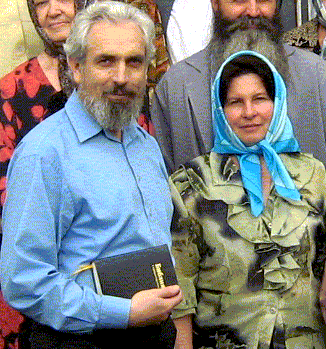
[By 2007,
Viktor Tikubnov and wife Tania (no kids) moved to
Moscow where he found a part-time job in a
bookstore, and launched a new website: По Следам
Молоканства (On the Molokan Trail). E-mail:
Tikunov.Viktor@itrm.ru].
In July 2008 his congregation in Tula province
hosted a youth
conference.
|
The
publication of Molokan periodicals readily
illustrates the process of the UCSCM’s dissolution.
From 1990 through 1994 the Molokan magazine Dukhovnyi
khristianin was published in Moscow,
with Aleksandrov as editor; the magazine Vest’ was
published for over four years beginning in 1991,
also in Moscow. Both were UCSCM publications. In
1994 another magazine — Slovo very
— was founded in Moscow, as a central organ
independent from the UCSCM, with the sole goal of
preaching the Gospel. In 1997 the Kochubeevskoe
community began publishing a periodical of the same
name, without the approval of the editorial board of
the original Slovo
very. So the Moscow magazine, beginning
with its ninth issue, was renamed Dobryi domostroitel’
blagodati. Also in 1997 two issues of
a generally literary/historical magazine entitled Mlechnyi put’
were published in the settlement of Slobodka,
Chernskii raion, Tula oblast, by Viktor Tikunov,
presbyter of the Molokan community that had
resettled there. |
|
| Совет Объединения духоборцев
России постепенно превратился в организацию, представляющую
интересы духоборцев, проживающих в Ростовской и Тульской
областях. Остававшиеся в Грузии в силу экономических причин
оказались с начала 90-х годов отрезанными от остальных
духоборцев и не могли приезжать на заседания совета. Потом
там появился свой лидер, и кавказские духоборцы, занятые
проблемой выживания, совершенно отстранились от
сотрудничества с советом Объединения. Весной 1997 г. внутри
общины духоборцев села Гореловка в Грузии произошел раскол
на экономической почве, который осложнился конфликтом части
духоборцев с армянскими властями Ниноцминдского района (это
район с почти моноэтничным армянским населением). Эта часть
духоборцев в настоящее время вынуждена искать пути для
миграции в Россию, но все переговоры с государственными
ведомствами они ведут помимо Объединения духоборцев России.
Иными словами, и у молокан, и у духоборцев с середины 90-х
годов начался процесс децентрализации руководящих органов.
Эти органы оказались невостребованными, их инициативы часто
не только не находили поддержки на местах, но воспринимались
как желание руководителей узурпировать власть. |
The ADR Council gradually
became an organization that represented the interests of
Dukhobors living in Rostov and Tula oblasts, since from the
early 1990s on the Dukhobors remaining in the Republic of
Georgia had been economically segregated from the rest of
the Dukhobors and could not attend council meetings. The
Dukhobors of the Caucasus subsequently acquired a leader of
their own and, preoccupied with the problem of simply
surviving, completely withdrew from cooperation with the ADR
Council. In the spring of 1997 the Dukhobor community in the
village of Gorelovka, Republic of Georgia, underwent an
economic schism, which was compounded by a conflict between
certain Dukhobors and the Armenian authorities of
Ninotsmindskii raion (whose population is almost exclusively
Armenian). These Dukhobors are being forced to look for ways
of migrating to Russia, but they are bypassing the ADR in
their negotiations with various state agencies. By the
mid-1990s, that is, managerial decentralization had begun
for both the [Spiritual
Christians] Molokans and Dukhobors.
Managerial bodies became irrelevant, and often their
initiatives not only failed to win local support but were
even perceived as a desire on the part of the leadership to
usurp power. |
| Несмотря на призывы возродить
духоборчество и молоканство, раздававшиеся в начале 90-х, на
деле мало что изменилось. Религиозные общины духоборцев
по-прежнему малочисленны и не регистрируются, так как просто
не видят в этом смысла. Среди молокан тоже не наблюдается
особого стремления узаконить свою деятельность, хотя
некоторые недавно возникшие общины, особенно
переселенческие, юридически оформились. Продолжают
регистрироваться в основном те общины, которые узаконили
свою деятельность еще в годы советской власти. Для некоторых
из них мотивировка остается прежней: сохранить за собой или
получить молитвенный дом или хотя бы квартиру. При анкетном
опросе выяснилось, что многие зарегистрированные молоканские
общины не имеют постоянного места для молений, так как
местные власти тянут с выделением помещения. Половина
опрошенных вообще не считает, что регистрация дает им
какое-либо преимущество. Среди тех, кто ответил на этот
вопрос утвердительно, большинство считает, что главным
преимуществом регистрации является получение общиной
юридического статуса, дающего возможность вступать в диалог
с представителями местной власти … опять же с целью
получения помещения. |
Despite calls in the early
1990s for the revival of [Spiritual
Christianity] Dukhoborism and Molokanism,
little has actually changed. Dukhobor religious communities
are still small in number and remain unregistered, because
they simply see no point to registration. Molokans are also
not eager to legitimize their activities, although some new
communities, especially those consisting of recent settlers,
have gone through the legal formalities. Most of the
communities that legitimized their activities in Soviet
times also continue to register. For some of them, the
motivation remains what it has always been: to retain or
acquire a prayer house or at least an apartment in which to
hold prayer meetings, a survey having revealed that many
registered Molokan communities have no permanent place for
prayer due to the local authorities’ dilatoriness in the
allocation of premises. Half of those surveyed did not
believe that registration would bring them any advantages
whatsoever, and those who thought that it would wanted it
mainly to give the community legal status, which would allow
it to engage in dialogue with the local authorities, again
with a view to acquiring premises.
|
| Незарегистрированные общины
по-прежнему собираются в частных домах и квартирах. Они
нашли возможность иметь и свой счет. Один из членов общины,
обычно казначей, заводит сберегательную книжку, на которой
лежат общественные деньги, и оформляет завещание на имя
другого члена общины. Этот вариант «расчетного счета»
достаточно распространен и в других конфессиях. |
The unregistered communities
continue to gather in private homes and apartments, and they
have even found a way to open their own bank accounts [which normally requires registration].
One community member, usually the treasurer, maintains a
savings account into which the group’s money is deposited,
making another community member the account beneficiary.
This variant of the “commercial account” is quite widespread
among other denominations, too. |
| Несмотря на то, что у молокан
и духоборцев еще свежи воспоминания о репрессиях, сейчас
редко кто отказ от регистрации мотивирует опасением их
возобновления. Прежде всего это можно объяснить, как и
прежде, отсутствием какой-либо деятельности, кроме
традиционных молитвенных собраний. |
Although [Spiritual Christian] Molokan
and Dukhobor memories of repression are still
fresh, it is unlikely that anyone would explain the refusal
to register by concern over a possible reprise. The primary
explanation proffered by the Molokans is the time-honored
one: that they do not do anything except hold their
traditional prayer meetings. |
| Никаких радикальных изменений
в возрастном составе молоканских и духоборческих духовных
общин за 90-е годы не произошло. Опыта какой-то специальной
работы с детьми и молодежью ни у молокан, ни у духоборцев не
было. Раньше дети росли в религиозной среде, и с детства
родители обучали их псалмам, молокане приобщали и к чтению
Библии. Все было органично и естественно. В советское время
атеистическое воспитание в школе у большинства совершенно
отбивало желание приобщиться к вере отцов, хотя после ухода
на пенсию некоторая, безусловно, меньшая часть людей
возвращалась к своим истокам. Несомненно, большую роль
сыграл официальный запрет на миссионерскую деятельность
религиозных организаций. Даже в селах, целиком состоящих из
молокан и духоборцев, где раньше было много детей и
молодежи, старшее поколение не пыталось привлечь их к
религиозной жизни общин. На вопрос о причинах сложившейся
ситуации старики обычно отвечали, что к Богу насильно не
приведешь. |
During the 1990s there was no
radical change in the age composition of the [Spiritual Christian] Molokan
and Dukhobor religious communities, neither of
which has had any specific experience in working with
children and young people. Previously, children grew up in a
religious environment, being taught the psalms by their
parents, while the Molokans also introduced their children
to Bible reading. It all came about organically and
naturally. In Soviet times atheist indoctrination in schools
robbed most children of any desire to share the faith of
their fathers, although some — unquestionably a minority —
returned to their roots in retirement. Undoubtedly, the
official ban on proselytization also played a large role.
Even in villages inhabited only by [Spiritual
Christians] Molokans and Dukhobors,
where there had once been many children and young people,
the older generation has made no attempt to draw them into
the communities’ religious life. When asked why, the elderly
normally reply that no one can be brought to God by force.
[The dominant factor is economics. Good paying jobs can
only be found in large cities, where there are no
Spiritual Christian meeting halls. In 2007, I met many
families who have a member, child or husband, that moved
to Moscow, St. Petersburg, or Rostov-na-donu for work,
where even the lowest paying jobs pay 2 or 3 times more
than outside the largest cities. Senior Presbyter
Shchetinkin admitted that the largest Molokan
congregations in Russia would now be in the big cities if
meeting buildings existed there. In March 2007, I met a
Russian-born pastor from Rostov, living in Phoenix,
Arizona, who reported that about 1000 Molokans were
attending his evangelic church in Rostov because they had
no other place to attend.]
|
Демократизация общественной
жизни и снятие запретов на деятельность религиозных
организаций, казалось бы, должны были изменить отношение к
миссионерской деятельности, особенно с целью привлечения
молодежи. Молокане раньше, чем духоборцы, забили тревогу по
поводу отсутствия у них молодого пополнения. Привлекать
молодежь в собрания, открывать воскресные школы для детей с
первых номеров призывал журнал «Духовный христианин». В
информационном листке «Весть» Цахкадзорская община молокан
(Армения) сообщала об открытии детской воскресной школы и
призывала остальных последовать этому примеру(6). С первого же года работы совет
Союза общин ДХМ поставил на повестку дня вопрос о молодежи.
Старший пресвитер Союза Т. Щетинкин обратился к женщинам со
страниц «Духовного христианина», призывая воспитывать детей
в молоканской вере: «… весь живой человеческий мир
воспитывается у вас на руках, и те слова, которые слышат
дети, они их впитывают с грудным молоком»(7).
|
One might have thought that
the democratization of public life and the lifting of
prohibitions on religious organizations would have changed
attitudes toward proselytization, especially to attract
young people. As it happened, the Molokans preceded the
Dukhobors in sounding the alarm on the younger generation’s
absence. From its earliest issues, the periodical Dukhovnyi khristianin [Spiritual Christian]
recommended encouraging young people to attend meetings and
opening Sunday schools for children. In the Vest’ fact sheet, the
Molokan community in Tsakhkadzor (Armenia) reported that it
had launched a Sunday school and called on other communities
to follow suit.(6) The UCSCM placed the
youth issue on the agenda from the outset. In Dukhovnyi khristianin
Senior Presbyter Shchetinkin urged Molokan women to raise
their children in their faith: “all the living human world
is nurtured at your hands, and the words that children hear
are imbibed with their mothers’ milk.”(7) |
| Однако в настоящее время во
многих местах компактного проживания молокан детей и
молодежи просто-напросто нет. В других общинах не оказалось
помещения или человека, желающего взять на себя этот труд.
Тем не менее несколько воскресных школ существует. В
некоторых общинах верующие по праздникам приводят внуков,
которым старцы толкуют св. Писание. На съезд в Целинском
районе в 1994 г. были приглашены дети из местных воскресных
школ и из села Кочубеевского, которые продемонстрировали
свое умение петь псалмы. Воскресная школа в Кочубеевском
успешно работает уже несколько лет. Учительница, которая
ведет занятия, 30 лет проработала в детском саду и умеет
заинтересовать детей. |
At present, however, there is
a conspicuous lack of children and young people in many
tight-knit Molokan communities, and others cannot find
suitable premises [for youth education] or anyone willing to
undertake the work. Still, a few Sunday schools do exist.
The faithful in some communities bring their grandchildren
to holiday meetings, where the elders talk to them about the
Holy Scriptures. The 1994 Congress in Tselinskii raion
invited children from the local Sunday schools and from
Kochubeevskoe to showcase their psalm-singing abilities. In
fact, the Kochubeevskoe Sunday school has been operating
successfully for some time, under a teacher [below] who
worked in a kindergarten for 30 years and knows how to
capture children’s interest. |
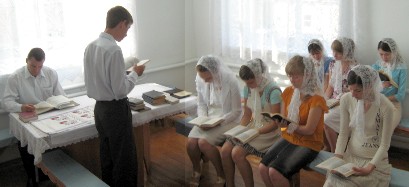
Sunday school, Kochubeevskoe, Summer
2007.
Воскресная школа, Кочубеевское, летом 2007 г.
|
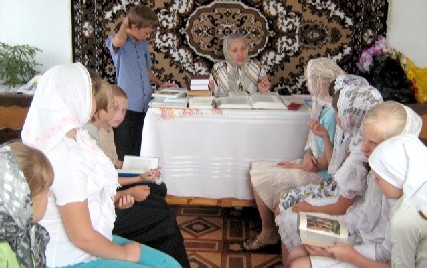
|
Проблеме духовного
возрождения детей и молодежи был посвящен Тамбовский съезд
1997 г. В обращении съезда ко всем молоканам говорилось:
«Наконец-то мы осознали, что без молодежного движения не
будет будущности. Наконец-то мы осознали свою
ответственность за наших детей». На съезде работала
молодежная группа, которая предложила программу действий:
создание журнала, семинары для молодежи, организацию летнего
лагеря и выработку новой формы проведения собраний, в
которых бы участвовала молодежь. В выступлениях некоторых
пресвитеров прямо говорилось, что если в ближайшее время
ничего не сделать, то молоканство просто выродится. Тем не
менее съезд закончился ничем, так как, когда надо было
принять заключительное решение, старейшие пресвитеры,
авторитет которых очень высок в молоканстве, предложили не
принимать резолюций, а объявить по всем общинам пост и
молитву, и Господь все устроит сам. Такой подход, совершенно
естественный с точки зрения глубоко верующего человека, вряд
ли будет способствовать успеху дела. [Съезд
молодёжи
и детей ДХМ, г. Иноземцво, Ставропольский
кр.,2002 г .]
|
The 1997 Tambov Congress
concentrated on the problem of spiritual renewal among
children and youth. The congress newsletter told all
Molokans: “Finally we have recognized that without a youth
movement there will be no future. At last we have recognized
our responsibility to our children.” A youth working group
at the congress recommended a program of action that
comprised a periodical, seminars for young people, a summer
camp, and a new form for conducting religious meetings that
would allow young people to take part. Some presbyters spoke
out publicly, stating baldly that if nothing was done in the
near future, Molokanism would simply die out. Even so, the
congress failed. When the time came to make a decision, the
older presbyters, who wielded great authority among the
Molokans, recommended not adopting any resolutions but
instead instructing all the communities to fast and pray, so
that the Lord Himself would make everything right. This
approach, although completely natural from a believer’s
viewpoint, is an unlikely springboard to success. [Annual summer camps have
been hosted by several congregations in Stavropol'. See: 2002
International
Molokan Youth Congress, Inozemstvo, Stavropol']
|
Проблема молодежи в
духоборческих духовных общинах стоит еще острее в силу
значительно меньшей религиозности этой группы и ее
малочисленности. Уже несколько десятилетий духоборческие
моления не посещают даже люди среднего возраста. В селе
Архангельском, куда как раз переселились главным образом
люди среднего возраста и молодежь, состав молитвенного
собрания значительно помолодел. Женщины 50—60 лет, которые
раньше не ходили на моления, собираются, разучивают псалмы.
Но делают они это скорее для поддержания традиции,
исполнения необходимых обрядов при похоронах, чем от
глубокой религиозности.
|
The youth problem in Dukhobor
communities is even more acute, by virtue of this group’s
considerably lower degree of religious commitment and its
smaller size. For the last few decades, even middle-aged
people have not been attending Dukhobor prayer services. In
the village of Arkhangel’skoe, which happens to have been
settled mostly by middle-aged and young people, attendance
at prayer meetings is significantly younger than the
average. Women aged fifty to sixty, who previously did not
attend services, now come together and study the psalms, but
they do that more to support a tradition and perform
necessary funeral rites than out of profound religious
commitment.
|
| Вопрос о молодежи стоял в
1996 г. на расширенном заседании совета Объединения
духоборцев России. Реализуя его решения, духоборцы
Архангельского организовали у себя на базе
общеобразовательной школы воскресную. Одна из
преподавательниц взялась читать цикл лекций по истории и
вероучению секты для старших классов. Планируется, что
ребята будут учить псалмы и стишки, но по сути дела речь
идет не о привлечении детей к духовной жизни общины, а об
изучении культурного наследия предков. Вся работа духоборцев
с молодежью выливается как раз в такие культуроведческие
формы. Одна из инициаторов культурного возрождения
духоборчества в Ростовской области писала в газете «Вестник
духоборцев», издающейся в г. Чернь Тульской области, что
нельзя называть себя духоборцем, если «не знать ни одного
псалма, историю предков, установившиеся духоборческие
ритуалы, обычаи»(8). Для приобщения к
традиционной культуре потомки духоборцев, живущие в Ростове,
собираются в краеведческом музее, где есть духоборческая
экспозиция, поют псалмы и стишки. Однажды на Троицу в
старинных костюмах эта группа с пением под аплодисменты
прохожих прошла по улицам города. Все это нельзя не
приветствовать, но в таких этноконфессиональных группах
нельзя возродить культуру, традиции без религии, иначе вся
работа выльется в создание фольклорных ансамблей, что,
собственно, мы и наблюдаем. |
The youth issue was brought
up in 1996 at an expanded session of the ADR Council. In
carrying out the decision reached there, the Arkhangel’skoe
Dukhobors set up a Sunday school under the auspices of the
secular day school, one of whose teachers undertook to
deliver a series of lectures on Dukhobor history and
doctrine to the upper grades. The plan was to teach the
students psalms and verses, but this was, in essence, less a
matter of attracting children into the community’s spiritual
life than of teaching them about the cultural legacy of
their forebears. Actually, all Dukhobor projects involving
young people take the form of cultural studies. One of the
inaugurators of Dukhoborism’s cultural revival in Rostov
oblast wrote in Vestnik
dukhobortsev, which is published in the city of
Chern (Tula oblast), that one cannot claim to be a Dukhobor
if “one does not know a single psalm, the history of one’s
forebears, or the established Dukhobor rituals and customs.”(8) To gain familiarity with the
traditional culture, the descendants of Dukhobors living in
Rostov meet in the regional museum, which has a permanent
Dukhobor exhibition, to sing psalms and verses. On one
Trinity Sunday, the members of the club dressed in
historical costume and paraded, singing, through the city
streets, to the applause of onlookers. But, while all this
is most welcome, there can be no revival of the culture, of
the traditions of such ethno- denominational groups absent
the religion, for otherwise the net result of these efforts
will be the formation of folk music troupes, which is what
we are indeed witnessing. |
Проблема увеличения
численности этих сект и их омоложения могла бы быть решена
за счет привлечения новых членов не из духоборческой и
молоканской среды, а со стороны. Но такой подход
противоречит традиции, в соответствии с которой стать
духоборцем или молоканином можно только по рождению.
Сложилось это исторически. В Таврии и в Закавказье
религиозные общины превратились еще и в земельные, и им было
невыгодно расширяться за счет притока людей извне. Молокане
во внутренних губерниях России были поставлены в такие
условия, при которых сколько-нибудь активная миссионерская
деятельность была просто невозможна.
|
The problem of increasing and
rejuvenating these sects could be resolved by drawing in new
members from outside the [Spiritual
Christian] Dukhobor and Molokan
milieus. But this approach runs counter to tradition, which
holds that one can be [Spiritual
Christian] Dukhobor or Molokan
only by birth. The historical background to this is that the
religious communities in the Taurida and the Transcaucasus
were simultaneously agrarian communities, which would not
have profited from an expansion entailing the acceptance of
an influx of outsiders. The Molokans in Russia’s inner
provinces were in the same circumstances, and as a result,
any even remotely active proselytizing was simply out of the
question. |
| В совете Союза общин ДХМ одно
время существовала миссионерская группа, которая, правда,
так ничего и не сделала в направлении распространения
молоканского учения. Очень уважаемый среди молокан старец из
Воронежа, упрекая единоверцев в бездействии, писал на
страницах «Слова веры», что настал час, когда надо
«включиться в активную проповедь Благой вести среди
окружающих вас людей: в ваших собраниях, через проповедь и
пение псалмов; в повседневной жизни, через добрые дела и
милосердие к окружающим, чтобы увидели “народы правду твою и
все цари — славу твою” (Ис.
52:2)»(9). |
The UCSCM Council at one time
included a missionary group — which, admittedly, did nothing
at all to spread the Molokan doctrine. A Voronezh elder who
is highly respected among the Molokans upbraided his
coreligionists for their inactivity in Slovo very, writing
that the hour had come “to engage in active exhortation and
the singing of psalms; in everyday life, through good works
and with loving kindness to all, that ‘the Gentiles shall
see thy righteousness, and all the kings thy glory’ [Isaiah 62:2].”(9)
|
Привлекать со стороны, как
признался один из лидеров тамбовских молокан, еще и
«смелости и твердости духа не хватает», так как новичка
нечем увлечь, и те, кто и приходит, сразу же охладевают, им
становиться тягостно, неинтересно и скучно(10).
Действительно, неоднократно приходилось слышать мнения, что
проповеди молоканских пресвитеров совершенно не отвечают
духовным запросам людей нынешнего времени. Подавляющее
большинство пресвитеров — это люди весьма преклонного
возраста, малограмотные, а верующим, особенно из городских
общин и тем более молодым, отличного знания Библии, чем
всегда отличались молоканские пресвитеры, уже недостаточно.
Многие, посещая молоканские собрания, ходят еще и на
собрания баптистов или адвентистов, мотивируя это тем, что
там они полнее удовлетворяют свои религиозные запросы.
|
Also, as a leader of the
Tambov Molokans has acknowledged, “the courage and firmness
of spirit” needed to attract outsiders “is lacking,” since
there is nothing that would serve to draw a newcomer in and
those who do come are immediately turned off, finding the
whole thing depressing, uninteresting, and dull.(10) Indeed, there is a frequently
voiced opinion that the preaching of Molokan presbyters in
no way meets the spiritual needs of people today. Most
presbyters are elderly and poorly educated, and the
excellent knowledge of the Bible whereby Molokan presbyters
have always distinguished themselves is no longer sufficient
for the faithful, especially those in urban communities and
the young. Many who attend Molokan meetings also go to
Baptist and Adventist meetings, on the grounds that they
more fully satisfy their religious needs. [Similarly in North America
most Spiritual Christians learn Christianity from
Christian TV, radio programs, tapes, and attending
meetings of other faiths.]
|
В нашем распоряжении есть
направленное в адрес Тамбовского съезда письмо от молодого,
активного, думающего молоканина из Рязани, в котором он дал
очень верный анализ ситуации, сложившейся в секте. Он
призывал не ждать, пока в духовную общину придут потомки
молокан, а идти и проповедовать среди других конфессий, не
держаться за «чистоту учения», а сделать молоканство
современным, шагнуть из XVIII в XXI в. В письме была
изложена программа действий, но ее никто даже не стал
обсуждать.
|
We have before us a letter
written to the Tambov Congress by a young, energetic,
thoughtful Molokan from Riazan, who offered an accurate
analysis of the situation within the sect. He urged not
waiting for Molokan offspring to join the spiritual
community and recommended instead going out to spread the
word among other denominations, not holding fast to the
“purity of the doctrine” but modernizing Molokanism, making
the leap from the eighteenth century to the twenty-first.
The letter laid out a program of action, but no one even
bothered to discuss it.
[Modernization using the Internet has
been mostly accomplished by individuals who host their own
websites.
A proposal to unite San Francisco youth with those in
Russia via the Internet was rejected by the American Molokan
presbyter who banned its official use in his congregation,
apparently echoing fears similar to zealous diaspora
Dukh-i-zhizniki.]
|
| Некоторые старцы связывают
упадок молоканства с отсутствием финансов. Один из них писал
в упомянутый журнал, что без десятины в пользу церкви
существование ДХМ будет печальным: «О, если бы наши общины
были бы более или менее побогаче и погостеприимнее, сколько
бы душ они приобрели!». И отчасти это верно, но нищета не
только не позволяет развернуть широкую миссионерскую работу,
она толкает наименее убежденных в истинности своей веры в
другие церкви. Отток молокан к баптистам был издавна, но
последние годы он шел очень сильно, и не только к баптистам,
но и к адвентистам, иеговистам. Немаловажную роль в этом
явлении последние годы играло не только духовное, но и
материальное начало. В этих сектах чуть ли не каждый месяц
раздавали гуманитарную помощь. Пресвитер одной из тбилисских
общин в разговоре сетовал, что экономические трудности
подорвали стойкость и преданность собратий молоканской вере.
Современные материальные проблемы еще сильнее выявили
неблагополучие в духовной общине молокан, ослабление
религиозности среди части ее членов. |
Some elders associate the
decline of Molokanism with the lack of money, one writing in
Slovy very that
without tithing, Spiritual Christian Molokans face a dismal
future: “Oh, were our communities a little wealthier in some
degree, and more welcoming, how many souls might they win!”
This is to some extent true, but poverty, in addition to
preventing the broader pursuit of proselytizing, propels
those who are less certain of the truth of their belief into
other churches. Molokans have long been leaving to join the
Baptists, but in recent years the outflow has become very
pronounced — and not only to the Baptists but to the
Adventists and the Jehovah’s Witnesses, too, for reasons not
only spiritual but material, since those latter sects
distribute humanitarian aid almost every month. The
presbyter of a community in Tbilisi complained in
conversation that economic difficulties have undermined the
constancy and devotion of his brethren in the Molokan faith.
Contemporary material problems point up even more forcefully
that all is not well in the Molokan spiritual community
either, that the religious commitment of some of its members
is weakening.
[In 2007, UCSCM senior presbyter V.V.
Shchetinkin regrettably confessed that he
over-aggressively pursued and won the head position in
1991-92, to the detriment of the organizers in Moscow. He
said in the beginning he naively thought that all
"Molokans" in America and Australia (actually Dukh-i-zhizniki
who falsely claimed to
be "Molokans") were members of a well-funded,
professionally managed international organization
that will employee him full-time. He thought
"Molokan" head presbyters were like those of other faiths
he had met (Baptist, Adventist, etc) who got training,
financing and management oversight from huge international
outreach organizations. He misinterpreted the donation of Bibles, privately done by John
A. Kochergen (Fresno, California, USA), humanitarian aid shipments, cash, appearance of a large group of mostly
"tourists" in 1992, 2 newspapers editions in America,
business advice, a trip to the U.S. (paid by the
Smithsonian Institute), etc., as the beginning of a
long-term planned support program. It was not. He really wanted a paid job to minister
and help needy people everyday, to visit the sick, to
council, to pray, etc., which he did on his own pension,
with a lot of help from 3 sons, until his death in 2012.]
|
| Что же касается духоборцев,
то вопрос о миссионерской деятельности никогда даже не
вставал в их среде. Главная причина того, что проблема
пополнения сект так и осталась нерешенной, на наш взгляд
заключается прежде всего в отсутствии как у старшего
поколения, так и у молодежи действительно серьезного желания
что-то делать в этом направлении. |
The issue of proselytizing
has never even arisen for the Dukhobors. As we see it, the
problem of replenishing their sect remains unresolved
primarily due to the lack of a truly serious desire to move
in that direction, on the part both of the older generation
and of the young.
|
Подавляющее большинство тех,
с кем мне довелось беседовать (а это и рядовые духоборцы и
молокане, и их руководители), не осознают свои специфические
групповые интересы, которые они должны бы декларировать и
отстаивать перед государством и обществом. При анкетном
опросе молокан выяснилось, что от государства, по их мнению,
требуется только законодательное обеспечение равенства всех
«невредных» для общества конфессий. Безусловно, и
духоборцам, и молоканам не безразлично их правовое
положение, отношение к ним государства, но складывается
впечатление, что все дискуссии, которые развернулись в 1997
г. по поводу закона «О свободе совести и религиозных
объединениях», их как бы не касались. В разговоре с
пресвитерами на молоканском съезде в Тамбове выяснилось, что
никто из них даже не интересуется этим законом, никто не
попытался хотя бы поднять вопросы, важные для духовной жизни
этой конфессии. Руководители духоборцев тоже не сочли нужным
прочитать его проект.
|
Most of those with whom I
spoke (both ordinary [Spiritual
Christians] Dukhobors and Molokans
and their leaders) fail to recognize the specific group
interests that they should be affirming and defending before
state and society. The Molokan survey reveals that all they
require of the state is the legally mandated equality of all
denominations that “do no harm” to society. Unquestionably [Spiritual Christians] both
Dukhobors and Molokans do care about their legal
position and the state’s attitude toward them, but one gains
the impression that all the discussions of the Law
on Freedom of Conscience and Religious Associations in
1997 seemed not to concern them at all. Conversation
with presbyters at the Molokan [Youth]
Congress in Tambov [in July 1997] revealed
that none of them even had any interest in the law or were
making any attempt to raise issues of importance to Molokan
spiritual life at the congress. The Dukhobor leaders also
did not consider it necessary to read the bill. |
| Если исходить из учения этих
сект и их исторического опыта, самым что ни есть религиозным
требованием, отражающим уровень их религиозности и
конфессионального самосознания, является требование
освобождения от воинской повинности. |
A study of these [Spiritual Christians] sects
and their history indicates that the most ultimately
religious requirement, which reflects the level of their
religious commitment and denominational self-awareness, is
the demand for exemption from military service.
|
| До конца 20-х годов члены
этих сект освобождались от службы в армии. Под нажимом
советской власти на Ахалкалакском
съезде сектантов Закавказья в 1929 г. они согласились
служить. В годы Великой Отечественной войны и те, и другие
наравне со всеми защищали родину, а позже из среды
духоборцев и молокан выходили даже профессиональные военные.
Последние годы представителей этих сект, учение которых
запрещает участие в насилии(11),
приглашали на заседания и совещания в общественные и
государственные организации, занимающиеся изучением вопроса
об альтернативной службе по религиозным убеждениям. Они
посещали эти заседания, но сами никакой инициативы не
проявляли. 75% опрошенных мной молокан (в основном
пресвитеров) старшего возраста — 65 лет и выше — на вопрос о
воинской повинности ответили, что молокане должны служить
наравне со всеми. Только 8% опрошенных заявили, что молокане
по своим убеждениям вообще не должны служить, а остальные
видят выход в альтернативной службе. Некоторые ответы
хотелось бы процитировать. «Мы — русский народ и обязаны
служить там, где потребует Родина», — написал в анкете
молоканский пресвитер 66 лет. Другой пресвитер более
старшего возраста ответил так: «Должны служить в армии все
юноши и даже часть девушек. Любовь к Родине, защита
Отечества — это и защита своего вероисповедания …». А вот
верующие представители среднего поколения почти все
высказались за альтернативную службу. Однако в разговоре
выяснилось, что это продиктовано не религиозными
установками, а социально-политическими, и прежде всего
недостатками армии, отрицательным отношением к ней, которое
сложилось под влиянием средств массовой информации. |
Until the late 1920s [Spiritual Christians] Dukhobors
and Molokans did not have to serve in the army,
but in 1929, under Soviet pressure, they agreed to do so, at
the Akhalkalak Congress of Sectarians of the Transcaucasus.
During the Great Patriotic War [1941–45], both groups
joined, on an equal footing, in the defense of the
motherland, and subsequently they even produced some
military professionals. In recent years, members of both
sects, whose doctrine forbids the use of violence, were
invited to meet with public and state organizations studying
the issue of alternative forms of national service to
accommodate religious convictions.(11)
They attended the meetings but did not take any initiative
there. Seventy-five percent of the older (65 and older)
Molokans I surveyed (mostly presbyters) responded to a
question about military service by stating that Molokans
should serve like everyone else. Only 8% declared that
they should not serve at all, on the grounds of their
convictions, and the remainder saw a solution in alternative
forms of service.* Some survey
responses bear quoting: “We are Russian people and are
obliged to serve wherever the Motherland needs us,” a
66-year-old Molokan presbyter wrote. Another, even older
presbyter responded: “All young men and even some girls
should serve in the army. Love for the Motherland and
defense of the Fatherland are the defense of our creed.”
Almost all the middle-aged faithful favored alternative
service. Subsequent conversations, however, revealed that
this choice was dictated not by religious but by
sociopolitical tenets, primarily the army’s shortcomings and
the negative attitude toward it fostered by the media.
[* These proportions match the
diaspora non-Doukhobors. More
than 700 (90%) joined the U.S. military during WW2,
while 76
chose alternative service, of whom about half did
not pay for their alternative service costs, cheating the
C.P.S. organization out of more than $17,000 at that
time.]
|
Те духоборцы, которые
когда-то отказались от службы в армии и сожгли свое оружие,
выехали в конце XIX в. в Канаду. Оставшиеся в России пошли
на компромисс с государством. С конца 20-х годов вопрос об
освобождении от службы в армии в этой секте никогда не
вставал. Совет Объединения духоборцев России этот вопрос
поднимать вообще отказался. И если кто-то из современной
молодежи и выказывает нежелание идти служить, то отнюдь не
по религиозным мотивам. Достаточно сказать, что указанный
совет возглавляет полковник в отставке.
|
Dukhobors who refused to
perform military service and burned their weapons in the
late nineteenth century emigrated to Canada, while those who
remained in Russia entered into a compromise with the state.
For them, the issue of exemption from military service was
closed to discussion in the late 1920s. The ADR Council —
which, suffice it to say, is headed by a retired colonel —
has refused to raise the issue under any circumstances. So,
should any young person today display an unwillingness to
serve, it would not be on religious grounds. |
| Изменения, произошедшие в
90-е годы в самосознании духоборцев и молокан, хорошо видны
также на примере отношения к православной церкви. Среди их
потомков, уехавших в города, и раньше встречались крещенные
в православие. Обычно это дети от браков с православными или
женщины, вышедшие замуж за православных и живущие в семье
мужа. Но в 90-е годы некоторые молокане, проживающие в
городах Закавказья, крестились у православных священников
для того, чтобы подчеркнуть свое этническое (русское)
происхождение. Прежняя религиозная неприязнь, не сильная, но
все-таки ощутимая, когда разговор касался православной
церкви, в настоящее время значительно стушевалась. Отношение
верующих этих конфессий к православной церкви сейчас
правильнее было бы назвать настороженным. Трудно
представить, чтобы еще десять лет назад духоборцы или
молокане изъявили желание чем-то помочь ей. Но сейчас есть и
такие случаи, когда, например, община духоборцев села
Гореловка в Грузии неоднократно помогала продуктами
Святоольгинскому монастырю или посылала продукты в русскую
православную церковь в Тбилиси для раздачи прихожанам. Свои
действия руководители общины мотивировали тем, что они
прежде всего русские и хотели помочь своим, оказавшимся в
тяжелом экономическом положении. |
The changes in the
self-awareness of [Spiritual
Christians] Dukhobors and Molokans
that came about in the 1990s are also clearly seen in their
attitude toward the Orthodox Church. Even before that, [Spiritual Christian] Dukhobor
and Molokan offspring who went to live in urban
areas were sometimes baptized into Orthodoxy. Usually these
were the children of mixed marriages or women who had
married an Orthodox man and lived with his family, but in
the 1990s some Molokans living in the towns and cities of
Transcaucasia accepted baptism by Orthodox priests to
underscore their ethnic (Russian) origins. The erstwhile
religiously motivated distaste — not strong but nevertheless
perceptible — when the conversation turned to the Orthodox
Church has been significantly muted, and the attitude would
now most accurately be classified as circumspect. It would
be difficult to imagine any [Spiritual
Christian] Dukhobor or Molokan,
even a decade ago, expressing any desire to help the Church,
but now there are such instances, as exemplified by a
Dukhobor community in Gorelovka, Republic of Georgia, that
has made several food donations to St.
Olga’s Monastery and has sent food to the Russian
Orthodox Church in Tbilisi for distribution to parishioners.
The usual explanation given by community leaders for these
actions is that they are Russians above all and wanted to
help some of their own who had fallen on hard times. |
Нарекания духоборцев и
молокан вызывает то, что православная религия все больше, по
их мнению, приобретает неофициальный статус государственной,
но эти претензии скорее обращены к государству, чем к самой
церкви. [Государство
и
Церковь в России: Православие по-кремлёвски? — Нью-Йорк Таймс, 22
Апрель 2008 г.]
|
[Spiritual
Christians] Dukhobors and Molokans
are apt to complain that Orthodoxy is gradually, albeit
unofficially, acquiring the status of a state religion, but
the complaints are directed more at the state than at the
Church. [See: At
Expense
of All Others, Putin Picks a Church — New York Times, April 24, 2008]
|
Уже давно и в помине нет
былого неприятия земных властей. Отношение молокан и
духоборцев к власти можно, пожалуй, выразить следующим
образом: «не мешают — и слава Богу». В информационном
сообщении о состоявшейся регистрации Союза общин ДХМ России
в декабре 1994 г. говорилось: «Возблагодарим Господа за
расположение всех властей к нам, не препятствующих совершать
молитвы и прошения, как о себе, так и за весь род
человеческий …»(12). Никаких иллюзий и
надежд на помощь государства в возрождении своей культуры у
них нет, хотя отношение местной администрации к сектам
молокан и духоборцев в последнее десятилетие заметно
изменилось в лучшую сторону.
|
There has long been no trace
of any denial of secular authority. The [Spiritual Christian] Molokan
and Dukhobor attitude to authority is, perhaps,
best couched as follows: “They don’t interfere with us, and
praise be to God for that.” Announcing the completion of its
registration in December 1994, the UCSCM of Russia stated,
“We give thanks to the Lord for the favor shown to us by all
authorities, which do not hinder us from offering up prayers
and petitions both for ourselves and for all mankind.”(12) They harbor no illusions or hopes
of official assistance in reviving their culture, although
in the last decade the attitude of the local administration
toward the [Spiritual Christians]
Dukhobor and Molokan sects
has improved noticeably. |
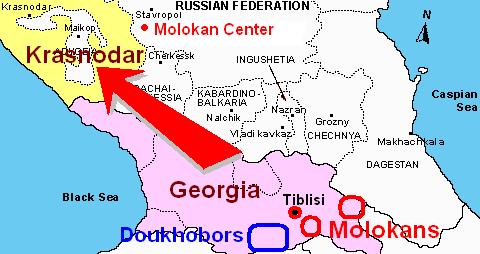
[In 2007 there were as many as 40
congregations of non-Doukhobor Spiritual Christians
scattered in the Krasnodar area. Inspection in 2012 found
8 regularly meeting, and a large new meeting hall built in
Ivanovka,
west Krasnodar, by Dukh-i-zhizhniki re-settled
from Armenia, but used by all Spiritual Christian
denominations in the surrounding area.]
|

Map by Jonathan Kalmakoff, Doukhobor
Genealogy Website.
|
| В начале 90-х годов в связи с
вынужденной миграцией об обеих сектах много писали в
центральной прессе, им было посвящено несколько
телевизионных передач. В результате сформировалось
положительное общественное мнение об этих группах, появился
интерес к их истории и культуре. Их духовность стали не
только ценить, но даже несколько преувеличивать.
Показательно в этом отношении обращение администрации
Целинского района Ростовской области к Союзу общин ДХМ после
проведения на территории района четвертого молоканского
съезда. В нем говорилось, что участники съезда
«...продемонстрировали добрую волю возрождения молоканства в
России, что неизбежно плодотворно влияет на общее духовное,
моральное состояние общества. Можно без преувеличения
сказать, что работа, проводимая вами, занимает достойное
место в процессе возрождения и поддержания движения духовных
христиан-молокан в Целинском районе и в целом по России,
затрагивая историческое прошлое и общие духовные ценности»(13). Администрации целого ряда
нечерноземных районов выражали желание принять духоборцев и
молокан из Закавказья. |
[Spiritual
Christians] Both sects received
much national press coverage and considerable television
airtime in the early 1990s, in connection with their forced
migration.* As a result, the
public began to regard them positively and to show an
interest in their history and culture. Their spirituality
was not only esteemed but even somewhat overstated.
Indicative in that regard is the communication addressed to
the UCSCM by the administration of Tselinskii raion, Rostov
oblast, where the Fourth Molokan Congress had been held,
which declared in part that the congress attendees had
“demonstrated the goodwill attendant upon the revival of
Molokanism in Russia, which will inevitably exert a fruitful
influence on the overall spiritual and moral state of
society. One may state without exaggeration that the work
you have done occupies a worthy place in the process of
reviving and supporting the Spiritual Christian Molokan
movement in Tselinskii raion and in Russia as a whole,
touching as it does on the past and on general spiritual
values.”(13) The administrations of a
whole array of non-black-earth districts also expressed a
desire to take in [Spiritual
Christians] Dukhobors and Molokans
emigrating from the Transcaucasus.
[* Doukhobors
in Georgia (a chronology)
Georgia
Spiritual Christians Invited to Russia, 2009]
|
| Оглядываясь назад, на
проблемы, которые стояли перед духоборцами и молоканами в
конце 80-х годов, приходится признать, что ни одна их них не
была решена. Более того, сегодня можно говорить о том, что
механизм, позволявший таким общностям долгое время сохранять
единство и функционировать, сломан. Вместо возрождения
конфессионального самосознания в 90-е годы продолжался
процесс его затухания. Большая часть постоянных молокан и
подавляющее большинство духоборцев (называющих себя
таковыми) идентифицируют себя не по общности религии, а по
общности исторического прошлого и культуры, которая, в свою
очередь, в значительной степени утратила религиозную основу.
И если у молокан религиозные вопросы поднимаются на съездах
и на страницах журналов, а должность старшего пресвитера
занимает человек, известный своей религиозностью и знанием
молоканских догматов, то у духоборцев религиозные вопросы
вообще уже давно не обсуждаются, а созданный ими совет
Объединения духоборцев — организация сугубо светская и
возглавляет ее человек светский. Духоборческие общины скорее
напоминают землячества, чем религиозную секту. |
But looking back on the
problems faced by the [Spiritual
Christians] Dukhobors and Molokans
in the late 1980s, it must be acknowledged that none of them
has been resolved. It may, furthermore, be said that the
mechanism that once permitted fellowships such as these to
retain their unity and to function is now in great
disrepair. Rather than reviving, denominational
self-awareness continued to wane in the 1990s. Most Constant
Molokane and the overwhelming majority of Dukhobors
(those who designate themselves as such) self-identify not
by their religious community but by a shared history and
culture that has lost a significant amount of its religious
underpinning. Whereas matters of religion are raised at
Molokan congresses and in Molokan periodicals and the post
of senior presbyter is occupied by a man known for his
religious commitment and knowledge of Molokan dogma, the
Dukhobors long ago stopped discussing religious issues in
general. The Council of the Alliance of Dukhobors is an
explicitly secular organization, led by a secular
individual. In fact, the Dukhobor communities are more
expressive of regional solidarity than of religious
sectarianism. |
Переселения, вызванные
распадом СССР и национальными конфликтами, нанесли этим
этноконфессиональным группам очень тяжелый удар.
Распылившись по стране среди русского населения, кавказские
духоборцы и молокане, до недавнего времени являвшиеся
хранителями наследия предков, постепенно будут
ассимилированы русскими. И вряд ли кто-либо сможет
затормозить этот процесс.
|
The re-settlements occasioned
by the collapse of the USSR and the ensuing national
conflicts have dealt a harsh blow to these two ethno-
denominational groups. Strewn across the country among the
Russian population, the [Spiritual
Christians] Dukhobors and Molokans
from the Caucasus who were until recently the custodians of
their forebears’ legacy will be assimilated piecemeal by the
Russians. It is unlikely that anyone can arrest that
process. |
| Данный историей шанс на
возрождение остался не использованным. |
The
opportunity for a revival that history offered has been
squandered.
|
Примечания
- Ниже речь в статье идет только о постоянных молоканах,
т. е. последователях Уклеина, придерживающихся его
обрядника.
- Среди духоборцев и молокан были представители разных
народов, но большинство их было русскими по
национальности.
- Необходимо уточнить, что мы имеем в виду, говоря о
молоканской и духоборческой общинах. Понятие «община»
применяется в отношении этих сект двояко. С одной
стороны, это группы людей, посещающих молитвенные
собрания и соблюдающих все религиозные обряды. Но, с
другой стороны, если это компактное поселение духоборцев
или молокан (например, закавказских), то о всем селе
обычно говорят как об общине, так как независимо от
степени религиозности все в той или иной мере принимают
участие в коллективных или семейных религиозных обрядах,
хотя и там есть ядро из наиболее убежденных верующих —
духовная община, контролирующая социальное поведение и
жизненный уклад даже неверующих односельчан.
- Петров С. П.
Нужны
ли в молоканстве наемные служители // Слово веры.
— 1996. — № 6.
- У духоборцев последним духовным лидером, признанным
всеми духоборцами, была Лукерья Калмыкова, умершая в
1886 г. Подчинение ей было основано на глубочайшей вере
в ее божественность. Духоборцы, выехавшие в 1898— 1899
гг. в Канаду, считали своим лидером П. Веригина.
Оставшиеся в России уже не имели духовного вождя.
- Весть ДХМ. — 1991. — № 4.
- Духовный христианин. — 1992. — № 1. — С. 64.
- Лаухина Л.
Каждый и все вместе возродим духоборчество // Вестник
духоборцев. — 1993. — 30 окт.
- Петров П. А.
Обращение
ко
всем духовным христианам-молоканам // Слово веры.
— 1995. — № 5.
- Петров С. П.
О
нашей тамбовской общине духовных христиан-молокан
// Слово веры. — 1994. — № 1.
- Иникова С. А.
История
пацифистского движения в секте духоборцев (XVIII— XX
вв.) // Долгий путь российского пацифизма. — М.,
1997.
- Весть. —
1995. — № 1.
- Нам
пишут // Слово веры. — 1995. — № 3.
|
Notes
- In this article we concern ourselves only with the
Constant
Molokane, [Semyon]
Uklein’s followers and the practitioners of the rite he
introduced.
[Unfortunately many Spiritual Christians falsely
report they are "Molokan." See: Taxonomy of
3 Spiritual Christian Grpups.]
- Though the [Spiritual
Christians]
Dukhobors and Molokans
included people of various nationalities, most were
Russian nationals.
- It is essential to specify what we have in mind when
we speak of [Spiritual Christian]
Molokan and Dukhobor communities, since
the concept of “community” has a dual meaning when
applied to these two
sects. On the one hand, it implies groups of people who
attend prayer meetings and perform all the religious
rituals. On the other hand, if the entity in question is
a compact colony of [Spiritual
Christians] Molokans and Dukhobors
(as, for example, in the Transcaucasus), the whole
village is usually referred to as a community, since
regardless of the degree of religious commitment,
everyone participates to some extent or another in
collective or familial religious rituals, although even
here there is a core of most dedicated believers—a
spiritual community that monitors the social behaviors
and lifestyles even of nonbelievers in the village. [Many villages have several
congregations of different Spiritual Christian
faiths which meet separately for worship (sobranie).]
- S.P. Petrov, “Nuzhny
li v molokanstve naemnye sluzhiteli,” Slovo very, 1996,
no. 6.
- The last spiritual leader recognized by all Dukhobors
was Luker’ia Kalmykova, to whom deference was paid due
to a profound faith in her divine nature. She died in
1886. The [majority of]
Dukhobors who emigrated to Canada in 1898 and 1899
considered Petr Verigin their leader, whereas those who
remained in Russia recognized no spiritual leadership. [Today only USCC
Doukhobors in Canada have a leadership social
structure.]
- Vest’ dukhovnykh
khristian-molokan, 1991, no. 4.
- Dukhovnyi
khristianin, 1992, no. 1, p. 64.
- L. Laukhina, “Kazhdyi i vse vmeste vozrodim
dukhoborchestvo,” Vestnik
dukhobortsev, 30 October 1993.
- P.A. Petrov, “Obrashchenie
ko vsem dukhovnym khristianam-molokanam,” Slovo very, 1995,
no. 5.
- S.P. Petrov, “O
nashei tambovskoi obshchine dukhovnykh
khristian-molokan,” Slovo very, 1994, no. 1.
- S.A. Inikova, “Istoriia
patsifistskogo dvizheniia v sekte dukhobortsev
(XVII–XX vv.)", in Dolgii put’ rossiiskogo patsifizma
(Moscow, 1997).
- Vest’, 1995,
no. 1.
- “Nam
pishut,” Slovo
very, 1995, no. 3.
|
|
Духовные христиане —
вокгуг света
|
Spiritual Christians
Around The World |