Open Letter
A reply to Letter from the Holy Spirit
By Michael P. Lediaev, September 15, 1998
Edited in red in 2017 by Andrei Conovaloff.
This letter is about obvious contradictions in what Dukh-i-zhizniki say, compared to what they do. This paradox was revealed more than 40 years ago: "Can you be malakan/ Molokan and Christian at the same time?"
In 1998, the author reported that literature in the Heritage Room and Library at the United Molokan Christian Association (U.M.C.A.), Hacienda Heights, California, falsely presents their Dukh-i-zhiznik faiths as a "Molokan" faith. The quandary is amplified because the Dukh-i-zhiznik organization name presents a false label, while its by-laws require members to be Pryguny. In practice, Dukh-i-zhiznik faiths prohibit members from affiliating with Molokane, Pryguny, or any non-Dukh-i-zhiznik faith.
If the library did not have documents from different faiths, claiming they were of one faith; and if the organization and member congregations did not lie about their identity, origins or membership rules, this open letter probably would not have been written.
Note that this "Open Letter" was written before the term Dukh-i-zhiznik was created in 2007 to properly label the variety of faiths which stem from use of the Книге солнца, дух и жизнь (Book of the Sun, Spirit and Life), 1928. When the Spiritual Christian faiths in the U.S.A. are accurately labeled, as done below in red, this letter becomes clearer.
For perspective and context, the reader must understand the background of the author and his point-of-view. Lediaev is Russian-literate, born in Iran (Persia) among Spiritual Christian Molokane, Subbotniki and Pryguny. About 1950, his family was among 668 people sponsored to the U.S.A. where they met the new Dukh-i-zhizniki faiths, previously unknown to all the incoming "Persians." The Persians who were sponsored to Northern California had no problem assimilating among Molokane, but the majority sponsored in Southern and Central California were expected to convert to a Dukh-i-zhiznik faith foreign to them. There were no Molokan or Prygun congregations in Southern or Central California, nor were the Persians allowed to form their own faith congregation.
For 10 years, a Persian Prygun congregation tried to form in Los Angeles, but were severely verbally abused by zealous Dukh-i-zhizniki who forced them to convert, or leave. Their Prygun presviter Ivan Lediaev transplanted some of his followers to Australia. Another presviter, Baghdanov, established a congregation in Oregon. The "Persians" remaining in Southern and Central California were treated as a lower class by the most racist Dukh-i-zhiniki. Their "Persian church" services, and anyone who attended, were shunned by practicing Dukh-i-zhizniki until the 1980s when the congregation was determined to be somewhat compliant to unwritten Dukh-i-zhiznik unwritten rules. Because the author is "Persian," the attenuating historic discrimination by zealot Dukh-i-zhizniki was inflamed by his "Open Letter."
Throughout his reply, Lediaev speaks from a contemporary American-Christian point-of-view which is gaining popularity among integrated western Dukh-i-zhizniki who have been trying to defend their form of Christianity because a majority have left the Dukh-i-zhiznik faiths, or declines to participate in services which are limited to old-world rituals conducted in Russian. Probably due to the Jesus Movement and Fourth Great Awakening, the Baby Boomer generation of Dukh-i-zhizniki, and some elders, have been incorporated limited Christianese to attract assimilated people back to their flock. This new American Dukh-i-zhiznik-Christian theology differs significantly from the historic Dukh-i-zhiznik faiths (since 1928) and their precursor faiths by trying to consolidate them under one false label: "Molokan," who are a "chosen" and "special" form of modern Evangelic Christians with a secret holy book and different unwritten rules for behavior.
Since this "Open Letter," the author's son David Mikhaeich Lediaev (also Russian-speaking) was appointed presviter of the Dukh-i-zhiznik congregation north of Kerman, California, commonly called Buchnoffs, Kochergens, and Siskiyou Avenue. Due to his father's essays about contradictions among the Dukh-i-zhinik faiths and literature, and the liberal attitudes of some of the congregation members, some non-member zealot Dukh-i-zhiniki feared that the new presviter would remove the holy book Kniga solntse dukh i zhizn' from the table, which did not occur.
Links added to King James Version (KJV) of the Bible.
— Andrei Conovaloff, 5 July, 2017
Contents
Reason 1 — God
Reason 2 — Christ
Reason 3 — Prophecies
Reason 4 — Rituals
Reason 5 — Editing Rudomyotkin's Manuscripts
Dear Friends of the "Clark Ave" congregation:In your Letter from the Holy Spirit that you sent to our congregations
churches, dated August 22, 1998, there were strong accusations made against our Dukh-i-zhiznikMolokanbrotherhood for being against God's "rituals", "holy days", "statutes" and "commandments" and for being against the "King of Spirits", namely, M. G. Rudomyotkin. It also stated that our "faith (our Dukh-i-zhiznikMolokanbrotherhood's faith) is our death" [упование = "hope", but M.P. Lediaev translates this as "faith"].
No letters were sent to the 2 Molokan congregations in Northern California.
These are very strong statements and accusations. I am sure that this letter will raise more than just eyebrows with people in our Dukh-i-zhiznik
Molokanbrotherhood. Speaking for myself, such accusations prompted me to sit down and write an open letter, as an individual, as one good friend to another and to mail it to all seven of the undersigned witnesses on the letter, to presbytersPreachersand to a few selected people.In this response, I will give five reasons why I, as an individual, reject Rudomyotkin and his claims. At the same time, I would like to point out to you how and where Rudomyotkin is against "rituals", "holy days", and against the First Commandment in the Bible.
First of all, accusations should have been leveled against Rudomyotkin and not against the Dukh-i-zhiznik
Molokanbrotherhood.
Reason 1 — God
(A) Rudomyotkin claimed to be a god.
(B) God's instruction on how to deal with such a situation.
(C) What was the faith of our forefathers regarding the First Commandment?
—————
(A) Rudomyotkin claimed to be a god.
In Rudomyotkin's writings, he claims to be a god in the following way:
"That's why I, Maksim, now called with this new name, King of Spirits and God of the believers throughout the world." (Spirit and Life, Book 9, Chapter 15, Verse 7)By making such a claim, Rudomyotkin is clearly against God's very first commandment. Friends, why make such an accusation against our brotherhood? Why not make the same accusation against Rudomyotkin? When God said "no other gods", He was not giving an opinion, He was giving a commandment.
(B) God's instruction on how to deal with such a situation.
The following is God's instructions on how to deal with such a situation:
"God spoke through him saying, "Thou shall not have ... other Gods..." To have another God is a "rebellion against the Lord your God." If anyone teaches to follow another God — kill him — even if he is a close member of your family. Any prophet that teaches to follow another God shall be put to death." (Deuteronomy 13:1-15)
(C) What was the faith of our forefathers regarding the First Commandment?
What did our forefathers (Russian: predki) believe regarding one God?Today we have many
twodifferent kinds of forefathers (predki). One kind is based on Rudomyotkin's teaching, as we have it today in the book, Spirit and Life. The other forefathers (predki) are Bible-based Spiritual ChristiansMolokans. Far too often when ourchurchspeakers (besedniki) mention our forefathers in theirchurchspeeches, they do not specify which forefathers (who, when, where)differentiate between the two. The truth of the matter is that there are some very major differences in basic theology and doctrines of thewhich make these twodifferent kinds of forefathers who are actually miles and miles apart from each other and from different heritages and faiths.The Bible-based predki (ancestors) left us two lengthy books that spelled out what their faith was. It was written for member Molokans of their day and for future Molokans, as information on what it is to be a Molokan, not a Dukh-i-zhiznik.
One book called Confession of Faith (1865) about Molokane, and the other called Summary of Dogmas also about Molokane, were both recently translated into the English language. I suggest that interested Dukh-i-zhizniki
Molokansread them. They are inspiring and very informative regarding the faith of theourearly Molokaneforefathers, in its purest form. Find copies at the U.M.C.A. Heritage Room and Bookstore, Hacienda Heights CA.The
OurBible-base predki, according to the Molokan book Confession of Faith (1865), believed in one God only. The following is a quote from them:"This commandment requires us to recognize only one God and to worship Him only. Therefore this commandment prohibits us to offer Divine honor or pray to anything or anybody other than the one God."In the Molokan Summary of Dogmas, our forefathers made the following statement of their faith regarding one God:"Though we speak much we cannot reach the end, and the sum of our words is: 'He is the all.' To the King of the ages, immortal, invisible, the Only God, be honor and glory forever and ever."
Reason 2 — Christ
(A) Rudomyotkin claimed to be a new Christ.
(B) Jesus' warning against false Christs.
(C) Who did our early forefathers accept as Christ?
—————
(A) Rudomyotkin claimed to be a new Christ.
In Rudomyotkin's writings, he claims to be a new Christ. Just as Jesus was the Messiah, Rudomyotkin claims, a number of times, that he also is a "Messiah". To cite only one passage:
In the book, Spirit and Life, the attempt to duplicate a Christ-like mission is very subtle and skillfully alluded to by Rudomyotkin. The following are a few examples:"I (Maksim) am called by a new name today and forever in heaven and on earth, for I (Maksim) am Ulesar, King Ures, New Jewish Messiah. The Jews and all other races of the world shall worship me (Maksim)." (Spirit and Life, Book 10, Article 8, Verse 7, Page 498; see also Book 10, Article 31, Verse I and Book 13, Article 1, Verse 1, Page 574.)
The list of examples attempting to show similarities between Jesus Christ and Rudomyotkin goes on and on. Much can be said on this subject of Rudomyotkin equating himself with Jesus Christ, but I think the above examples are sufficient.
- Just as Jesus was the Lamb that was led to the slaughter, Rudomyotkin makes the same claim. To quote his own words: "Publicly they lead me (Maksim) as a lamb to the slaughter." (Spirit and Life, Book 9, Article 4, Verse 3, Page 452)
- Just as Jesus prayed in the Garden of Gethsemane, saying, "Oh, my Father, if it be possible, let this cup pass from me; nevertheless, not as I will but as Thou wilt." (Matthew 26:39) Rudomyotkin also prays: "I (Maksim) beseech you my Father — pass this cup of death from me (Maksim) for it is extremely bitter to me (Maksim). I (Maksim) cannot drink it of my own free will, unless you, my Father, will it." (Spirit and Life, Book 9, Article 4, Verses 4-5, Page 453.)
- Just as Jesus was on the cross, Rudomyotkin claims to have done the same. (Spirit and Life: Book 10, Article 1, Verse XVI, Page 590; Book 13, Article 9, Verse 6, Page 583; Book l0, Article 24, Verse 2, Page 516.)
- Just as Jesus forgave sins, Rudomyotkin claims that under a "new covenant" (Rudomyotkin's new law), sins are only forgiven through him — Maksim. (Spirit and Life, Book 8, Article 1, Verse 14, Page 417.)
- Just as Jesus said he was a Shepherd, Rudomyotkin's claims are: He (Maksim) is a "King Ulia, the only Shepherd...." (Spirit and Life Book 12, Article 7, Verse 3, Page 564.)
"Messiah" is a Hebrew word. The same word translated into Greek is "Christos". In other words, Messiah and Christos are one and the same (John 1:42, 4:25). When Rudomyotkin said he is a Messiah, he is indeed claiming to be "Christ".
(B) Jesus' warning against false Christs.
Jesus' warning: Jesus Christ gave us a clear and strong warning about future "deceivers" such as Rudomyotkin.
"And Jesus answered and said unto them, Take heed that no man deceive you. For many shall come in my name saying I am the Christ and shall deceive many." (Matthew 24:4-5)The above prediction of Jesus Christ came to fulfillment among our Molokan people in the person of Rudomyotkin. We do have two Christs — one Christ of the Bible and another new Christ of the book, Spirit and Life.
(C) Who did our early forefathers accept as Christ?
In Confession Of Faith (1865), our early forefathers stated the following:
"Consequently, Christ and the Holy Scriptures are the sole foundations upon which the true Christian Church is built. The commune of Christ or any community which does not have the teachings of Christ as its foundation is not a true church, because the true church is in on the one accord, and no one can establish another foundation other than the one established, who is Jesus Christ."In the book Summary of Dogmas, our early forefathers stated the following:"....there is one God, and there is one Mediator between God and men, the man Christ Jesus."Most of our founding forefathers came out of the malakan peoplesDoukhobors and theKhlysty, some of whom had leaders that claimed themselves to be a God or a Christ. This was not acceptable to our founding forefathers then, nor would it have been acceptable to them today. The very reason the Molokan sect came into being was ..... rejection of other Gods and other Christs and accepting only one God, one Christ of the Bible.Regarding the belief as to how many Gods or how many Christs to believe in, Paul the Apostle settles this with the following words:
"... there is no God but one." For although there may be so-called gods in heaven or on earth — as indeed there are many "gods" and many "lords" — yet for us there is one God, the Father, from whom are all things and for whom we exist, and one Lord, Jesus Christ, through whom are all things and through whom we exist. However, not all possess this knowledge...." (1 Corinthians 8:4-7)
Reason 3 — Prophecies
(A) Rudomyotkin's false prophecies.
(B) What does it say in the Bible about this matter and what to do about it?
—————
(A) Rudomyotkin's false prophecies.
Rudomyotkin lived at a time and place where the Russian sectarians expected the second-coming of Christ and the end of the world to occur at any hour.*
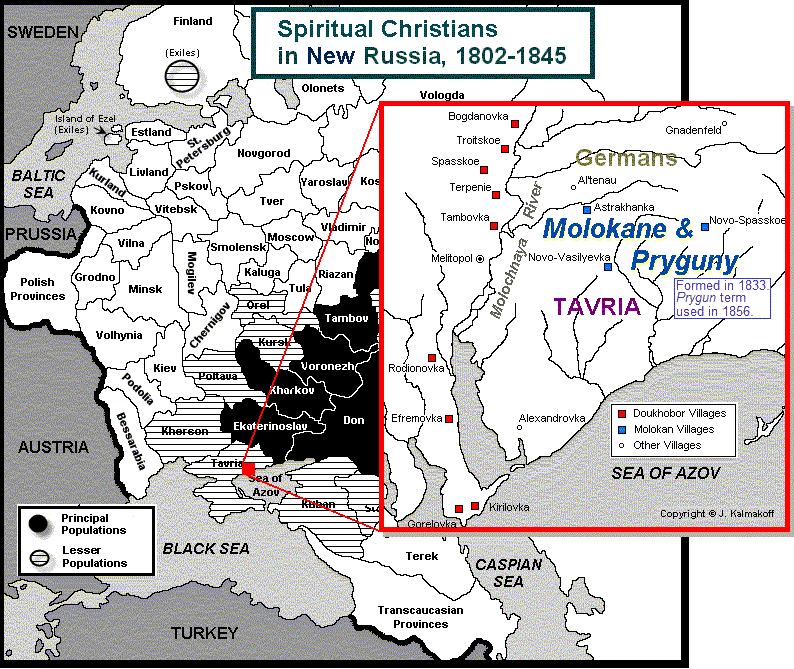
* Before 1833 in Tavria, New Russia, Spiritual Christians had contact with a faction of German protestants who were following their German prophesy to go "south" to Mt. Zion (Jerusalem) for an 1836 Apocalypse, inspired by Jung-Stilling's fictional religious fantasies about refuge in the Far East. Many who were sick or tired, settled near Odessa. When some of these Germans got as far south as the Caucasus, they were not allowed visas to continue out of Russia, so they declared Mt. Ararat to be the location for the 2nd coming of Christ. M.G. Rudomyotkin apparently adopted this German prophesy for his Zion. A more documented and discussed "Great Trek" (pakhod) occurred among varieties of Mennonites in 1880-1882 to Turkestan, Central Asia, to meet Christ in 1889.(23)
It was in such an atmosphere that Rudomyotkin began to prophesy and set dates for the end of the world and the beginning of the thousand year Millennium. Rudomyotkin first prophesied that the Millennium would start in 1857. When the Millennium did not materialize, Rudomyotkin again prophesied that it would come in 1860. He led groups to Mount Ararat. (Berokoff, John K. Molokans in America, Chapters 1,5,9, and Addemdum XXX.) That year came and went, but again the kingdom was nowhere in sight. This kingdom was to be a time when Rudomyotkin would be a ruler for a thousand years.
Rudomyotkin writes of himself, saying, "The King of Kings and Lord of Lords ... would set me (Rudomyotkin), your anointed, in Christ's stead as your king upon the earth for a thousand years and also enthrone all of my people (followers)." (Spirit and Life, Book 11, Chapter 16, Verses 1-15)
In other words, Rudomyotkin and his followers were to be the principal rulers for a thousand years. In 1860, it turned out that instead of beginning his Millennium ruler-ship as predicted, Rudomyotkin began his sentence in Solovetsky Monastery prison. Even though Rudomyotkin's initial predictions were not fulfilled, he was not discouraged from making further predictions. It seems that he was so determined to be a kingdom ruler, that he continued to predict that the Millennium would occur in the nineteenth century (Spirit and Life, Book 6:14:1-12).
The nineteenth century has been gone for almost 100 years now, and yet none of these events have come to pass. So much for those predictions. As a prophet, Rudomyotkin was a failure, to say the least. These revelations, according to Rudomyotkin's own writing, were inspired by a "new Spirit". (Spirit and Life, Book 10, Chapter 5, Verse 4)
This "new Spirit" of Rudomyotkin's is obviously different from the Holy Spirit that was spoken about in the Old and New Testaments of the Bible. They are in total disagreement on topics already mentioned here. Both Spirits cannot be right.
Rudomyotkin's prophecies mentioned above were not fulfilled. Why do some people regard him as a great prophet? I will never know.
(B) What does it say in the Bible about this matter and what to do about it?
The Bible gives us a clear guideline regarding false prophets. And that is "... .do not be afraid of them ... do not listen to them ... do not conceal them ... do not have pity on them ... stone them ... kill them." (Deuteronomy 13:1-11)
In the decades of the 1950s, 1960s, and 1970s, our Dukh-i-zhiznik congregations held several big rallies
churches had a big rallyfor the Spirit and Life book and for Rudomyotkin. Such days are gone. God forbid that we should ever see them again.
Reason 4 — Rituals
(A) Rudomyotkin on Holy Days and Rituals.Dear friends of the Clark Ave. congregation, your the letter also stated that our people are against the Holy Days and Rituals (Russian: obryadi). I do not know where that Spirit gets its information. I do not know of one Dukh-i-zhiznik congregation
Molokan churchor prestol here in the Los Angeles area, where I live, to be against Holy Days, Rituals, or anything of that sort.The only conclusion I came to is that letter is from Rudomyotkin's "new Spirit" and not from the Holy Spirit that is spoken about in the Bible. The Holy Spirit of the Bible would not have made such untrue accusations. The following is what Rudomyotkin wrote against rituals:
"Visible rituals and vestments (formal church garments) are for fallen Jews and deceived Gentiles." (Spirit and Life, Book 13, Chapter 4, Verse 16)Here is what Rudomyotkin wrote about weekly Holy Days:"Should not do any work on the Sabbath (Saturday) also the Day of Resurrection (Sunday) should be observed as one of the Holy Days." (Spirit and Life, Book 4, Chapter 12, Verses 10-11)That means that two days a week should be observed as Holy Days.* Regarding the annual Holy Days, Rudomyotkin writes:"We observe the Holy Days according to the Scriptures. As God commanded Moses and all Israel. And the Lord Himself with His Apostles observed the same Holy Days, as we do today." (Spirit and Life, Book 3, Chapter 6, Verse 7)After instructing his followers as above, Rudomyotkin, for some reason, contradicts himself and makes a 180-degree turnaround, and then says the following to his new church:"For this reason, my new sanctified church is called, in Spirit: Zion of the Holy God of Israel. In it today, there is no need for us to keep ritualistic dressed up holy days of any kind — Hebrew or Gentile." (Spirit and Life, Book 10, Chapter 10, Verse 8)If the above did not confuse you enough, Rudomyotkin changes his mind again, and does away with God's commandments regarding Holy Days, even though these are the same ones that he already instructed his followers to observe. He then informs them that he himself has started to observe all new Holy Days and he intended these all new Holy Days to be part of his new law, which was to be instituted for his followers of that day to observe:"... to all my dear ones, I will bring about a great rejoicing and proclaim all new Holy Days which I myself presently honor according to this new law, there will be no need for any high Holy Days or temporary Holy Days … (Spirit and Life, Book 10, Chapter 14, Verses 1-6)
* Historically for a while, the labels "Saturday Molokans" (Subbotniki) and "Sunday Molokans" (Voskreseniki) were used. About 1833 the precursor millennial movement to the Pryguny formed, which adapted the Subbotnik Old Testament holidays, now transferred to the Dukh-i-zhiznik faiths. (P.N. Miluikov on Molokans and Judaizers.) Keep in mind that the writings attributed to Rudomyotkin probably came from a variety of faith sources.
Reason 5 — Editing Rudomyotkin's Manuscripts
Many years ago I became suspicious, due to the way the so-called Rudomyotkin writings appeared in today's Spirit and Life book. Namely, they came across to me, with good reason, as some portions having been "cooked up." Where and when did this "cooking" take place? To find the answer to that question, I needed a copy of Rudomyotkin's manuscripts that were brought to this country from Russia. For many years I tried to get hold of the copies without any success. When I gave up and lost all hope of ever seeing them, someone unexpectedly came along and gave me a copy of the manuscript. To put it mildly, I was very surprised and grateful.What did the manuscripts indicate?
First of all, the manuscripts for Books 1-3 were missing (for a good reason). What reason ?
Secondly, the manuscripts were not the original manuscripts of Rudomyotkin. Rudomyotkin wrote on loose pieces of paper, as letters, that were smuggled out of the monastery prison.
According to oral history, these "pieces of paper" were small tea wrappers, bound with string, and tossed to a visiter while Rudomyotkin distracted a guard. Because they were contraband, possession was a felony. The writtings were smuggled to America baked in a loaf of bread, by ____ Tolmachoff, Rudomyotkin's niece, and brought to Arizona where the first book of his secret writings was arranged — Утренняя звезда (Morning Star), and published in Los Angeles in 1915. Photocopies of some of these original writings are on display in the U.M.C.A. Heritage Room, Hacienda Heights CA. The originals were kept in a safe in Glendale, Arizona, for many years.
The original writings of Rudomyotkin may have had a short lifespan. We read at least on one occasion where Rudomyotkin instructs his followers to make a copy of his letter, then hide the original letter.
"... and then read aloud completely, to all, in a loud voice. Raise your voice like a trumpet. After that, copy it to another plain paper. Then hide my original manuscript, under a rock, in the field, in an unknown place ..." (Spirit and Life, Book 1, Chapter 37, Verses 1-7)The copy of the manuscript that was given to me was not copies of loose papers, but were copies of handwritten bound books. Without having any access to the original manuscripts that were brought to this country, I cannot say whether they were transcribed into bound books here in the U.S.A., or in Russia. Wherever, or whoever transcribed them, did some heavy-duty editing, adding his or another person's material.Without Rudomyotkin's original writings, we will never know what exactly was edited in or edited out. We can tell, with certainty that Rudomyotkin did not write some of the passages. Other passages are less certain. Sometimes it is hard to tell where Rudomyotkin leaves off and someone else begins. Let me give you just one sure example of a passage that Rudomyotkin did not write. It is written in the second person:
"O, our most honored and beloved brother, out of the midst of them all, the final principal hero and a king of the entire universe. For he is an eternal heir to the throne of the earthly kingdom of Christ for a thousand years. By name he is Maksim Gavrilovitch Rudomyotkin." (Spirit and Life, Book 9, Chapter 17, Verses 1-2)According to copies of manuscripts in my possession, material which was substantially damaging to Rudomyotkin's image was left out and not included in his writings as we read them today in the Spirit and Life book. Books 1-3 were added in as Rudomyotkin's writings. When I read them with care and attention, they seem to be different from his other books. They seem to have a different style, mode of expression, level of intellect and character.This means that at least two other writers contributed their own material. It all adds up to a large portion not having been written by Rudomyotkin, but sold to us as a true, God-inspired writing of Rudomyotkin.
Anthropologist Dr. Stephen P. Dunn detected at least two distinct grammatical styles in Rudomyotkin's section of the 1928 Spirit and Life, suggesting at least two authors or extensive editing. Ledieav suspects at least three different authors.
Since seeing is believing, I suggest that anyone who is interested should get a copy of the manuscripts and examine them. Be warned, prepare yourself to be surprised, stunned and more.
There are suspicious telling clues that someone did some "cooking" with other authors of the Spirit and Life book. Manuscripts of all authors should be made available for study and verification for anyone who may wish to do so. For that purpose, copies should be deposited into the Dukh-i-zhiznik
Molokanlibrary. Dukh-i-zhiznikiMolokansshould have the right to examine them. After all, the Spirit and Life book has been shaping the faith of many.Now stop and think. What right does anyone have to edit something in or edit something out if the manuscripts are truly God-inspired? Did God make mistakes in inspiring Rudomyotkin? Who was being corrected, God or Rudomyotkin?
Obviously, someone knew full well that Rudomyotkin's original writings were not God-inspired, nor were they fit to be read in churches in their original form. Someone engaged themselves in such a way as to give the final printed version some semblance, as if they were God-inspired. This was done knowingly and deliberately. Friends, in this matter, we have been fooled, we have been duped, we have been deceived.
In the past, our Dukh-i-zhiznik congregations
Molokan churchesaccepted the Spirit and Life book in its present printed form, believing and trusting that the book was solely written by its authors, without any alterations to their content. As to alterations, no disclosure was made to our brotherhood. In this matter they were in the dark. True facts were concealed from them. The manuscripts were not made available for verification and study purposes.Some Dukh-i-zhizniki
Molokan peoplehave less faith in the Bible than they do in the Spirit and Life book. For this reason, some Presbyters use the Spirit and Life book as a preference over the Bible during the blessing ceremony. I do not believe they would use it if only true facts were made available to them. After all, truth and the spiritual welfare of their flock is their duty, and should be near and dear to their hearts.If Rudomyotkin's original letters were available and published as they were in their original content, without deletions and additions, they would not have been on our prestol (front table in assembly halls
church) in the first place. About this I am certain.In my younger days I used to have the Spirit and Life book on our living room table. After becoming aware of the situation, I took it off, sometimes replacing it with the book containing articles of the Molokan sect, put together by our early Bible-based Molokans. I hold them with respect and high esteem. They remind me of what our Molokan sect once was and what it should have been today.
NOTE: In this "Open Letter", with exception to only one reference, all other references from so-called Rudomyotkin writings are cited, without distinction, whether they are his or otherwise.
My thanks to those who did typing, correcting, etc. Great job! Spasi Gospods! [Russian: Thank God!]
Michael P. Lediaev
5912 S. Adele Avenue
Whittier CA 90606
— Edited in RED by Andrei Conovaloff, 7 July 2017.
About year 2000, two years after writing this reply, Lediaev reported that at least 100 copies have been circulated and not one American Dukh-i-zhiznik had criticized him. To his surprise, many front-row (prestol) elders have publicly told him that they agree with his "Open Letter" though they would not risk writing and distributing it. Comments welcome.