|
||||
| 200
лет в Азербайджане Как живут молокане в нашей стране М. Мурсалова |
200
years in Azerbaijan How Molokans lived in our country by M. Mursalova |
|||
| Издревле
Кавказ
называли "горой языков", — так многочисленны и
разнообразны звучащие здесь языки и наречия. Славяне
обосновались на Кавказе в X веке. Первые славянские
поселения появились на северо-западе Кавказа на Таманском
полуострове (Тмутараканское княжество, реально
существовавшее в то далекое время), а уже в XIX веке
практически во всех кавказских регионах значительная часть
городского населения и крестьян была славянского
происхождения. Предпосылки для миграции такого
значительного числа людей из России нужно искать в
политической и экономической обстановке соседствующих
государств того времени. |
Since olden days the
Caucasus was called a "mountain of languages" [many
languages], thus languages and dialects heard here are
numerous and various. Slavs settled in the Caucasus in the
900s. The first Slavic settlements originated in the
northwest Caucasus on the Tamansk Peninsula (Tmutarakans
was a princedom in that ancient time), and during the
1800s in nearly all the Caucasian regions a significant
part of the urban and peasant [rural] population was of
Slavic origin. The causes for this migration of a
significant number of people from Russia is found in the
political and economic conditions of the adjoining states
at that time. [For
an in depth story of Russian sectarian settlement in the
Caucasus, see Breyfogle's
thesis and book.] |
|||
| 20
июля 2005 года отмечается 200-летие молоканства — одного
из течений русского христианства, и именно это явилось
поводом заглянуть в историю. Можно ли считать молоканство
течением, ответвлением или сектой, — сейчас вопрос не
принципиальный. Хотя во все времена своего существования в
Азербайджане молокане — единственные "сектанты",
официально получившие право на легальное существование в
советское время. Достаточно вспомнить ныне существующий
сквер в центре Баку, до сих пор в народе называемый
Молоканским, сохранившийся район Молоканки (в районе
старой ул. Чапаева), а также Собрание молокан (молельный
дом) в том же районе, — все это живые свидетельства нашей
истории. |
On July 20, 2005, the 200th anniversary
of Molokanism, one current [trend, stream] of
Russian Christianity will be celebrated, and this is an
occasion to briefly look at their history. Whether it is
possible to consider Molokanism as a current [trend], a
branch, or a [religious faith] sect*, is not an important question.
All the time they existed in Azerbaijan, Molokans were the
only "sectarians" [non-Orthodox Russians] who officially
acquired legal status during Soviet times. Let us now
remember the square that exists in the center of Baku
which people still call Molokanski
[Molokan Garden],
the well-kept Molokanka
district (in the old Chapaev Street district) [now:
Tebriz
street]), and also the Molokan Church [Sobraniia] (Prayer House) in the same
district. All this is vivid evidence of our history. [* In Russia "sect" refers to Russians who refused to be Orthodox, heretics. In Old Russian law, all ethnic Russians must obey the Orthodox Church. Prejudice still exists for Russians who are not Orthodox.] |
|||
| Первое
поселение
русских-молокан — Кызыл кишлак в Карабахе — появилось в
1832 году и состояло из 26 мужчин и 30 женщин. По
историческим источникам они были сосланы из России по
обвинению "в дерзости против церквей и православной веры".
Молокане, причисляя себя к христианам, расходились с
православием в некоторых вопросах. В частности, они
отказались от осенения крестом, от поклонения Кресту и не
носят нательных крестов — символа православия, так как, по
их убеждению, именно на кресте принял мученическую смерть
сам Христос. Также они отказались от церковного золотого
великолепия и икон,— считали недопустимым рукотворное
изображение святых. Главное в вере, по мнению молокан, —
это духовное единение с Богом; истинная вера должна
проявляться в каждодневных делах и смирении духа. |
The first settlement of
Russian-Molokans, in Kyzyl
[small] village in the Karabakh, appeared in 1832 and
consisted of 26 men and 30 women. History reports that
they were banished from Russia on charges of "rudeness
against the [Russian Orthodox] Churches and the Orthodox
faith". Molokans consider themselves to be Christians who
left the Orthodoxy with some problems. In particular, they
refused to cross
themselves [make a sign of the cross with hand across
chest], to use the Cross in worship and do not wear
crosses on their body, which is a symbol in Orthodoxy
since they are convinced that in fact on the cross Christ
himself was taken in an excruciating tormented death. Also
they refused gold ornaments and icons of the Church, and
do not accept that any man-made image can be sacred. The
importance of faith, in the opinion of Molokans, is a
spiritual unification with God. [A person's] real faith
should be shown in everyday actions [affairs] and a humble
soul. |
|||
| Скромное
место
встречи единомышленников раз в неделю по воскресным дням в
собрании и Священная книга Библия — вот и все, что, по их
мнению, нужно для истинно верующего человека.
Благоприятные климатические условия Азербайджана,
доброжелательность местного населения и традиционный уклад
в молоканских семьях, где усердный крестьянский труд во
все времена стоял во главе угла, позволили крепко
обосноваться на новом месте и добиться значительных
успехов в коллективном труде. Каждое молоканское село по
сути своей всегда представляло колонию, огромный клан, где
все жители так или иначе приходились друг другу родней. За
счет своего труда во все времена молокане жили безбедно и
могли обеспечить свои семьи сельскохозяйственной
продукцией с одних только приусадебных участков
практически круглогодично. В молоканской общине сильно
развито чувство товарищества и взаимопомощи. Свадьбы и
похороны, сбор урожая и религиозные праздники — дело рук
всей общины. По этой же причине колхозы, основу которых
составляли молокане, в советское время являлись одними из
высокоразвитых и ведущих в Азербайджане. |
In the opinion of Molokans,
all that a truly faithful person needs is to meet once a
week on Sundays at a meeting [sobraniia] with other members, and the
Sacred book, the Bible. The favorable climatic conditions
of Azerbaidzhan, the goodwill of the local population, and
the traditional ways of Molokan families where assiduous
peasants work all the time as a cornerstone, have allowed
them to firmly settle in a new place and to achieve
significant successes in collective [farm] work. Each
Molokan village always was a colony, a huge clan where all
the inhabitants somehow are related to each other. By
working all the time, Molokans lived comfortably and could
provide for their families just from the agricultural
production of their personal garden plots,
practically year-round. In Molokan communities a
feeling of solidarity and mutual aid is strongly
developed. Weddings and funerals, harvests and religious
holidays are the work of the entire community. For that
same reason, the collective farms which were built mostly
by Molokans during Soviet times were the most advanced and
progressive ones in Azerbaijan. |
|||
| Как
люди глубоко верующие молокане в основной массе не
подвержены таким вредным привычкам, как алкоголь и
табакокурение, причем современное поколение воспитывается
в соответствии с устоявшимися незыблемыми молоканскими
религиозными и семейными традициями. |
People, as deeply believing
as the Molokans, for the most part, are not susceptible to
such bad habits as alcoholism and smoking tobacco, and the
younger generation is brought up according to established
stable Molokan religious and family traditions. |
|||
| В
народе бытует поговорка "щеки красные, как у молоканки".
Благодаря здоровому, активному образу жизни и
благоприятной экологии, молокане всегда отличались
отменным здоровьем и высоким процентом долгожителей.
Средняя продолжительность жизни среди них составляет 80
лет. В Азербайджане некогда существовало большое
количество сел, где компактно проживали молокане. Расцвет
и разукрупнение молоканских сел пришелся на советский
период. Самым развитым и перспективным считалось село
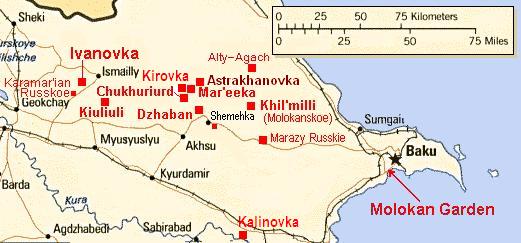
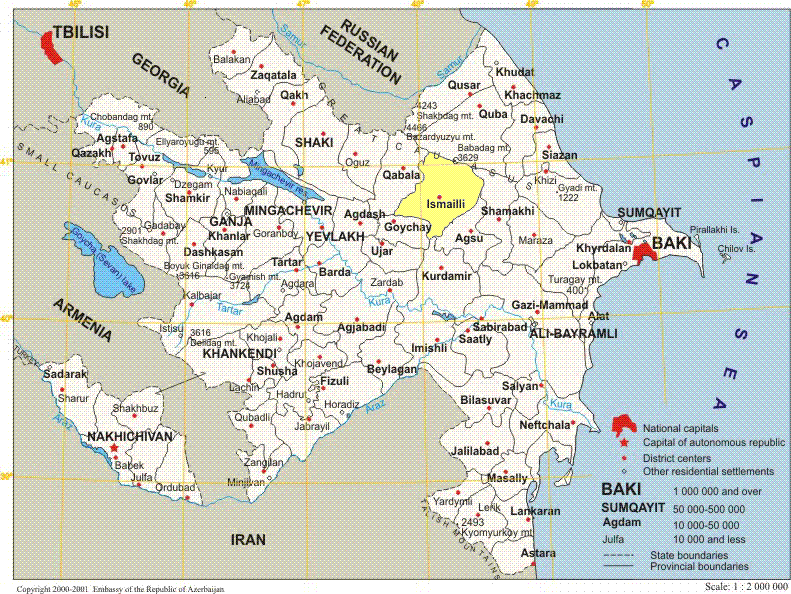
Ивановка Исмаиллинского района — колхоз им. Калинина. В
наши дни он переименован в колхоз им. Н. Никитина в честь
покойного прежнего председателя. |
Among all people there is a
saying: "The cheeks are as red as a Molokan girl's". Due
to a healthy, active way of life and favorable
environment, the Molokans always differed in excellent
health and in a high percent of long-livers. The average
life expectancy among them is 80 years. At one time in
Azerbaidzhan there were many villages where only Molokans
lived. The flourishing and growth of Molokan villages
occured during the Soviet period. The Kalinin collective
farm in Ivanovka village,
Ismailli District, was
considered to be the most developed and prosperous. Today
it is renamed the N. Nikitina collective farm [kolkhoz] in honor of
the late former chairman [a Molokan]. |
|||
| За
все 43 года бессменного председательства Николай
Васильевич Никитин зарекомендовал себя не только как
умный, прозорливый хозяйственник, но и как чуткий,
заботливый руководитель, понимающий нужды своих
односельчан. Стоит отметить один факт. В 70-е годы ему
удалось наладить бартерный обмен с Финляндией и Болгарией.
Взамен поставок чеснока колхозники обеспечивались
высококачественной импортной мебелью. В бытность Никитина
колхозу принадлежали большие площади винограда отменных
сортов, он поставлял республике разнообразную мясомолочную
и плодоовощную продукцию. За свои виноградные
плантации Н.Никитин боролся до последнего и им удалось
избежать участи быть уничтоженными на корню, как это
случилось с многими другими виноградарскими хозяйствами в
республике в горбачевские годы. |
For all of 43 years of his
continuous presidency, Nikolay Vasilevich Nikitin proved
to be not only an intelligent, intuitive business
executive, but he was also a keen, thoughtful leader who
understood the needs of his fellow villagers.* It is
necessary to note one fact. In the 1970s he managed to
arrange a barter exchange with Finland** and Bulgaria. In exchange for
garlic, the collective farmers received high-quality
imported furniture. In Nikitin's days, the collective farm
had a greater acreage of excellent grades of grapes, and
he delivered a variety of meat and dairy products, and
fruit-and-vegetable production to the republic [of
Azerbaijan]. N. Nikitin fought to the end for his
vineyards and managed to avoid the rapid cutting of the
grape vines to the root, as happen to many other vineyards
in the republic during the Gorbachev years.*** [* See Stepanov's 1992 interview with Nikitin in "Among the Russian Molokans in Azerbaijan" ** See: "Bridging the Gaps: The Finns Fascilitate Food Projects" (2000). *** In May 1985, less than two months after becoming General Secretary of the Communist Party, Mikhail Gorbachev launched an Anti-Alcohol Campaign.] |
|||
| Вино
с никитинских лоз до сих пор славится своими вкусовыми
качествами, к тому же оно бесспорно является экологически
чистым продуктом. В магазины Баку вино "Ивановка"
поставляется бесперебойно и уже успело обрести своих
почитателей. Несомненно, что от руководителя зависит не
только состояние вверенного ему хозяйства, но и
настроение, желание работать и выполнять поставленные
задачи его подчиненных. В этом смысле авторитет Никитина
был непререкаем, колхозники работали с большой отдачей, а
достигнутые высокие результаты были плодами общего дела. |
Still today, the wine from
Nikitin vines is famous for its quality flavors, besides
it is undoubtedly an organically pure product. The
"Ivanovka" brand wine is regularly delivered to the Baku store,
and already has its admirers. Without doubt, not only dos
the condition of the entrusted farm* depend on the leader; but his
employees' mood, desire to work and accomplish his
goals. In this sense Nikitin's authority was
indisputable. The collective farmers worked with a lot of
efficiency, and achieved the high results due to teamwork. [* The collective farm is essentially given to the leader as his personal responsibility.] |
|||
| В
столице Никитин открыл магазин, сразу завоевавший
популярность среди бакинцев, — за продукцией из Ивановки
выстраивались очереди. |
The Nikitin farm opened a store in the
capital which at once became popular among Baku residents.
[People] formed lines [to buy] products from Ivanovka. |
|||
| Однако
сильнейший
экономический спад не обошел и этот колхоз. Распались
многолетние каналы поставок, исчезли связи с постоянными
партнерами, понизился уровень жизни колхозников, наметился
дефицит рабочих рук в связи с начавшейся миграцией
населения, из колхоза уехало 96 семей. В настоящее время
население Ивановки — около 3000 человек, и только 1080 —
люди работоспособного возраста, остальные — дети и
пенсионеры. |
However the strongest
economic recession did not bypass this collective-farm.
Long-term channels of delivery were broken up.
Communications with steady [business] partners have
disappeared. The standard of living of the
collective-farmers has gone down. A shortage of workers
resulted from a decline in population. 96 families left
the collective farm. Now the population of Ivanovka is
about 3000, but only 1080 are of a productive age, the
others are children and pensioners. |
|||
| С
начала 90-х годов в Азербайджане произошел значительный
отток русского населения, не только городского, но и
сельского. Привычные к общинному коллективному образу
жизни, молокане снимались большими семьями и, эмигрировав,
в частности в Россию, обосновывали там новые поселения —
фактически колонии, где по-прежнему проживают компактно.
Например, в подмосковном поселке Узуново в настоящее время
проживает значительная часть бывших жителей молоканского
села Алтыагач, которые благодаря своей коммуникабельности
быстро адаптировались на новом месте и так же, как некогда
в Азербайджане, усердно занялись сельским хозяйством. |
At the beginning of the
1990s, in Azerbaijan there was a significant outflow of
the Russian population, not only urban but also rural.
Accustomed to a communal collective way of life, big
families of Molokans took off and emigrated, partly
to Russia, where they founded new settlements, actually
colonies where they still live close together. For
example, a significant part of the former inhabitants of
the Molokan village Altyagach
now live in the settlement of Uzunovo located near
Moscow. Because of their good communicative skills,
Molokans quickly adapted to their new place the same as
they did in Azerbaijan a long time ago, and diligently
started to work on farms. |
|||
| После
того, как страну вновь возглавил президент Г.Алиев, дела
колхоза постепенно пошли на поправку. Кстати, именно по
личной просьбе Николая Никитина Гейдар Алиев оставил за
селом такую необычную форму существования — колхоз.
Нынешний президент Ильхам Алиев в курсе проблем ивановцев
и поддерживает все их начинания и инициативы. Новый глава
исполнительной власти Исмаиллинского района Ровшан Садыхов
также не оставляет своим вниманием дела Ивановского
колхоза. Однако в Конституции Азербайджанской Республики
нет такого термина "колхоз" и нынешнее руководство в лице
переизбранного в марте этого года нового председателя
Алексея Козловцева испытывает немалые трудности в связи с
этим. Так как колхоз не является юридическим лицом, ему
приходится иметь дело с посредниками, что значительно
тормозит развитие хозяйства. |
After president G. Aliev
headed the country again, the business of collective farms
gradually started to improve. By the way, because of a
personal request from Nikolay Nikitin, Gejdar Aliev
allowed their village to remain in an unusual form of
existence — a collective farm [kolkhoz]. [Instead of privatizing
it to modernized the country.] The current
President Ilham Aliev stays informed about the problems of
the Ivanovka residents, and also supports their
initiatives and undertakings. The new chief executive of
Ismailli District, Rovshan Sadyhov, also pays attention to
the of business of the Ivanovka collective farm.
However in the Constitution of the Azerbaijan Republic
there is no such term "collective farm". Because of that,
the current new chairman, Alexey Kozlovtsevon who was
re-elected in March of this year, experiences considerable
difficulties. Because a collective farm is not a
legitimate organization, it has to deal with
intermediaries [middle-men], and this considerably hinders
the farm's development. |
|||
| Вместе
с должностью руководителя колхоза Козловцеву достались
огромные долги — результат не очень чистоплотной работы
прежнего председателя Николая Минникова. Минников
практически развалил дело Никитина, а жители некогда
благополучного села оказались за чертой бедности. 700
тысяч долларов, переданные российской стороной на
приобретение оборудования для молочного-мини завода, так
до него и не дошли. Дело, по идее, требует судебного
вмешательства. Решающий голос принадлежит старейшинам
(аксакалам) села, мнение которых непременно учитывается
при решении тех или иных вопросов. Минников, по их мнению,
— свой, односельчанин, поэтому жители не хотят обходиться
с ним очень строго. |
Along with the postition of
the head of the collective farm, Kozlovtsevu got huge
debts, the result of not very honest work of the
former chairman Nikolay Minnikov. Minnikov practically
destroyed Nikitin's business, and the residents of what
used to be a prosperous village lived below the poverty
level. The Russian Federation gave $700,000 to buy
equipment for a dairy plant, which was never
recieved [stolen before delivery]. This case demands
judicial intervention. The casting vote belongs to the
elders (aksakals*) of the village
whose opinion is by all means considered when deciding any
questions. Minnikov, in their opinion, is a fellow
villager, therefore residents do not want punished his
very strictly. [*
Azeri word for "elders".] |
|||
| Сегодня
молочный
мини-завод, деньги на который были выделены российской
стороной, возводится собственными усилиями колхоза.
Недавно была закуплена небольшая партия расфасовочной тары
для сметаны и сыра. Колхозу принадлежит огромное стадо
высокопородных коров, дающих молоко повышенной жирности.
Сейчас полным ходом идет заготовка кормов на зиму, которая
в этих местах случается довольно суровой. Коровы колхоза
круглогодично получают "усиленное питание", благодаря чему
достигаются такие высокие удои и процент жирности. Как
шутят сами колхозники, "зарплата подождет, — сначала
накорми коров". |
This small dairy plant, for
which the Russian Federation gave money [now missing], is
s being built today by the efforts of collective farm
itself. Recently a moderate batch of packing containers
for sour cream and cheese were purchased. The collective
farm owns a huge herd of pure bred cows, which give milk
with high fat content. Now the preparation of animal-feed
for the winter is at full speed. Winter is these regions
happens to be quite severe. Year-round the cows of the
collective farm receive "fortified feed", therefore they
produce high yields of milk with high fat content. As the
collective farmers joke, "the paycheck can wait, first we
should feed the cows". [We need to buy good feed for the
cows, to make good quality milk, and from that we can make
a profit to get paid .] |
|||
| Жители
Ивановки
возлагают большие надежды на нового председателя
Козловцева. При жизни Никитина он работал главным
инженером, поэтому хорошо знает колхозные проблемы. Он
вырос на глазах односельчан, успел проявить себя в работе,
поэтому люди считают, что на этот раз их выбор удачен. За
короткий срок управления таким большим хозяйством
Козловцеву удалось добиться главного — наметилась
тенденция к улучшению в жизни колхозников, отток населения
прекратился, 9 семей вернулись из эмиграции в родные
пенаты, в селе появилось несколько новых молодых семей,
которые никуда уезжать не собираются. В этом году в
Ивановской школе был 41 выпускник. Четверо из них уже
поступили в различные вузы России, благодаря поддержке
российского посольства. Вообще с посольством России, с
русской общиной Азербайджана Ивановку связывают давние
крепкие узы. Русская община трижды организовывала концерты
самодеятельности от Центра русской культуры, в гостях у
жителей колхоза побывал журнал "Меридиан". |
Ivanovka residents placed
all their hopes on the new chairman Kozlovtsev. During
Nikitin's lifetime he worked as the chief engineer,
therefore he knew the problems of the collective-farm
problem well. He grew up before the eyes of the fellow
villagers, and proved himself at his job, therefore people
consider that this time their choice [for the chairman]
was good. In the short term of his leadership of such a
big collective farm, Kozlovtsev achieved the main goal —
to improve the life of the collective farmers. Migration
has stopped, and 9 families returned from emigration back
home. There are several new young families in the village
who are not preparing to go anywhere. 41 students
graduated this year from the Ivanovka school. Four of them
have already been accepted at different universities in
Russia, due to support from the Russian embassy. In
general, the Embassy of Russia has old and strong ties
with the Russian community of Ivanovka in
Azerbaijan. The Russian community organized amateur
concert performances at the Center of Russian culture
three times. The magazine "Meridian" visited the residents
of the collective farm. |
|||
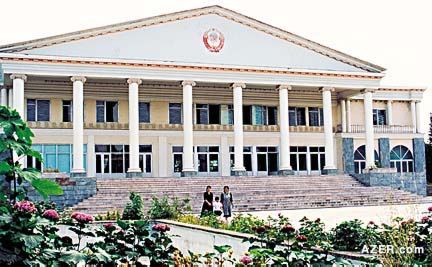 Russian Culture Center and Comuntiy Hall, Ivanovka village. From "Seeds of Change: Transition in Azerbaijan's Agriculture", Azerbaijan International, Autumn 2000 . |
||||
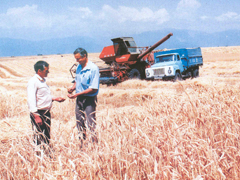
| Летом,
в страду в колхозе рабочие руки на вес золота. Урожай
необходимо "довести до ума" и убрать, не дожидаясь
непогоды. В поле заняты все, от мала до велика.
Школьники работают на прополке наряду со взрослыми, с 10
утра до четырех. За это получают 6 тыс. манатов в день.
Сельские ребята привычны к крестьянской работе, а
возможность заработать повышает энтузиазм и приучает с
детства ценить заработанные нелегким трудом деньги. Зато
по субботам в развлекательном центре для молодежи
устраивается веселая дискотека. Козловцев считает, что
организацией досуга молодежи заниматься просто необходимо,
— все пороки, как известно, появляются от нечего делать. В
селе имеется приличный стадион, где молодежь занимается
различными видами спорта, в школе организованы кружки по
интересам. |
In the Summer, during the
harvest season, the collective farm workers are worth
their weight in gold. It is necessary to finish
[Literally: "take to mind"] harvesting the crop before bad
weather arrives. Everybody, from young to old, is working
in the fields. School kids work on weeding along
with adults, from 10 a.m. to four p.m. For that they get
paid 6000 manat
[US$0.82] per day. Rural children are accustomed to
[peasant] farm work, and the opportunity to earn some
money increases their enthusiasm and teaches them from
childhood to appreciate hard-earned money. But to make up
for it, a fun disco is organized for the youth on
Saturdays in the entertainment center. Kozlovtsev knows
that it is necessary to organize the leisure-time of the
youth. It is well known that all vices appear when
there is nothing to do. There is a decent stadium in the
village where the youth practice a variety of sports, and
at school there are different clubs organized according to
interest. |
|||
| Юношеская
мужская
сборная Ивановки по гандболу заняла 2-е место на
республиканских соревнованиях, а женская — 3-е. На
фольклорном фестивале в Астаре участвовал молодежный
фольклорный ансамбль Ивановки. Там они показали старый
молоканский обряд сватовства. Молодежи оказывают большую
поддержку, несмотря на все еще неразрешенные финансовые
проблемы колхоза. Молодым семьям выдается кредит на
подъем собственного хозяйства, некоторым предоставлена
собственная жилплощадь. Старики тоже не остаются без
внимания. 9 Мая для них — участников войны — устроили
большой праздник, раздали подарочные продуктовые наборы, а
инвалидам ВОВ правление выплатило по 50 долларов. |
The boys' handball sports
team of Ivanovka took 2nd place in the state [republic]
competitions, and the girls' team took 3rd place. The
youth folklore ensemble of Ivanovka participated at the
folklore festival in Astar, where they showed the old
Molokan wedding ceremony. The youth are given major
support, despite the unresolved financial problems of the
collective farm. Young families are given loans to build
their own households, but some get apartments. The elders
also get attention. A big holiday was arranged on May 9
for war veterans. They got gifts of groceries, and each
disabled [veteran] from the The Great Patriotic War [World
War II] got $50 from the management. |
|||
| На
сегодняшний день больше половины жителей Ивановки
пенсионеры, все проблемы которых, по устоявшейся еще при
Н. Никитине традиции, ложатся на плечи колхоза, в том
числе в случае их смерти: похороны и поминки оплачиваются
колхозом. |
Today more than half of
Ivanovka residents are senior citizens. Their problems get
solved by the management of the collective farm as a
tradition started by N. Nikitin. For example, when they
die the funerals and memorials are paid by the
collective farm. |
|||
| Новый молодой председатель Алексей Козловцев полон энергии и энтузиазма. Он чувствует за собой поддержку своих односельчан и уверен, что дело Никитина не умрет. "Дайте только время, — говорит Алексей Козловцев, — и все у нас будет хорошо". В связи с празднованием 200-летия молоканства в Ивановке планируется провести праздничные мероприятия. Но так как 20 июля попадает на будний день, скорее всего, праздник будет перенесен на воскресенье — традиционный день отдыха молокан. | The new young chairman
Alexey Kozlovtsev is full of energy and enthusiasm. He
feels that the support of his fellow villagers is behind
him, and he is assured that Nikitin's business will not
die. Alexey Kozlovtsev says: "Give us only time, and
everything we have will be good". In connection with
celebrating the 200th anniversary of Molokanism in
Ivanovka, he plans to lead the celebration. But since July
20 falls on a weekday, most likely the holiday will be
moved to Sunday, the traditional day of rest for Molokans. [Note how different this article reports the facts compared to one published 4 days later: The President of Azerbaidzhan Il'kham Aliev receives representatives from the Molokan Community in our country AzerTAJ — July 20, 2005] |
|||
|
|
||||
| 200th Anniversary
list Spiritual Christians in Azerbaijan Spiritual Christians Around the World |
||||