
|
Маленькая
Россия
на Севере Армении
Текст: Марк Григорян.
Невиданная Армения, ct. 46-49
Главный редактор: Рубен Мангасарян
|
"Little Russia"
in the North of Armenia
By Mark Grigoryan
Armenia Undiscovered, pages 12-14
Chief Editor, Ruben Mangasaryan
|
La Petite
Russie
du Nord de l’Arménie
article: Marc Grigorian
Extraordinaire Arménie, pages 82-85
Rédacteur en chef Rouben Mangassarian
|
 |
|
|
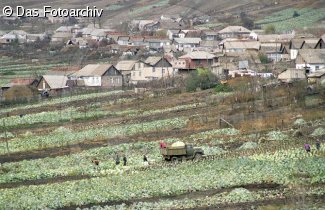
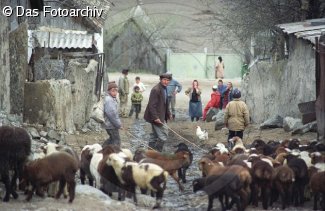
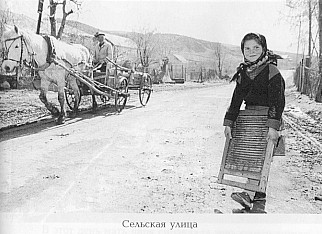
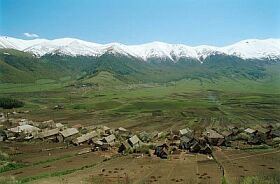
Странное чувство… Всего два
часа пути от Еревана, и оказываешься в совершенно ином мире:
березовая рощица, русские избы, возле которых бегают
смешливые дети с золотистыми волосами, слышна русская речь.
Понимаешь, что ты в Армении. И горы, вроде, армянские,
типичные для северной части страны. Но посмотришь на людей,
на деревню – настоящая российская глубинка.
|
It feels eerie… A two-hour
ride takes you from Yerevan to a completely different world,
with smiley blond kids playing amongst sycamore trees and
Russian-style houses. Surely you are still in Armenia,
amidst a mountain landscape typical for the Armenian North.
And yet if you just look at the people and the houses, it
feels like a Russian village. |
Un sentiment étrange… A
seulement deux heures de route d’Erévan, on se retrouve dans
un monde complètement différent: des platanes, des maisons
construites dans le style russe, autour desquelles courent
des enfants rieurs aux cheveux dorés. On réalise qu’on est
en Arménie, que les montagnes, caractéristiques du Nord du
pays, sont arméniennes. Mais en regardant les gens, le
village, on constate que c’est une véritable périphérie
russe. |
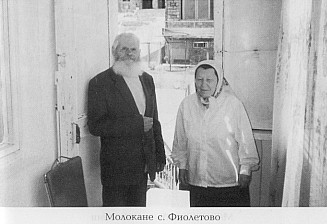
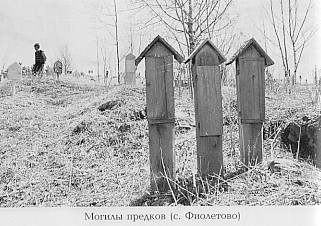
Это Фиолетово, деревня,
населенная духовными христианами — (1) дух-и-жизники и (2) молокане ами — две
разные религии, большенство этническими
русскими, которые были переселены на Кавказ в первой
половине XIX века. |
The village is called
Fioletovo and the people living there are called Spirtual
Christians — (1) Dukh-i-zhizniki and
(2) Molokane Molokans) — two different faiths.
They are mostly ethnic
Russians, resettled in the Caucasus in the early 1840s 19th century.
|
Il s’agit du village de
Fioletovo, peuplé par les Les Chrétiens
spirituels — (1) Dukh-i-zhizniki
et (2) Molokane Molokans — deux religions différentes,
ethniquement principalement,
des Russes, qui ont migré au Caucase au cours de la première
moitié du XIXème siècle. |
|
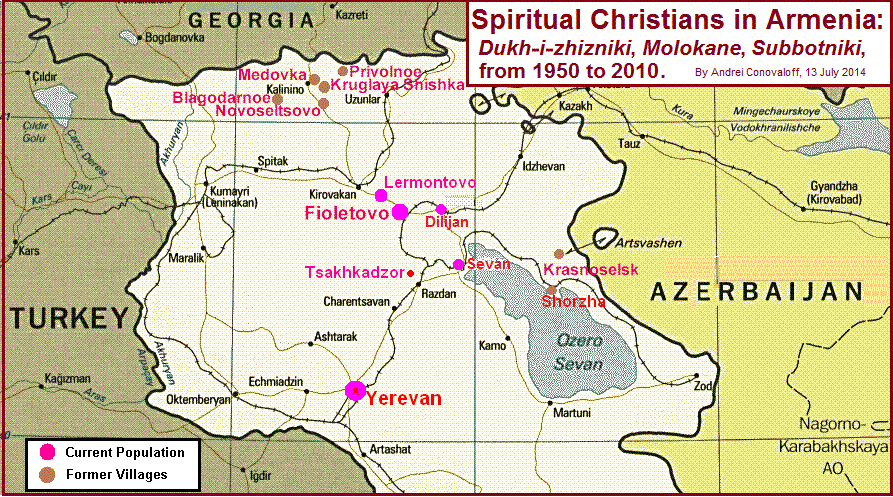
Фиолетово находится в 20
километрах от Ванадзора [Лермонтово]
(бывший Кировакан), третьего по величине города Армении. Это
– всего в двух часах пути от Еревана, столицы страны. И
больше в Армении нет ни одной деревни, населенной только духовными
христианами молоканами.
А ведь в начале XX века в Армении было более 30 молоканских
деревень, от которых сейчас остались лишь названия.
|
Fioletovo is situated 20
kilometers [12.4 miles] from Armenia's third largest city of
Vanadzor [Lermontovo] (farther
out is Kirovakan). This is the only village in Armenia where
only Spiritual
Christians Molokans live now. But in the early
20th century Armenia had more than 30 such villages. Only
names now remain from those villages. |
Fioletovo se situe à 20 km de
Vanadzor [Lermontovo], troisième ville d’Arménie. C’est un
village exceptionnel - en Arménie, il n’en existe pas
d’autre qui soit peuplé de manière aussi homogène par les Chrétiens spirituels Molokans.
Cependant, au début du XXème siècle, on comptait en Arménie
plus de 30 villages molokans, dont seuls les noms ont
survécu jusqu'à nous.
|
Согласно данным Ивана
Яковлевича Семенова, президента Фонда помощи и содействия
российским соотечественникам Республики Армения, в стране
осталось всего около пяти тысяч духовных христиан молокан,
причем больше тысячи из них живут в Фиолетово. В конце
восьмидесятых годов прошлого века духовных христиан молокан
в Армении было около пятидесяти тысяч.
|
According to Ivan Yakovlevich
Semyonov, the chairman of the "Fund of Assistance and
Cooperation with Russia's Compatriots in Armenia", about
5000 Spiritual
Christians Molokans now remain in the country,
of whom more than a thousand live in Fioletovo. And in the
late 1980s there were about 50,000 Spiritual Christians Molokans
in Armenia. [The
History of Caucasian Molokans and Doukhobors, August
1, 2001]
|
Selon Ivan Yakovlevitch
Semionov, président de la « Fondation pour l’assistance et
la coopération des compatriotes russes en République
d'Arménie », il ne reste environ que 5000 Chrétiens spirituels Molokans
dans le pays, dont plus d'un millier qui habitent
Fioletovo.Alors qu’à la fin du siècle dernier, on compait
50.000 Chrétiens spirituels Molokans
en Arménie.
|
Духовные христиане Молокан
живут в Армении уже 170 лет, не смешиваясь с местным
населением и не теряя своего языка. Им удалось в новых
условиях построить свою маленькую Россию и жить в ней
обособленно, но не одиноко. |
Spiritual Christians Molokans
have lived in Armenia for 170 years without mixing
with the local population and without losing their language.
In new conditions they managed to build their little Russia
and adapt to living there, without feeling isolated. |
Les Chrétiens
spirituels Molokans vivent en
Arménie depuis 170 ans, sans se mélanger aux habitants
locaux et en conservant leur langue. Ils ont réussi, dans de
nouvelles conditions, à construire leur «petite Russie», à y
vivre en s’adaptant et à ne pas se sentir isolés. |
А условия не были
благоприятными — духовным христианам
молоканам пришлось селиться в
высокогорных деревнях, часть которых находится на высоте
свыше 2.000 метров над уровнем моря, в местах с тяжелым
климатом, неблагоприятных для сельского хозяйства. Но духовные христиане
молокан выдержали это испытание, и
огромную роль в этом сыграла религия.
|
But conditions were not
auspicious. Spiritual
Christians Molokans had to settle in upland
villages some of which were located at a height of 2,000
meters [6,562 feet, 1.2 miles] above sea-level, in hard
climatic conditions unfavorable for agriculture. But Spiritual Christians
Molokans
overcame this trial and faith played a big part in that. |
Pourtant, les conditions
n’ont pas été favorables : les Chrétiens
spirituels Molokans étaient
obligés de s’installer dans les villages montagneux, dont
certains se trouvent à 2000 m d’altitude, avec un climat
rigoureux, néfaste pour l’agriculture. Mais les Molokans ont
surmonté cet obstacle grâce à l’important rôle de leur
religion.
|
Дух-и-жизник-максимист,
Dukh-i-zhiznik-Maksimist
|
|
|
| История и вера |
History and belief |
Histoire et religion |
История духовных христиан
молокан хорошо изучена и успела
обрасти легендами. Само название "молокане" трактуется
по-разному. Иван Семенов, рассказывает, что название пошло
от того, что молокане не придерживались постов, принятых
православной церковью, ели в постные дне скоромное, главным
образом, молочные продукты.
|
Spiritual Christian Molokan
history has many times become a subject of studies and even
has been shrouded in myths. Ivan Semyonov says that the name
"Molokane" is
interpreted in different ways. He says that the name derives
from the fact that Molokane
did not keep the Lents [fasts] accepted by the
Orthodox Church and ate more modest food on lent [fast]
days, mainly dairy products.
|
L’histoire des Chrétiens spirituels Molokans
a fait l’objet de plusieurs études, et est même auréolée de
plusieurs légendes. Ivan Semionov dit que le nom « molokan »
a plusieurs interprétations. Il dit que ce nom provient du
fait que les Molokans ne respectaient pas les carêmes
orthodoxes, au cours desquels ils mangeaient plus
modestement, en utilisant surtout les produits laitiers.
|
По другой версии
источником названия является река Молочная, находящаяся в
Мелитопольском уезде Таврической губернии, где молокане
прожили в ссылке несколько десятков лет, до того, как их
выселили на Кавказ. |
By another version,
the basis of the name was the river Molochnaya, which is
in the Melitopol area of the Tavircheskaya province where
Molokane
lived in exile for a few decades
before they were exiled to the Caucasus.
[Map of Molochnaya
Doukhobor Settlement by Jonathan J. Kalmakoff, with 3 Molokan villages.]
|
Selon une autre
version, ce nom provient de la rivière Molotchnaya, qui se
trouvait dans la province de Tavritcheskaya de la région
de Melitopolskaya, où les Molokans vivaient en exil depuis
plusieurs décennies avant leur expulsion vers le Caucase. |
| Александр Тикунов, молоканин
из курортного поселка Цахкадзор (бывшая молоканская деревня
Константиновка [Дарачичак]),
толкует название «молокане», исходя их Библии, где в Первом
Соборном Послании святого апостола Петра, сказано:
«…как новорожденные младенцы, возлюбите чистое словесное
молоко». Тикунов говорит: «Слово Священного Писания, в
зависимости от духовного уровня человека, производит
различное действие. Когда человек в духовном понятии мал, то
слово Божие ему как молоко. Духовное молоко. Отсюда и наше
название – молокане». |
Alexander Tikunov, a Molokan from the
resort town of Tsaghkadzor (by the way, the former Molokan village of
Konstantinovka [Darachichak]),
interprets the name "Molokan"
basing on the Bible where it is said in the first
epistle of Apostle Peter: "…as new-born babes,
earnestly desire the unadulterated milk of the word…"
Tikunov argues: "The word of the Holy Bible, independently
of the degree of man's spiritual development, has various
influences. When a person is a child in spiritual terms,
then God's word is like milk for him. Spiritual milk. And
hence our name —
Molokane."
|
Alexandre Tikounov,
d’ailleurs originaire d’un ex village molokan,
Constantinovka, et habitant de Tzaghkadzor, station de ski
et lieu de villiégiature, explique l’étymologie du nom «
molokan » en se basant sur la Bible où il est dit, dans le
premier message de l’Apôtre Pierre : «comme des enfants
nouveaux-nés ont soif du lait qui les nourrit, soyez avides
du lait pur de la Parole de Dieu ». Tikounov insiste : « la
parole de la Bible, indépendamment du développement
spirituel de la personne, a des influences diverses. Quand
la personne est un enfant, au niveau spirituel, pour elle,
la parole de Dieu est comme du lait, du lait spirituel.
C’est de là que provient notre nom – molokan. »
|
| Дух-и-жизники — это
разная вераюю
Они названы по имени их
священной книги — «Книга солнце, дух
и жизнь» (1928) — которую они
кладут на стол рядом с Библией
как дополнение. Они
имеют много живых пророков,
и другие праздники
чем молокане. |
Dukh-i-zhizniki
are a different faith, named for their holy book — Kniga
solnste, dukh i zhizn' (1928) — placed next to the
Bible as an addition. They have many living prophets, and
different holidays than Molokane.
|
Dukh-i-zhizniki
sont une
foi différente, du nom de leur livre sacré —
Kniga solnste,
dukh i jizn'
(1928)
— placé à côté de la
Bible. Ils ont
beaucoup de prophètes
et les jours fériés différents que
Molokane. |
Духовные христиане Mолокане
считают, что каждый верующий должен удовлетворять свои
духовные потребности, усовершенствовать свое поведение и
свои чувства. Важное место в их веровании занимает теория о
переселении души Иисуса Христа от Отца к Сыну. Духовные христиане
Mолокане отвергают поклонение
изображениям – иконам, кресту.
|
Spiritual
Christians Molokane
consider that every believer must satisfy his or her
spiritual needs, improve his or her behavior and feelings.
Jesus Christ's spiritual transference from Father to Son has
an important place in their faith. Spiritual
Christians Molokane reject
image worship — the worship of icons and the cross. |
Les Chrétiens
spirituels Molokans croient que
chaque croyant doit répondre à ses exigences spirituelles,
perfectionner son comportement et ses sentiments. Dans leur
croyance, le passage de l’âme de Jésus Christ, du Père au
Fils, occupe une place importante. Les Molokans refusent
l’adoration des icônes et le culte de la Croix. |
| «Мы считаемся духовными
христианами, – говорит Тикунов, – мы толкуем Библию
аллегорически, иначе говоря, воспринимаем ее духовно». |
"We're considered to be
Spiritual Christians," Tikunov says. "We
interpret the Bible allegorically,
in other words, we perceive it spiritually." |
« Nous sommes considérés
comme des chrétiens épris de spiritualité...», dit Tikounov.
« Nous interprétons la Bible différement, autrement dit,
nous la percevons spirituellement ». |
| Английский путешественник,
член Географического общества Х.Ф.Б. Линч, побывавший в
Армении в конце 19 века, передает философию молокан так:
«Бог обитает в живых объектах своей любви… Я говорил с одним
стариком, пленившим меня своим симпатичным голосом и
манерами, о религиозных верованиях молокан. Они почитают
Моисея и пророков [из Библии]
и Св. Евангелие, но исповедуют свою религию посвоему. Пение
псалмов, по-видимому, служит главным внешним выражением их
религиозных чувств. Детей не крестят, но приносят их в
молельню, читают главу из Евангелия в присутствии ребенка и
публично объявляют его имя. Подобной же церемонией
освящается брачный союз». |
A British traveler, member of
the Geographic Society Henry
Finnis Blosse Lynch, who was in Armenia in the 19th
century, explains the philosophy of the Molokane as follows:
"God lives in living objects of his love… I spoke to one
elderly man with a beautiful voice and grace about religious
beliefs of the Molokane .
They worship Moses and the [Bible]
prophets and the Holy Bible, but profess religion in a
different way. Singing psalms appears to serve as the main
expression of their religious feelings. They do not christen
their children, but bring them to the prayer house, read a
few passages from the Bible in the presence of a child and
declare his name in front of all. Matrimonial bonds are
sanctified in a similar ritual."
|
Le voyageur anglais, membre
de l’Association géographique, H. F. B. Lynch, qui avait
visité l’Arménie à la fin du XIXème siècle, explique ainsi
la philosophie des Molokans : « Dieu habite les objets
vivants de son amour… J’ai parlé avec un homme âgé à la
belle voix et aux beaux gestes, à propos de croyances
religieuses des molokans. Ils adorent Moïse, les prophètes,
et la Sainte Bible, mais ils pratiquent la religion
différemment. Apparemment, le fait de chanter les psaumes
sert à exprimer essentiellement leurs sentiments religieux.
Ils ne baptisent pas les enfants, mais les emmènent au
temple, lisent quelques paragraphes de la Bible en présence
de l’enfant et déclarent devant tout le monde son nom. La
consécration de l’union conjugale passe par la même
cérémonie ».
|
Максимисты
поклоненяются Максиму Рудомёткину. У дух-и-жизников есть 4
пророка в их священной книге, и ещё около 200 пророков из
разных собраний начиная с 1928 года.
|
Maksimisty worship
Maksim Rudomyotkin.
Dukh-i-zhizniki
have 4 prophets in their holy book, plus about 200
prophets among all congregations since 1928. |
Maksimisty culte
Maksim Rudomyotkin. Dukh-i-zhizniki ont quatre
prophètes dans leur livre sacré, plus environ 200
prophètes depuis 1928.
|
Духовные христиане молокане
живут замкнутой общиной. Члены ее стремятся к осуществлению
на деле своих социальных идеалов: ненасилия, братства,
равенства, хозяйственной кооперации, духовного совершенства.
"Мы никого ни к чему не принуждаем – вера не велит, –
говорит один из жителей Фиолетово. – Вот так непринужденно и
живем". |
Spiritual Christians Molokane
live in a secluded community. Its members strive to realize
their social ideals — peace, fraternity, equality, economic
cooperation, spiritual perfection. "We do not foist anything
on anyone, faith does not allow it," one of the Fioletovo
residents says. "And here is where we live." |
Les Chrétiens
spirituels Molokans vivent en
communautés fermées. Leurs membres essaient d’atteindre
leurs idéaux sociaux – la paix, la fraternité, l’égalité, la
coopération économique, le perfectionnement spirituel. «
Nous n’imposons rien à Extraordinaire Arménie personne,
notre foi nous l’interdit », dit un habitant de Fioletovo. «
C’est ainsi que nous vivons ». |
|
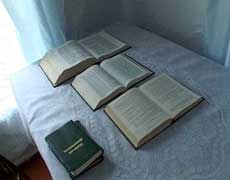
Дух-и-жизник священные книги с
Библии.
Dukh-i-zhiznik holy books with
Bible.
Dukh-i-zhiznik livres saints avec
la Bible.
|
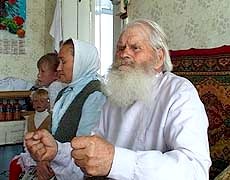
Дух-и-жизники, Dukh-i-zhizniki |
| Быт |
Mode of Life |
Vie quotidienne |
Замкнутость является очень
важной чертой жизни дух-и-жизников
молокан. Они не
разрешают себя отографировать, очень мало кто согласен,
чтобы фотографировали интерьер избы. менно благодаря этой
замкнутости, считает Иван Семенов, общины духовных христиан
молокан сохранились до сих пор,
пройдя через полутравековую жизнь в инонациональном
окружении, семьдесят лет Советской власти, раскулачивание и
религиозные гонения. |
Living a secluded life is a
major characteristic of the Dukh-i-zhizniki Molokans.
They do not let others take pictures of them, very few agree
that their home furniture and utensils be photographed. It
is due to this seclusion, as Ivan Semyonov says, that the Spiritual Christian
Molokan
communities have been preserved till today having lived
for more than a century and a half in a foreign land,
surviving the 70-year Soviet rule, dispossession of the
kulaks and religious persecutions.
|
Vivre en communauté homogène
est un trait caractéristique des Dukh-i-zhizniki
Molokans. Ils interdisent qu’on les
photographie, très peu d’entre eux acceptent qu’on
photographie leurs ustensiles ménagers. C’est grâce à ce
repli sur soi, comme le confirme Ivan Semionov, que les
communautés Les Chrétiens spirituels
molokannes se sont préservées jusqu’à
aujourd’hui, à travers plus de 100 ans d’existence parmi une
autre nation, en traversant les 70 ans du pouvoir
communiste, l’élimination des koulaks et les persécutions
religieuses. |
В избе (или, как они сами
говорят, хате) одна или две комнаты. В воскресенье на стол
кладутся книги Священного Писания, многие из которых
досоветские, "с ятями". Чтение Писания – важная часть
воспитания детей. "Зимними вечерами собираемся всей семьей,
читаем Писание, разговариваем… Летом времени почти не
бывает".
|
A Spiritual Christian Molokan
house (or as they themselves call it, a khate: hut) has one or
two rooms. On Sundays holy books are put on a table most of
which are of pre-Soviet times with old-fashioned Russian
orthography. Book reading is an important part of education
for children. "In winter evenings we gather with the whole
family, read the Book, have conversations…In summer we
barely have time for that." |
La maison Chrétiens spirituels molokanne
(ou, comme ils disent, khata) est pourvue d’une ou deux
chambres. Les dimanches, ils mettent sur la table les Saints
Livres dont la majorité remonte à l'époque pré-soviétique,
imprimés avec l’ancienne orthographe russe. La lecture des
livres joue un rôle important dans l’éducation des enfants.
« Pendant les soirées d’hiver, on se réunit en famille, on
lit le Livre, on parle… En été, il n’y a presque pas de
temps. » |
| Не у всех есть телевизоры.
Пресвитеры дух-и-жизники (руководители
молитвенных собраний) не рекомендуют их из нравственных
соображений. Но некоторые семьи все-таки имеют дома
телевизоры, а чтобы пресвитеры не ругались, прячут их в
шкаф. Молокане имеют меньше
ограничений. |
Not all have TV-sets. The Dukh-i-zhizniki
presbyters (leaders of religious assemblies) do not allow
the purchase of TV-sets proceeding from moral
considerations. But several families do have a
TV-set, and for the leaders not to be discontent, they hide
them in cupboards. Molokane have
fewer restrictions. |
Ce ne sont pas tous les
Dukh-i-zhizniki
Molokans qui ont un poste de télévision
chez eux. Les chefs de communauté (les dirigeants des
rassemblements religieux) interdisent de l’acheter pour des
raisons morales. Cependant, certaines familles, ont malgré
tout des postes de télévision.Afin d’éviter la réaction
négative des chefs, ils cachent leurs télés dans les
armoires. Molokane ont moins
de restrictions.
|
Воскресный день для духовных христиан
молокан – праздник. Утром все идут в
молитвенный дом ("в собрание"). Затем, девочки надевают
праздничные белые кофточки, повязываются белыми кружевными
платочками и гуляют по деревне, лузгая семечки. "Каждое
воскресенье у нас праздник. Как у вас Новый Год". Мальчишки,
как полагается, вьются возле них. Старшие ходят друг к другу
в гости. В воскресенье запрещено работать. |
Sunday is a holiday for Spiritual Christians
Molokans.
In the morning everybody goes to the prayer house (to a
"gathering"). Afterwards, girls wear white holiday blouses,
put on white laced headscarves and walk around the village,
cracking sunflower seeds. "Every Sunday is a festival here,
like the New Year that you have." Guys, as it should be, go
around them. Older people go to each other's homes as
guests. It is prohibited to work on a Sunday.
|
Le dimanche est une fête pour
les Chrétiens spirituels Molokans.
Le matin, tout le monde va au temple (au « rassemblement »).
Ensuite, les filles mettent leurs chemises blanches de fête,
leurs foulards blancs décorés de dentelles et se promènent
dans le village en croquant des graines de tournesol. «
Chaque dimanche est une fête pour nous, comme le Jour de
l’an chez vous ». Les garçons, naturellement, tournent
autour des filles. Les adultes se rendent visite. Il est
interdit de travailler le dimanche.
|
| Капуста |
Cabbage |
Le chou |
|
|
|
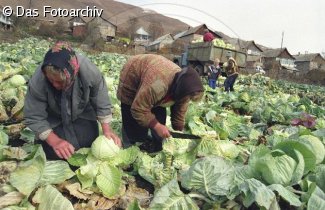
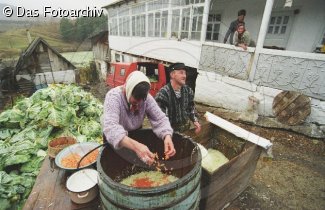
А в будние дни практически
вся деревня занята выращиванием капусты. Это, можно сказать,
фирменный продукт Фиолетово. Кто не покупал на рынках
Армении "капустку" у краснощеких, веселых молодых женщин в
платочках!?
|
And on ordinary weekdays
almost the whole village is engaged in growing cabbage.
Cabbage appears to be Fioletovo's firm product. Who hasn't
bought Molokan
cabbage from red-cheeked young and merry woman in
headscarves at markets in Armenia? |
Pendant le reste de la
semaine, quasiment tout le village cultive le chou. On
dirait que c’est une spécialité alimentaire de Fioletovo.
Qui n’a pas acheté aux marchés d’Arménie le kapoustka (le
chou) vendu par les jeunes femmes souriantes, en foulard et
aux joues roses ! |
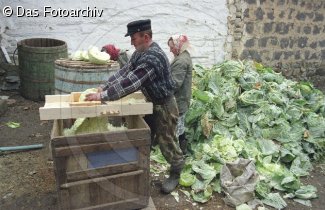
Капуста, заквашенная
«армянскими» духовным
христианам молоканами,
высоко ценится и в Грузии, и на юге России. Раньше, в
советские времена, молокане вывозили ее на продажу в
огромных бочках. Сейчас, когда бочки трудно переправлять
через границы, они вывозят свой "ноу-хау". Духовные христиане
молокане сами едут в Краснодар или
Ставрополь, там покупают бочки, капусту, квасят ее и
продают. Есть семьи, которые успешно наладили этот бизнес и
преуспевают в России. "Но там не вкусно, – говорят они, –
там капуста другая".
|
The sauerkraut of "Armenian"
Spiritual Christians
Molokane
is highly valued both in Georgia and southern Russia. In
the past, in Soviet years, Spiritual Christians Molokane
took them for sale in big barrels. Now that it has
become difficult to take barrels from one country to
another, they export their 'know-how'. Spiritual Christians Molokane
themselves go to Russia's Krasnodar or Stavropol, there
they buy barrels, make sauerkraut and sell it. There are
families that have set up successful sauerkraut businesses
in Russia. "But it is not tasty there," they say. "Cabbage
there tastes different." |
Le chou mariné par les Chrétiens spirituels Molokans
« arméniens » est très apprécié en Géorgie ainsi qu’au Sud
de la Russie. Autrefois, à l'époque soviétique, les Molokans
transportaient en gros tonneaux leur chou pour le vendre.
Maintenant qu'il est difficile de transporter les tonneaux
d’un pays à l’autre, ils exportent leur «savoir faire». Les
Chrétiens spirituels Molokans
partent à Krasnodar ou à Stavropol, ils y achètent des
tonneaux, font mariner le chou et le vendent. Il y a des
familles qui ont bien organisé cette activité en Russie. «
Mais là bas, ce n’est pas bon », disent les Molokans de
Filoetovo « Le chou est différent ».
|
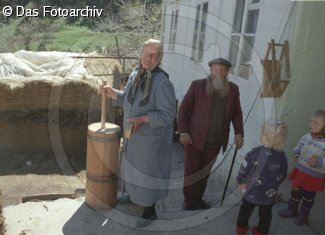
Для того, чтобы сделать
настоящую квашеную капусту "по-молокански", как рассказывали
мне в Фиолетово, нужно нашинковать ее (мелко нарубить).
Затем помыть (это специально отмечается) почистить и мелко
нарубить морковку, после чего вымочить ее ("а то она
покрасит капусту"). На ведро капусты кладется около горсти
морковки, и немногим больше горсти соли. Добавляется еще
лавровый лист и черный перец. Через неделю капуста готова.
|
Cabbage for genuinely Spiritual Christians
Molokans
sauerkraut, as I was told in Fioletovo, should be cut into
very small pieces. Then washed (it is specifically
mentioned), cleaned and carrot should be cut into small
pieces then it should be soaked in water (otherwise, it
would impart color to cabbage). A handful of carrot and a
little more than a handful of salt are put for a bucket of
cabbage. Bay leaves and black pepper are also added.
Sauerkraut is ready in a week's time.
|
Pour faire une vraie marinade
de chou « Les Chrétiens spirituels
molokan », il faut, comme on me l’a dit à
Fioletovo, le couper en tout petis morceaux. Ensuite, le
laver (une opération très importante) ; ensuite nettoyer et
découper en petits morceaux les carottes, les mettre dans
l’eau (autrement, ils coloreront le chou). Pour un seau de
chou, on met une poignée de carottes et un peu plus qu’une
poignée de sel. On ajoute également des feuilles de laurier
et du poivre. Une semaine plus tard, le chou est prêt. |
| Это очень вкусно! |
Very delicious. |
C’est délicieux. |
Фиолетово — идеальное место
для отдыха, если вы устали от цивилизации. Вдали от
телевидения, радио, газет, алкоголя, вранья и ругани, здесь
вы можете отдохнуть в спокойной сельской обстановке,
подышать чистым воздухом и питаться исключительно
натуральными продуктами: домашнее молоко, сметана и свежий
хлеб, испеченный в русской печке.
|
Fioletovo is a special place
to be for rest if you feel you’re tired of civilization. Far
from television, radio, newspapers, spirits, lies and
obscenities, here you may have a rest in a tranquil rural
environment, breathe in fresh air and eat exclusive natural
food products, “home-made” milk, sour cream and bread baked
inside a Russian stove. |
Fioletovo est un lieu
particulièrement calme, surtout si vous êtes fatigués de la
civilisation. Loin de la télévision, de la radio, des
journaux, de l’alcool, des mensonges et des insultes, ici
vous pouvez vous reposer dans une calme ambiance
campagnarde, respirer l’air frais et manger des produits
exceptionnellement naturels : le lait et la crème fraîche
maison et du pain cuit dans un poêle russe.
|
| Глава сельской общины:
Алексей Новиков, тел.: +374 322 96211 |
Community head — Alexey
Novikov Tel.: +374322 96211 |
Tel : +374 322 96211 |
|
Духовные христиане в Армении
Духовные христиане —
вокгуг света |
Spiritual Christians in Armenia
Spiritual Christians
Around the World |
Chrétiens spirituels
en Arménie
Chrétiens
spirituels dans le monde |