ДАРЬЯ ОКУНЕВА,
Ереван — 4 декабря 2007 г. |
Novye Izvestiia (New
News)
By Dar'ia Okuneva, Erevan (Armenia) — December 4, 2007 |
Последние из молокан
|
Last of the Molokans
|
Русская духовная
община в Армении переживает упадок
То, что на
московских рынках, несмотря на все запреты
правительства, по-прежнему многие торговцы –
выходцы из Закавказья, ни для кого не секрет. Зато
мало кто знает: за прилавками ереванских базаров
нередко стоят русские. Правда, не граждане России
— этнические русские, духовние крестиане (молокане
и
дух-и-жизники). В начале XIX века
представители этого религиозного движения были
сосланы на Кавказ, где и живут до сих пор, храня в
горных селах свои традиции и не тронутый
неологизмами чистый русский язык. |
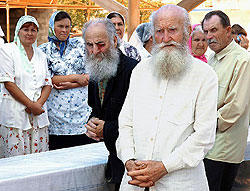
Те из молокан, кто носит бороды, свято
чтут традиции предков.
Those
Molokans
who have beards piously honor ancestoral
traditions.
|
The Russian spiritual
community in Armenia survives a decline
It's no secret that
that in the Moscow street markets [bazaars], in spite of all government prohibitions, often there are merchants who are descendants from
Transcaucasia [Armenians, Azeris, Georgians]. Almost no one knows
that Russians frequently stand behind the counters
of the Erevan bazaars. Indeed, these ethnic Russians are Spiritutal Christians (Molokane and Dukh-i-zhiniki), but not citizens of
Russia. In the early 1800s [1830s] representatives of
this religious movement were exiled [voluntarily
relocated]
to the Caucasus, where they live, even now,
preserving their traditions in the mountain
villages and their Russian language
avoiding neologisms
[using modern Russian]. |
|
| Увы,
вполне возможно их деревни совсем скоро могут прекратить
свое существование. Основной бизнес духовние крестиане (молокане и дух-и-жизники)
— торговля квашеной капустой, солеными огурцами, мочеными
яблоками с огорода — особых денег не приносит. Местным они
не конкуренты. Единственный выход — ехать на заработки в
Америку, Австралию, Россию, где еще существуют
немногочисленные общины дух-и-жизник
и молокан. |
Unfortunately,
it's
possible that their villages soon will no longer exist. The
main business of the Spiritutal Christians (Molokane and Dukh-i-zhiniki)
— selling sauerkraut, pickled cucumbers, and pickled apples
from the vegetable-garden — is not profitable. They don't
compete with the locals in business. Their only way to earn
money is to go work in America, Australia, or Russia, where
there are still several small communities of Dukh-i-zhniki and Molokans. [90%
moved to Russia, only about 50 families of Dukh-i-zhiniki moved
to the US and Australia.]
|
Ольга, Татьяна и Светлана
стоят в самом дальнем углу Центрального ереванского рынка.
Но на фоне жгучих армянских брюнеток три славянского вида
женщины (носы картошкой, русые волосы) в платках и длинных
юбках сразу бросаются в глаза. Хотя торгуют скромно: на
покупателей не бросаются, никого не зазывают. Возможно,
поэтому желающих украсить свой стол соленьями с молоканского
огорода не много.
|
Olga, Tat'iana and Svetlana
stand in the most distant corner of the central Erevan
market. The three Slavic-looking woman (with round [literal:
potato] noses, and blond hair) in shawls and long skirts are
a stark contrast against the background of very-dark-haired
Armenians. They don't agressively sell by barking at the
crowd. Possibly for this reason, there are not many
customers buying pickles [for their table] from the Molokan
garden. |
| «Я люблю молоканские
огурчики, — говорит покупатель Ашот. Товар у них всегда
свежий, да и сами женщины приветливые. Угостят, не
обсчитают. На таких посмотреть приятно: всегда одеты в
чистое, отглаженное. Но в основном ереванцы у своих, армян,
берут. Не из-за национализма — из-за дружеских чувств,
знакомым, приятелям хотят помочь». |
"I love Molokan pickles, says
the buyer Ashot. Their produce is always fresh, and the
women themselves are very nice. They give you samples, and
won't cheat you. It's very pleasant to see them. They are
always dressed in clean, ironed clothes. But the majority of
Erevanians buy from their own Armenians. Not because of
nationalism, but because of friendship. People want to help
their friends." |
На более успешных армянских
продавцов молокане смотрят без зависти, в их общине это
считается большим грехом. Называют конкурентов
коллегами, говорят, что дружат.
Но признаются, что торговля идет ни шатко, ни валко. |
Molokane and Dukh-i-zhiniki look without envy
at the more successful Armenian salesmen because jealousy is
considered as a big sin in their community. They call
competitors colleagues, and say that they are friends. But
they acknowledge that business is so-so. |
«Если продадим рублей на
500–700 за день, — уже хорошо, — жалуется на чистейшем
русском 23-летняя Ольга Иванова. — У соседей-армян
доход побольше. Они торгуют круглый год. Покупают в
овощехранилищах капусту и солят ее. По знакомству получается
о поставках в кафе-рестораны договориться. А мы со своего
огорода возим. Летом вообще не торгуем: покупателей мало,
везти из деревни за 150 километров по горным дорогам —
далеко и дорого, на бензине разоришься. От урожая полностью
зависим. Бывает, заготовим несколько тонн капусты, а продать
не успеваем, портится. Все труды зря. Кто побойчее
пытались договориться о том, чтобы капусту эту
централизованно куда-нибудь поставлять — ну, в магазин или к
своим, русским, на военную базу в Армении. Но, судя по
всему, дело так ничем и не кончилось».
|
"If we sell 500-700 rubles
[~US $24] worth a day, it's good, complains 23-year-old Olga
Ivanova, in a pure Russian language. Armenian neighbors have
a bigger income. They sell year-round. They buy cabbage from
the warehouses and ferment [salt] it. They arrange
deliveries to restaurants with the help of their friends.
But we get vegetables only from our gardens. In summer we
don't sell at all. It's too far and to expensive to
deliver produce from the village for 150 kilometers [100
miles] along the mountain roads. You can go bankrupt on
gasoline. We completely depend on the harvest. Sometimes we
prepare several tons of cabbage, but don't have time to sell
it all, so it spoils. All our work is wasted. The more
assertive people attempted to organize centralized delivery
of our cabbage, perhaps supplying stores or the the Russian
military base in Armenia. But, as far as I know, nothing
resulted."
|
| Ольга не так давно вышла
замуж за молоканина, но городского. Живет теперь в Ереване.
В городе молокан не много — несколько сотен. Всего же в
Армении — более пяти тысяч. Муж работает на экскаваторе,
получает мало, но хватает для того, чтобы помочь
родственникам из деревни Фиолетово — там живет мама Оли, она
выращивает капусту, морковку, солит ее, а дочка продает. |
Olga recently married a Spiritual Christian
Molokan,
an urbanite. Now she lives in Erevan. There are not many Spiritual Christians
Molokans
in the city, several hundred. In all Armenia there are more
than 5000
[Molokane and Dukh-i-zhizniki]. Her
husband works on a backhoe [tractor]. He earns little, but
it is enough to help relatives in the village of Fioletovo.
Olia's* mom
lives there and grows cabbage and carrots, and ferments
them, which the daughter sells. [* Olia is diminutive
for Olga.]
|
Деревня Фиолетово — одно из
самых крупных поселений молокан в Армении. 60-летняя Татьяна
Задоркина говорит, улыбаясь во весь рот, что больше чем на
несколько месяцев она за всю жизнь из деревни не отлучалась.
«Там родилась, там помру», — улыбается Татьяна. У нее уже
взрослые дети, внуки поехали в Краснодар учиться. Сейчас в
Фиолетово чуть меньше 400 дворов, есть молельный дом,
русская школа. Учебники привозят из российского посольства.
По-армянски молокане говорят плохо: читают по слогам,
считают до десяти.
|
Fioletovo village is one of
the largest settliements of Molokane and Dukh-i-zhizniki in Armenia.
60-year-old Tatiana Zadorkina says, with a big smile, that
she never left the village for more than a few months in her
entire life. "I was born there, and I will die there,"
smiles Tatiana. Her children are grown up, and her
grandchildren are attending school in Krasnodar. Now there
are less than 400 households in Fioletovo, and a prayer
house, and a Russian school. Textbooks were brought in from
the Russian embassy. Molokane
and Dukh-i-zhizniki
speak Armenian poorly. They read by syllables, and
they can count to ten.
|
| Общину возглавляет выбранный
всем миром пресвитер. «В последние годы мы обнищали. У
местных властей особых средств на то, чтобы нас
поддерживать, нет. Рядом с Фиолетово армянские села, там
тоже люди не жируют, — вздыхает Татьяна Задоркина. — Наша
молодежь ездит на заработки в Россию. Но деньги
привозят с переменным успехом: кто с рублем возвращается, а
кто и с долгами. А тут еще напасать — копили-копили на новые
тракторы, чтоб огород нормально обрабатывать. Купили —
оказалось, барахло. Все разваливаются». |
The presbyter, elected by
everyone, is the leader of the community. [There are 4 congregations
in Fioletovo, one Molokan
and 3 Dukh-i-zhiznik].
"In recent years we became poor. The local government
doesn't have a special budget to support us. There are
Armenian villages next to Fioletovo where the people are
also poor," sighs Tatiana Zadorkina. "Our young people go to
work in Russia. But they have variable success in earning
money. Some come back with money, some with debt. And here's
another disaster, we saved and saved for new tractors so we
can farm the vegetable-gardens well. And after we bought
them, they turned out to be junk. Everything is falling
apart." |
Деревянные домики в Фиолетово
накренились, на дворах уже заметен беспорядок. Мало осталось
от знаменитой молоканской чистоплотности и хозяйственности.
Традиционный молоканский уклад тоже колеблется. Местные
разделилась на тех, кто носит бороды, эти стараются
сохранять традиции, не курят, спиртного в рот не берут,
молятся несколько раз в день, друг к другу обращаются —
«брат» и «сестра».
|
The wooden houses in
Fioletovo are tilting, and the yards are already unkept.
Little remains of the famous Spiritual Christian Molokan
cleanliness and housekeeping. The traditional Spiritual Christian
Molokan
structure is also shakey. The locals are divided into those
who have beards, these people who try to preserve the
traditions, don't smoke, don't drink alcohol, pray several
times a day, and they call each other "brother" and
"sister".
|
| В конце декабря в Калужской
области построят самую
большую русскую печь. Класть ее будет печник из
Фиолетово — молоканин Михаил Михайлович Рудаметкин.
Парадоксально, но в армянском селе лучше, чем в России,
удалось сохранить это древнее искусство. |
The largest
Russian wood stove [pech,
oven] will be built at the end of December in Kaluga
province. It will be erected by a stove-setter from
Fioletovo, the Spiritual
Christian Molokan Mikhail Mikhailovich
Rudametkin. It is paradoxical, that in an Armenian village
better than in Russia, it was possible to preserve this
ancient skill. |
Новое поколение молокан — те,
кто бороды сбрил. Эти ездят на заработки, выпивают, за
хозяйством не следят. Татьяна Задоркина говорит, что и
алкоголики в селе появились. Через «новых молокан» жители
Фиолетово приобщились и к телевидению, газетам. Хотя долгое
время считалось, что все это от лукавого. Нынешний пресвитер
не запрещает, но и не приветствует тягу молокан к
информации.
|
The new generation of the Spiritual Christians
Molokans
are those who shaved off their beards. They travel to
earn money, they drink alcohol, and they don't keep up their
yards. Tatiana Zadorkina says that alcoholics also appeared
in the village. Through the "new Spiritual Christians Molokans"
the residents of Fioletovo were also introduced to
television and newspapers. Although for a long time it was
considered from Satan. The present presbyter* does not forbid
it, but also he does not welcome the desire for information
by Spiritual
Christians Molokans. [* There are 4 congregations in
Fioletovo, and 4 presbyters.]
|
| 45-летняя Светлана Наумова
говорит, что самая обсуждаемая тема на селе — это пензенские
сектанты, которые ушли под землю в ожидании конца
света. «Мы не то чтобы их осуждаем, мы просто не
понимаем, — пожимает плечами Светлана. — Пути Господни
неисповедимы. Как же смертный может знать, когда апокалипсис
наступит? Заблуждаются, бедные. Ошибаются». |
45-year-old Svetlana Naumova
says that the most discussed subject in the village are the
Penza
sectarians, who fled into caves in expectation of the
end of times. "We don't condemn them, we just don't
understand them", shrugs Svetlana. "God works in mysterious
ways. But how can a mortal know when the apocalypse comes?
Pity for those misled. They are making a mistake." |
| Хотя за жизнью в России
молокане так или иначе следят, уезжать на историческую
родину пока не собираются. Старшее поколение даже в бедности
не хочет покидать насиженные места. Да и в России не медом
намазано. Впрочем, гражданами Армении молокане тоже себя не
считают. Некоторые даже от пенсий и пособий отказываются —
мол, сами с усами. Есть еще один путь — ехать в США, где
живет богатая община. Но останавливают бюрократические
трудности: тут ловкость иметь надо, оборотливость, а эти
качества даже для безбородых молокан непривычны. Так и
застряли кавказские молокане между небом и землей, между
Россией и Арменией, между сносной жизнью и бедностью. К
какому берегу пристанет небольшая деревенька Фиолетово,
молокане и сами не знают. |
Although the Spiritual Christians
Molokans,
one way or another, follow the news in Russia, but they
don't want to move back to their motherland. The elder
generation, even in poverty, don't want to leave the place
were they lived so long. Russia is also not the best place
[literal: There is no honey in Russia]. However, Spiritual Christians
Molokans
don't consider themselves to be citizens of Armenia. Some
even reject pensions and government aid, saying that they
can take care of themselves. There is another additional
way, to go to the USA, where a wealthy community lives. But
the bureaucratic difficulties stop them. One has to be
cunning and resourceful, but these qualities are unusual
even for the beardless Spiritual
Christians Molokans. So the Caucasian Spiritual Christians
Molokans
are stuck between the sky and the earth, between Russia and
Armenia, and between a normal life and poverty. The Spiritual Christians
Molokans
themselves do not know to what shore [country] the small
hamlet of Fioletovo will adhere.
|
| МОЛОКАНЕ — КТО ОНИ? |
Who are the
Molokans? |
| Молокане как самостоятельное духовное течение в
христианстве сформировалось в 60–70-е годы XVIII века в
Тамбовской губернии. Его основателем считается бродячий
портной Семен Уклеин. Молокане отвергают иконы,
богослужебные обряды православия, священников и церкви,
совершают моления в обычных домах, не соблюдают пост, не
признают святых. Единственным источником вероучения для них
является аллегорически толкуемая Библия, которую они
ассоциируют с образом «духовного
молока» (отсюда название). Общинами руководят старцы и
выборные пресвитеры. Моления их состоят из чтения Святого
писания и пения гимнов, написанных на тексты Библии. |
The Molokans formed in
1760-1770 in Tambov province as an independent spiritual
branch of Christianity. Its founder is considered to be the
vagrant tailor Semion Uklein. The Molokans reject icons,
liturgical rites of Orthodoxy, priests and the church.
They perform prayers in regular houses, do not observe
fasts, do not recognized the saints as the sole source of
dogma. They interpret the Bible allegorically, which
they associate with the means of "spiritual
milk" (hence their name). The communities are lead by
elders and an elective presvitery. Their services consist of
reading the holy scripture, and singing hymns based on texts
written in the Bible . |
В 30-х годах XIX века среди молокан выделилось
самостоятельное течение прыгунов (скакунов, ползунов,
нагишей). Основателя учения — Максима Рудометкина — прыгуны
объявили пророком. Его последователи, распевая гимны, прыгая
(иногда в обнаженном виде, уподобляясь Адаму и Еве) и бурно
жестикулируя, доводили себя до религиозного экстаза.
|
In the 1830s independent
divisions broke away from the Molokan- Prygyny — Skakuny (Skippers), Polzunov (Crawlers),
and Nagishei
(Nudists). The founder of this branch was Maxim Rudometkin
who the Pryguny declared
a prophet. His followers, sing hymns, jump (sometimes naked,
becoming like Adam and Eve) and violently gesticulating,
leading themselves into religious ecstasy.
|
| В Российской империи подвергались преследованию
властей. Были переселены в окраинные районы страны — в
Закавказье, Крым, Сибирь, Среднюю Азию. Значительная община
молокан появилась в США и Южной Америке. В начале XX века их
численность только в России составляла около 1,2 млн.
человек. |
In the Russian Empire they
were persecuted by the government. They were resetltled to
the outlying regions of the country — to Transcaucasia, the
Crimea, Siberia, and Central Asia. A significant community
of Spiritual
Christians Molokans [mostly Pryguny] appeared in
USA and South America [rather
Mexico, though some did settle in South America].
In the beginning of the 1900s their populaton just in Russia
was about 1.2 million people. |
| Чудовищный удар по весьма состоятельным
крестьянским общинам молокан нанесла политика
коллективизации и раскулачивания в 30-х годах прошлого века.
После распада СССР началась массовая миграция молокан из
республик Южного Кавказа в Россию и Америку. |
The policy of collectivization
and de-kulakization in the 1930s delivered
a monstrous impact on the wealthy peasant communities of Spiritual Christians
Molokans.
A mass migration of Spiritual
Christians Molokans from the republics of the
Southern Caucasus to Russia and America began after the collapse of the
USSR. [90% went to
Russia, and only about 50 families emigrated to the US and Australia, about
half to each country.] |
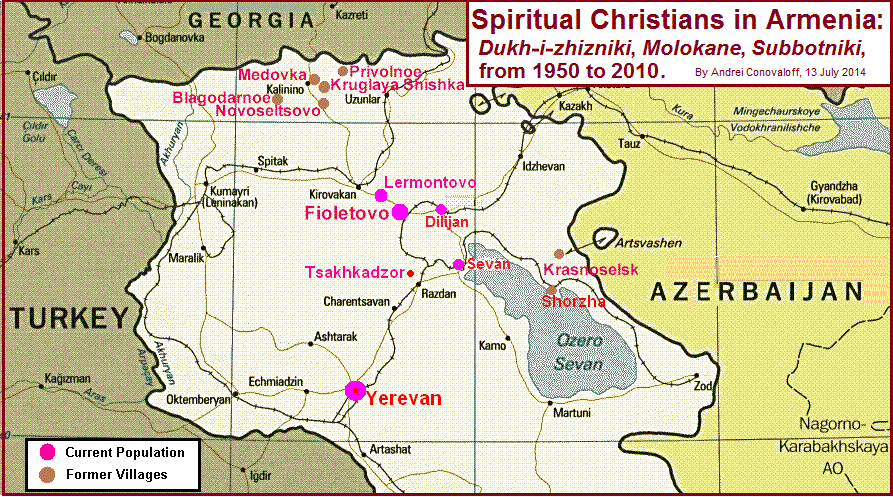
| Сейчас численность молокан в Армении оценивается
в 5 тыс. человек. Большинство проживают в Ереване и других
городах — Ванадзоре, Дилижане, Раздане, Севане,
Красносельске, а также в селе Фиолетово, в Таширском районе.
Несмотря на их рассредоточение среди основного населения, у
молокан практически отсутствуют смешанные браки. Их дети
учатся в русских школах или классах. При этом все владеют
разговорным армянским. |
Now the population of Spiritual Christians
Molokans
in Armenia is estimated
at
5,000 people. The majory live in Erevan and other
cities — Vanadzor,
Dilizhan,
Razdan, Sevan, Krasnosel'sk, and also in the village of
Fioletovo, Tashir region. In spite of their dispersion
among the local population, the Spiritual Christians Molokans
practically lack mixed marriages. Their children study in
the Russian schools or classes. In addition, all manage to
speak Armenian. |
|
|
|
Spiritual Christians in Armenia
Spiritual Christians
Around the World
|