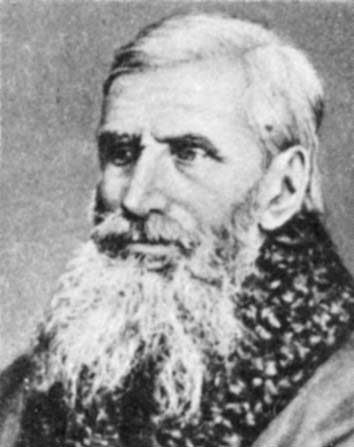
 Bondarev Timofei
Mikhailovich
Bondarev Timofei
Mikhailovich
(1820 - 1898)
 Andrew Donskov
[Page
68, Figure]
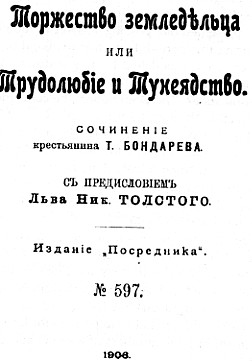
I-10: Title page of Timofej Bondarev's (1906) Torzhestvo
zemledel'tsa ili Trudoljubie i Tunejadstvo
[The
Triumph of the Landtiller, or Industry and
Idleness/Parasitism]. The words printed
beneath the actual title read: "COMPOSITION / of
the peasant T. BONDAREV / with a foreward by
/ Lev Nik. TOLSTOY / Posrednik Edition / No.
597 / 1906
|
Bondarev and Tolstoy
Excerpts from: Leo
Tolstoy
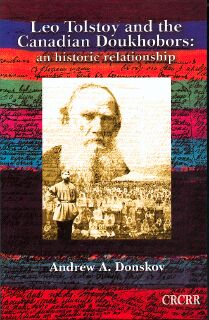
and the Canadian Doukhobors: an historical
relationship, by Andrew
Donskov, 2005.
Donskov is a
Distinquished Professor and Director
of the Slavic Research Group at the University of
Ottawa, Canada
Pages 47-48:
...Especially noteworthy are his [Tolstoy's] exchanges of
letters with Sabbatarian
Timofej Bondarev (Donskov 1996c), Molokan writer
Fedor
Zheltov (Donskov 2001)
and radical dissident Mikhail Novikov (Donskov 1996a). The text of
Tolstoy's treatise Tak
chto zhe nam delat'? [What then must be done?]
(1886) suggests two powerful role models for his (and, by
extension, others') moral regeneration. He wrote (PSS
25: 386):
Over my whole lifetime two
Russian thinking people had a profound moral influence
on me; they enriched my thought and clarified my
worldview. These people were not Russian poets, scholars
or preachers — they were two remarkable men who are
still alive today, having lived their whole lives by the
sweat of their brow — the peasants Sjutaev and Bondarev.
This paragraph reveals several important features in
Tolstoy's thought. It begins with a reference to his
lifelong preoccupation with moral questions. It suggests
the exclusion of any contribution from his own class or
from the clergy to his Weltanschauung,
[world view] which drew upon the solid moral fibre of
ordinary Russian peasants, whose life derived its meaning
from working 'by the sweat of their brow'. They had not
only enriched, but actually clarified (ujasnili) his thought for him. This was
an extremely important point for him in his socalled
'postconversion period' (following the completion of Anna Karenina in the
late 1870s) and is of utmost importance in any discussion
of Tolstoy and the peasantry.
It is also significant that the two peasants mentioned
were both sectarians: Vasilij K. Sjutaev (1820-1892) was
well known to Tolstoy and contemporary writers, while
Timofej M. Bondarev (1820-1898),
who belonged to the Sabbatarians;
(a splinter group of the Molokans,
which had earlier broken away from the Doukhobors) carried on an
extensive correspondence with Tolstoy from 1885 until his
death in 1898.(12)
___________________
- Regarding Bondarev's writings on religious
utopias, see my essay in Donskov
1996b: 1-15. For more on Bondarev and Sjutaev,
see: Bondarev (1890, 1906), Donskov (1996b, 1997), Gastev
(1912), Kosovanov (1958), Shesterikov (1928) and
Unknown author (1913).
Pages 52-54:
Sectarian Timofej
Bondarev
Throughout his correspondence with Bondarev (see Donskov 1996b), Tolstoy applied
a religious perspective to the question of landless
peasants. The letters are marked with frequent repetitions
of his tenet that physical landtilling labour is a
necessary precondition for a moral, happy and joyful life
on earth. Bondarev,
for his part, kept insisting that field labour is a
fundamental religious law
of life. Bondarev comes across as a colourful figure, a
Russian peasant who, though unshakeable in his
convictions, is not at one with his milieu because of the
penetrating insight of his sharp analytical mind and the
logic of his conclusions.
In his correspondence with Bondarev, Tolstoy makes particular
reference to Bondarev's work Torzhestvo
zemledel'tsa ili Trudoljubie i Tunejadstvo [The
Triumph of the Landtiller, or Industry and Idleness]
[cover in left sidebar] a work which Tolstoy helped get
published. Written in the late 1870s and early 1880s, it
is largely based on the Biblical decree in Genesis (3:19):
"In the sweat of thy face shalt thou eat bread, till thou
return unto the ground; for out of it wast thou taken..."
Bondarev argues
that people sin because they do not obey this rule, which
he takes literally. Tolstoy shared Bondarev's criticism of
militarism and the noble classes, as well as his
condemnation not only of the corruption rampant in the
civil service but also the narrowness and intolerance of
the church hierarchy.
Over and over again in his subsequent works Tolstoy
returns to Bondarev's
ideas.(20) In working out his Cycle of readings in
1904, he included in his 'Monthly readings' section an
excerpt from Bondarev's
book, with an accompanying article he had penned in 1895.
He also mentions Bondarev
in a diary entry in 1906 (PSS
55: 212):
It has become quite clear
to me of late that the life of the landtiller is not
just one of the various types of life, but is life
itself, just as the Bible is life itself, the only life
of mankind, and it is only through such a life that the
higher human qualities can be manifested. The chief
mistake in the organisation of human societies — a
mistake that removes the opportunity for any kind of
intelligent lifestructure — is that people wish to set
up their society either without any landtilling activity
or whereby such activity is only one — and the most
demeaning — way of life. How right is Bondarev!
All this testifies to the existence of a complementary or
even symbiotic relationship between society and the
tilling of the land, a hypothesis confirmed in Tolstoy's
letter to Bondarev of
26 March 1886:
I read your long
manuscript and addendum. Both are very good and true...
I am in agreement with everything said in the manuscript
and shall only mention a couple of points where I see
things differently. The first law is "In the sweat of
thy face shalt thou eat bread", but in order for this
law to avoid being violated, one must also obey a second
law: "Resist not evil".(21)
And later on Tolstoy acknowledges frankly: "I have found
in you a strong helper in this cause. I hope you have
found a helper in me. Our cause is one and the same." (Donskov 1996b: 34).
It is worth noting that Bondarev's
work
proved
very timely for Tolstoy, appearing at the very moment when
the latter was particularly concerned over questions of
the peasantry (especially the suffering and maltreatment
experienced by the Doukhobors), hard labour, the
simplicity of peasant life etc. Such questions grew out of
the deep dissatisfaction thi writer felt toward his social
class, and even more toward himself. Bondarev's ideas were
a source of enrichment to Tolstoy's own views on life and
gave a religious perspective to the whole issue of peasant
labour that was a lifetime concern of Tolstoy's.
_______________
- Abbreviated variants of Bondarev's work
are known to us from their publication in the weekly
"Russkoe Delo" (1888, no. 1213), with an Afterword
by Tolstoy. In 1890, thanks to Tolstoy's
cooperation, a French translation was published:
"Le'on Tolstoi et Timothe' Bondareff. Le travail".
Traduit du russe par V. Tseytline et A. Pages
(Paris, 1890). Interestingly, the English version
published the same year was based not on the Russian
but on the French translation by Tseytline and Pages
— see: "The suppressed book of the peasant
Bondareff. Labour:
the divine command. Made known, augmented and
edited by Count Lyof Tolstoy". Trans. Mary Cruger
(Toronto, 1890). Bondarev
repeatedly
complained both to Tolstoy and to G. I. Uspenskij
about the poor translation of his work (a reverse
translation into Russian was done by a local
translator at his request), as well as about the
many abridgements. The manuscript ran approximately
200 sheets. "The
triumph of the landtiller, or Industry and
Idleness" was also published in condensed form
by Posrednik in 1906 (Bondarev 1906). See book cover left.
- Donskov
1996b: 33-34. Tolstoy concluded the letter by
reaffirming the importance of physical labour: "I
shall soon be 60 years old and have had millions of
torments, but over the past few years I have been
both reaping and ploughing, and hope to do so again
this year. And joy and health and inner peace I find
most of all in this work."
Bibliography
Donskov Andrew 1996b.
L.N. Tolstoj i T.M. Bondarev: perepiska. Munich:
Verlag Otto Sagner, 1996. [ISBN: 3-87690-635-0 / Dewey:
891.7]
Donskov Andrew 1997. "Pis'ma Bondareva k L.N. Tolstomu". Russkaja literartura
no. 1 (1997): 163-81.
Gastev, Petr 1912. "Vospominanija o Vasilii Kirilloviche
Sjuteve". Vegetarianskoe
obozrenie no.1 (1912): 24-28 & no.2
(1912):66-72.
Kosovanov, Natalia 1983. "The Doukhobors". In Tamara F.
Jeletsky (ed.) Russian
Canadians: their past and present. Ottawa:
Borealis, 1983: 11-47.
Shesterikov, S. 1928. "Zametka Leskova o Sjutaeve". In:
N.N. Gusev (ed.), Lev
Tolstoj. Jubilejnyj sbornik. Moskva i Leningrad:
Gozidat [Khudozhdestvennoj literatury], 1928:329-31.
Unknown author 1913. "Sjutaev and Bondarev". Tolstovskij ezhegodnik.
S.-Petersburg & Moskva:Izd. Tolstovskogo muzeja v
Sankt-Peterburge i Tolstovskogo obshchestva v Moskve,
1913:1-44.
|