| Lowell Parker | |
Arizona Ended Russians' Long Search |
|
First of Three Parts
At the northeast corner
of 75th and Maryland avenues some distance southwest of
the city of Glendale is an inconspicuous little cemetery
often unnoticed by passing motorists. THIS IS the meeting
hall church of the Spiritual Christian Pryguny* Molokans
of Arizona, a structure outwardly unidentifiable as a
church because it bears no crosses or other evidence of
being a spiritual center. |
Behind
the meeting hall
church,
the cemetery and the Russian names lies the story of a
proud but recalcitrant people who endured the travail of
religious persecution and slow movement from one part of
the world to another. Finally, they found peace, freedom
and prosperity in Arizona just as this world of desert and
mountains was changing from territorial to statehood
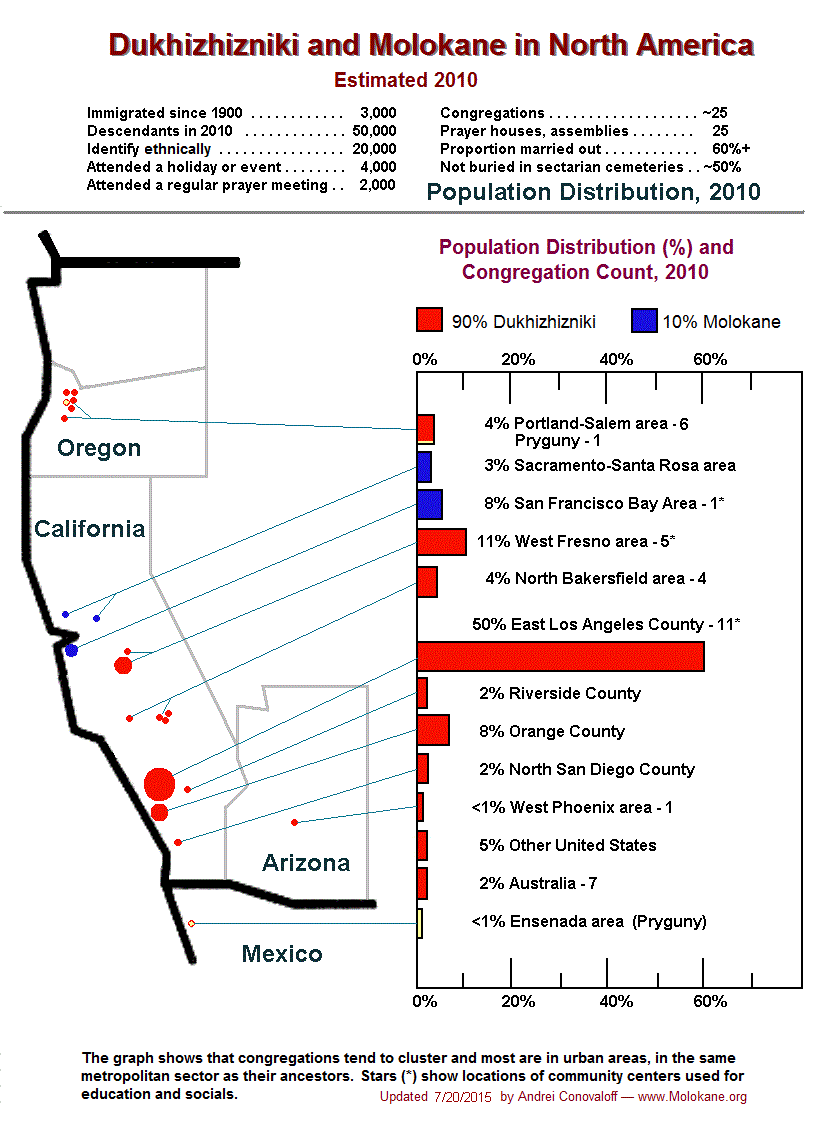
status. Less than 1% of all Spiritual Christians in Russia came to America, about 3,000. Most live in Califonia. Nowadays in the Glendale and Phoenix area there are about 20 family units of them, but the family units are large with second and third generation children, grandchildren and great grandchildren. Times have changed since the first of them arrived here in 1911, the children have changed and the grandchildren have scattered and changed even more. But among even the youngest even those who became high school queens and football stars in the best traditions of America, there still is a feeling of roots that reaches back as far as their ancestors' native country. FOR ARIZONA it all began on a Wednesday afternoon, Aug.
30, 1911, when a Santa Fe train departed Los Angeles.
Aboard were 170 adults and progeny ranging from babes in
arms to a host of boy: and girl youngsters. About
30 families. |
They
were an unwanted people because desertion from the Russian
Orthodox Church sometimes was a capital offense, a felony.
They were strict but peaceful people who believed
primarily in brotherly love, constant Bible reading,
opposition to service in the Czar's army, taxes and
anything else that had to do with oppressive government. They were mainly an agricultural people who for generations had lived in little villages and tolled in nearby fields. By necessity they had flocked together in Boyle Heights, East Los Angeles and San Francisco after reaching, one family after another, the United States of America, a land, that in 1904 1905 offered a freedom they had never known. THEIR MOVE to Arizona was prompted primarily by the
land development company of Greene and Griffin, an
adjunct of the Southwestern Sugar
and Land Company, a big, for those times,
corporation which in 1906 [started in 1903] built a large sugar
beet mill in Glendale. |
| * In Russia most of the
congregatons were varieties of dukhovnie krestiane
pryguny — Spiritual Christian Jumpers.
This Arizona congregation was incorporated in 1936 as
"Church of Spiritual Molokans of Arizona, Inc." though
their religion was not Molokan. Membership was limted
to "Molokans Spiritual Christians of the Sect of
Jumpers religious faith." The word "Molokan" was added
by congregatons in Los Angeles when they published the
ritual books for their new Dukh-i-zhiznik faith to hide the actual
secret faith. |
||
Spiritual Christians in Arizona
Molokane, Pryguny and Dukh-i-zhizniki Around the World
| Lowell Parker | |
Pryguny Molokans' Arizona Start Difficult |
|
Second of Three Parts
The party of Russian Spiritual Christians Molokans
who detrained at Glendale early in the morning of Aug.
31, 1911 was said by newspapers of the day to be the
largest single group of settlers to arrive in the Salt
River Valley up to that time. IT WAS THOUGHT that the new comers would compete
unfairly with native labor when not engaged on their own
plots of newly-purchased ground. And, anyway, they were
a strange people speaking a strange tongue, a people
with dress, customs and a religion that did not conform.
|
The dissenters of the official Church were similar to
Protestants in Europe. Many called themselves "Spiritual
Christians." In the 1800s they were tolerated by moving
them to borders of the Empire, south and east. Those
who migrated to Arizona were from the Russian
border with Turkey, a war zone. There in an area not far from the capital of Georgia in Kars and Erevan provinces, they lived in small, isolated villages while farming plots of State-owned land and working at other tasks. Always their faith remained at odds with the decrees of government. AROUND 1905, singly and in small groups (largest 300),
the Spiritual
Christians, mostly Pryguny
with Molokans and others, began working their way toward
America, journeying from first one country to another as
they worked and saved for the final jump across the
Atlantic and on westward. THE TENTS gave way to sturdy frame houses. The small
plots of land expanded into more acreage as a frugal,
hard-working, shrewd people gradually acquired more
ground and more know-how about American farming. Still
for most the meeting
hall (sobraniia) church
continued to be the center of their lives, and the
elders of
the church ruled with an iron band. |
THEIRS WAS a strict Dukh-i-zhiznik religion,
but, as in all religions and governments some took the
rules and regulations more seriously than others.
Nevertheless, in those earlier years of the settlement,
few rebelled. |
Spiritual Christians in Arizona
Molokane, Pryguny and Dukh-i-zhizniki Around the World
| Lowell Parker | |
Dukh-i-zhizniki Molokans |
|
Last
Of
Three Parts
Russian Spiritual Christians Molokans,
a strict but all but outlawed sect in their native
country, found all the religious freedom they wanted
when, in 1911, they established their colony in the
Glendale area. Nevertheless, they did run into trouble
after the start of World War I. WHEREUPON the baffled governor left them to the mercy
of the courts. Federal court decreed that all should go
to jail for a year, and that they did, spending, in all,
10 months in the Yavapai County hoosegow which had been
designated a federal detention center just for them. |
It was a heartbreaking
scene, said the newspapers, when the 34 35
departed Phoenix for Prescott. Mothers wept, little
brothers and sisters looked on with chins quivering. The
prisoners sang songs but otherwise conducted themselves in
stoical fashion while hundreds of non-Molokan curious
thronged around the Santa Fe station. More than a score of older sect members were tossed brieny into the Maricopa County jail for inciting a riot. That was the only time the Spiritual Christians Molokans, because of their adherence to the faith, really crossed swords with the government or their new-found land of freedom. Their time, before and after War I, was spent mostly behind the plow or at religous church services and the various festivals that were a part of community church life. THOSE FESTIVALS were a great break from the hard,
boring routine of a life of toil. Women cooked
tasty Russian dishes in the kitchen at the rear of
the church. Men yarned and sang Russian hymns somewhat
like the Gregorian chants of the Roman Catholic church.
|
After years of exposure to
American ways even the older among the Spiritual Christians Molokans became
less clannish, and their native-born neighbors no longer
looked upon them with suspicion. In fact, you couldn't
tell a Spiritual
Christian Molokan from a Methodist, except
when a fight started in a bar. On those occasions. Russian-American Molokan
men, pacifists though they should be were, always gave a good account
of themselves. They still do. Mainly a few uneducated
brutes from the Glendale clans were known for drinking
and fighting.
MANY OF THE younger generation became class
valedictorians, athletes,*
beauty queens or otherwise distinguished themselves in
the Glendale school system. (Also in Maryvale,
Pendergast, Tolleson, Cashion, and Fowler schools.) Most
were highly popular with both teachers and fellow
students. Of those more than a few married outside the
church and quite a number made their mark in a variety
of professions in Arizona and elsewhere. * Nationally famous
athletes include Olympic diver Michael
Galitzen, his brother AAU diver Johhny Galitzen,
and baseball player Lou
Novikoff. ** The original wood
meeting hall burned in 1950, and was rebuilt in stucco. *** In 1977, there
were over 100 households in Arizona that descended
from these Russian Spiritual Christians, and over 100
attended holiday services. By 2000, about 150
descendant households existed, but holiday attendance
dropped to less than 30. |
Spiritual Christians in Arizona
Molokane, Pryguny and Dukh-i-zhizniki Around the World